Przejdź do zawartości
Merck

C6417

Monoclonal Anti-Cytokeratin Peptide 7 antibody produced in mouse

clone LDS-68, ascites fluid

Zaloguj się, aby wyświetlić ceny organizacyjne i kontraktowe.

Wybierz wielkość


Informacje o tej pozycji

UNSPSC Code:
12352203
NACRES:
NA.41
MDL number:
Conjugate:
unconjugated
Clone:
LDS-68, monoclonal
Application:
ARR, IF, IHC (f), IHC (p), WB
Citations:
11
Pomoc techniczna
Potrzebujesz pomocy? Nasz zespół doświadczonych naukowców chętnie Ci pomoże.
Pozwól nam pomóc
Pomoc techniczna
Potrzebujesz pomocy? Nasz zespół doświadczonych naukowców chętnie Ci pomoże.
Pozwól nam pomóc

biological source

mouse

Quality Level

conjugate

unconjugated

antibody form

ascites fluid

antibody product type

primary antibodies

clone

LDS-68, monoclonal

contains

15 mM sodium azide

species reactivity

human

technique(s)

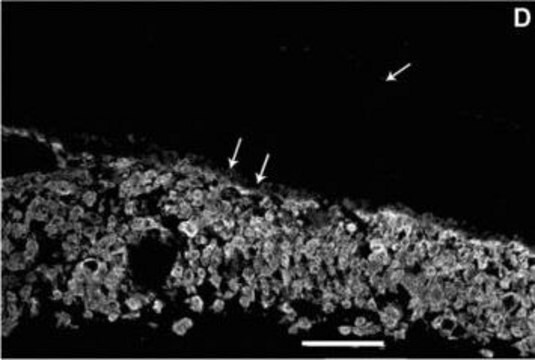
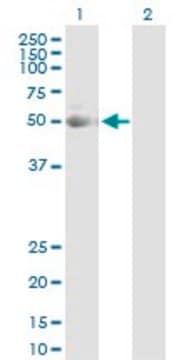
immunohistochemistry (formalin-fixed, paraffin-embedded sections): suitable, immunohistochemistry (frozen sections): suitable, indirect immunofluorescence: 1:200 using formalin-fixed, paraffin-embedded sections of human and animal tissue, microarray: suitable, western blot: suitable

isotype

IgG1

UniProt accession no.

shipped in

dry ice

storage temp.

−20°C

target post-translational modification

unmodified

Gene Information

human ... KRT7(3855)

General description

Keratin, type II cytoskeletal 7 is a protein encoded by the KRT7 gene in humans. It is also known as cytokeratin-7 (CK-7), keratin-7 (K7), sarcolectin (SCL) and K2C7. Keratin 7 is a type II keratin and is a member of the keratin gene family. It is found on chromosome 12. It is specifically expressed in the simple epithelia lining of the internal organs and in the gland ducts as well as blood vessels.
Monoclonal anti-Cytokeratin Peptide 7 (mouse IgG1 isotype) is derived from the hybridoma produced the fusion of mouse myeloma cells and splenocytes of an immunized mouse. Cytokeratins are the intermediate filaments of endocrine cells. These proteins belongs to the intermediate filament (10 nm) superfamily of cytoskeletal proteins. Cytokeratin 7 (CK 7/ KRT7) is a low molecular weight cytokeratin. It is present in epithelial tissues of lung, breast and ovary.

Immunogen

cytoskeletal preparation of the RT4 human bladder carcinoma cell line.

Application

Monoclonal Anti-Cytokeratin Peptide 7 antibody produced in mouse has been used in:
  • immunohistochemical staining
  • western blotting
  • immunohistochemistry
  • immunofluorescence.

Biochem/physiol Actions

Cytokeratins may play an important role in transhepatic transport and canalicular secretion. Cytokeratin 7 (CK 7/ KRT7) only stains bile ducts in normal liver, hence it is considered as “bile duct keratin”. CK 7 is widely used in surgical pathology. It acts as a specific marker for mammary and extramammary Paget′s disease.
The antibody reacts specifically with most simple epithelia but shows no reaction with epithelial cells in the intestine or in the stomach.

Disclaimer

Unless otherwise stated in our catalog or other company documentation accompanying the product(s), our products are intended for research use only and are not to be used for any other purpose, which includes but is not limited to, unauthorized commercial uses, in vitro diagnostic uses, ex vivo or in vivo therapeutic uses or any type of consumption or application to humans or animals.
Ta strona może zawierać tekst przetłumaczony maszynowo.

Nie możesz znaleźć właściwego produktu?  

Wypróbuj nasz Narzędzie selektora produktów.

Klasa składowania

10 - Combustible liquids

wgk

nwg

flash_point_f

Not applicable

flash_point_c

Not applicable


Wybierz jedną z najnowszych wersji:

Certyfikaty analizy (CoA)

Lot/Batch Number

Nie widzisz odpowiedniej wersji?

Jeśli potrzebujesz konkretnej wersji, możesz wyszukać konkretny certyfikat według numeru partii lub serii.

Masz już ten produkt?

Dokumenty związane z niedawno zakupionymi produktami zostały zamieszczone w Bibliotece dokumentów.

Odwiedź Bibliotekę dokumentów

Brush biopsy of human oral mucosal epithelial cells as a quality control of the cell source for fabrication of transplantable epithelial cell sheets for regenerative medicine
Kasai Y, et al.
Regenerative therapy, 4, 71-77 (2016)
Immunohistology of endocrine tumors
Diagnostic Immunohistochemistry (Masson Publishing), 291-339 (2010)
Yoshiyuki Kasai et al.
Regenerative therapy, 4, 71-77 (2016-03-24)
Autologous oral mucosal epithelial cell sheets have been used for treating epithelial defects such as cornea and esophagus. The cell source of patients' oral mucosal epithelial cell sheet should be examined in normality because it has individual difference. In this
Role of cytokeratin intermediate filaments in transhepatic transport and canalicular secretion
Kawahara H, et al.
Hepatology, 11(3), 435-448 (1990)
M Rosenberg et al.
Cytogenetics and cell genetics, 57(1), 33-38 (1991-01-01)
We have localized the genes which encode the human type II epidermal keratins K5, K6a, and K6b and the simple epithelial keratin K7 (KRT5, KRT6A, KRT6B, and KRT7, respectively) to chromosome 12 using Southern blot analysis of somatic cell hybrids.

Powiązane treści

Numer pozycji handlu globalnego

SKUNUMER GTIN
C6417-.2ML04061838104403

Nasz zespół naukowców ma doświadczenie we wszystkich obszarach badań, w tym w naukach przyrodniczych, materiałoznawstwie, syntezie chemicznej, chromatografii, analityce i wielu innych dziedzinach.

Skontaktuj się z zespołem ds. pomocy technicznej