Przejdź do zawartości
Merck

A5295

Anti-Bovine IgG (whole molecule)−Peroxidase antibody produced in rabbit

affinity isolated antibody, buffered aqueous solution

Synonim(y):

Rabbit Anti-Bovine IgG (whole molecule)−HRP

Zaloguj się, aby wyświetlić ceny organizacyjne i kontraktowe.

Wybierz wielkość

A5295-1ML

996,00 zł

996,00 zł


Skontaktuj się z Obsługą Klienta, aby uzyskać informacje na temat dostępności

Zamów zamówienie zbiorcze

Informacje o tej pozycji

UNSPSC Code:
12352203
NACRES:
NA.46
MDL number:
Conjugate:
peroxidase conjugate
Clone:
polyclonal
Application:
DB, ELISA (d), IHC (p)
Citations:
31

Przejdź do

Pomoc techniczna
Potrzebujesz pomocy? Nasz zespół doświadczonych naukowców chętnie Ci pomoże.
Pozwól nam pomóc

biological source

rabbit

conjugate

peroxidase conjugate

antibody form

affinity isolated antibody

antibody product type

secondary antibodies

clone

polyclonal

form

buffered aqueous solution

species reactivity

bovine

technique(s)

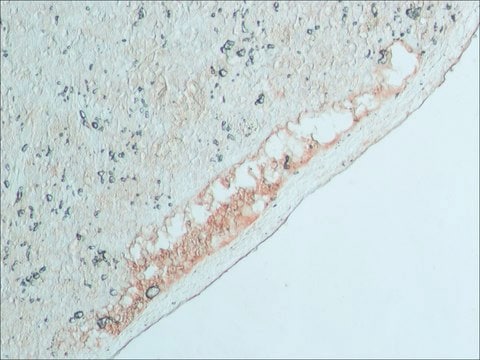
direct ELISA: 1:20,000, dot blot: 1:80,000 (chemiluminescent), immunohistochemistry (formalin-fixed, paraffin-embedded sections): 1:1,000

shipped in

dry ice

storage temp.

−20°C

target post-translational modification

unmodified

Quality Level

Szukasz podobnych produktów? Odwiedź Przewodnik dotyczący porównywania produktów

Powiązane kategorie

Porównaj podobne pozycje

Wyświetl pełne porównanie

Pokaż różnice

1 of 4

Ta pozycja
A8917A5545A5420
technique(s)

direct ELISA: 1:20,000, immunohistochemistry (formalin-fixed, paraffin-embedded sections): 1:1,000, dot blot: 1:80,000 (chemiluminescent)

technique(s)

direct ELISA: 1:20,000, dot blot: 1:80,000, immunohistochemistry (formalin-fixed, paraffin-embedded sections): 1:1,000

technique(s)

direct ELISA: 1:50,000-1:80,000, dot blot: 1:50,000-1:100,000 (chemiluminescent), immunohistochemistry (formalin-fixed, paraffin-embedded sections): 1:400-1:800

technique(s)

direct ELISA: 1:40,000, dot blot: 1:80,000-1:160,000, immunohistochemistry (formalin-fixed, paraffin-embedded sections): 1:200

antibody form

affinity isolated antibody

antibody form

IgG fraction of antiserum

antibody form

affinity isolated antibody

antibody form

affinity isolated antibody

conjugate

peroxidase conjugate

conjugate

peroxidase conjugate

conjugate

peroxidase conjugate

conjugate

peroxidase conjugate

biological source

rabbit

biological source

rabbit

biological source

rabbit

biological source

rabbit

species reactivity

bovine

species reactivity

bovine

species reactivity

guinea pig

species reactivity

goat

form

buffered aqueous solution

form

buffered aqueous solution

form

buffered aqueous solution

form

buffered aqueous solution

General description

IgG (immunoglobulin G) contributes to 10-20% of plasma protein and is regarded as one of the most predominant serum protein. It consists of four subclasses: IgG1, IgG2, IgG3 and IgG4. The IgG structure possesses four polypeptide chains containing two identical γ heavy (H) chains and two identical κ or λ light (L) chains of 50 kDa and 25 kDa, respectively.

Immunogen

purified bovine IgG

Application

Anti-Bovine IgG (whole molecule)-Peroxidase antibody produced in rabbit has been used in:
  • enzyme-linked immunosorbent assay (ELISA)
  • bovine viral diarrhea virus (BVDV) plaque
  • focus-forming assays

Biochem/physiol Actions

Bovine IgGs are glycoprotein antibodies that regulate immune responses in herds. These antibodies inhibit TLR5 activation upon immunization with native H7 flagellin. Bovine IgG levels can be used for the detection of Johne′s disease and milk adulteration.

Physical form

Solution in 0.01 M phosphate buffered saline pH 7.4, containing 0.05% MIT.

Preparation Note

Prepared by the two-step glutaraldehyde method described by Avrameas, S., et al., Scand. J. Immunol., 8, Suppl. 7, 7 (1978).

Disclaimer

Unless otherwise stated in our catalog or other company documentation accompanying the product(s), our products are intended for research use only and are not to be used for any other purpose, which includes but is not limited to, unauthorized commercial uses, in vitro diagnostic uses, ex vivo or in vivo therapeutic uses or any type of consumption or application to humans or animals.
Ta strona może zawierać tekst przetłumaczony maszynowo.

Nie możesz znaleźć właściwego produktu?  

Wypróbuj nasz Narzędzie selektora produktów.

pictograms

Exclamation mark

signalword

Warning

hcodes

Hazard Classifications

Skin Sens. 1

Klasa składowania

12 - Non Combustible Liquids

wgk

WGK 2

flash_point_f

Not applicable

flash_point_c

Not applicable


Wybierz jedną z najnowszych wersji:

Certyfikaty analizy (CoA)

Lot/Batch Number

Nie widzisz odpowiedniej wersji?

Jeśli potrzebujesz konkretnej wersji, możesz wyszukać konkretny certyfikat według numeru partii lub serii.

Masz już ten produkt?

Dokumenty związane z niedawno zakupionymi produktami zostały zamieszczone w Bibliotece dokumentów.

Odwiedź Bibliotekę dokumentów

Ana Oleaga et al.
PLoS neglected tropical diseases, 13(6), e0007543-e0007543 (2019-06-25)
Environmental and anthropogenic changes are expected to promote emergence and spread of pathogens worldwide. Since 2013, human urogenital schistosomiasis is established in Corsica island (France). Schistosomiasis is a parasitic disease affecting both humans and animals. The parasite involved in the
Epidemiological surveys of camel trypanosomosis in Al-jouf, Saudi Arabia based on PCR and ELISA
Elwathig M, et al.
Emirates Journal of Food and Agriculture, 212-216 (2016)
Effect of adjuvants on the humoral immune response to congopain in mice and cattle
Kateregga J, et al.
BMC Veterinary Research, 8(1), 63-63 (2012)
Abigail L Henderson et al.
Digestive diseases and sciences, 60(11), 3293-3303 (2015-06-01)
The pathogenesis of inflammatory bowel disease (IBD) is complex and multifaceted including genetic predisposition, environmental components, microbial dysbiosis, and inappropriate immune activation to microbial components. Pathogenic bacterial provocateurs like adherent and invasive E. coli have been reported to increase susceptibility
Laura Garza-Cuartero et al.
Vaccine, 36(7), 958-968 (2018-01-27)
Fasciola hepatica infection causes important economic losses in livestock and food industries around the world. In the Republic of Ireland F. hepatica infection has an 76% prevalence in cattle. Due to the increase of anti-helminthic resistance, a vaccine-based approach to

Powiązane treści

Questions

Reviews

No rating value

Active Filters

Nasz zespół naukowców ma doświadczenie we wszystkich obszarach badań, w tym w naukach przyrodniczych, materiałoznawstwie, syntezie chemicznej, chromatografii, analityce i wielu innych dziedzinach.

Skontaktuj się z zespołem ds. pomocy technicznej