


The presence of glutaminase activity, or any other non-specific enzymatic activity, is not assayed for this product.
Przejdź do
A3809

Asparaginase from Escherichia coli
lyophilized powder, 100-300 units/mg protein (biuret)
Synonim(y):
L-Asparagine Amidohydrolase
Zaloguj się, aby wyświetlić ceny organizacyjne i kontraktowe.
Wybierz wielkość
Zmień widok
| Do Państwa/SKU | Dostępność | Cena netto |
|---|---|---|
100 units | Skontaktuj się z Obsługą Klienta, aby uzyskać informacje na temat dostępności | 1400,00 zł |
1000 units | Skontaktuj się z Obsługą Klienta, aby uzyskać informacje na temat dostępności | 6690,00 zł |
Informacje o tej pozycji
Numer CAS:
UNSPSC Code:
12352204
NACRES:
NA.54
EC Number:
232-765-3
MDL number:
Specific activity:
100-300 units/mg protein (biuret)
1400,00 zł
Skontaktuj się z Obsługą Klienta, aby uzyskać informacje na temat dostępności
Pomoc techniczna
Potrzebujesz pomocy? Nasz zespół doświadczonych naukowców chętnie Ci pomoże.
Pozwól nam pomócform
lyophilized powder
Quality Segment
specific activity
100-300 units/mg protein (biuret)
composition
Protein, ≥60%
storage temp.
2-8°C
General description
Asparaginase is a bacterial enzyme and also a chemotherapeutic drug.
Application
Asparaginase from Escherichia coli has been used:
- to compare the cytotoxic effect of L-asparaginase purified from Streptomyces brollosae NEAE-115
- as a standard in asparaginase assay to quantify asparaginase activities in various eel tissues
- to elicit amino acid deprivation
Biochem/physiol Actions
Asparaginase is used in enzymatic assays and to convert asparagine to aspartic acid. Asparaginase is used to reduce the formation of acrylamide in starchy food products. It is also used as a chemotherapy agent for acute lymphoblastic leukemia . Product A3809 is from Escherichia coli and is provided as a lyophilized powder containing sodium chloride.
Asparaginase may cause cell death in leukemic cells by converting the necessary L-asparagine to aspartic acid and ammonia . Asparaginase is allosterically regulated and is crucial for proper cell functioning .
Asparaginase (ASNase) products are usually obtained from Escherichia coli and Erwinia chrysanthemi. These enzymes can block the synthesis of protein in tumor cells. It shows high activity in the G1 phase of the cell cycle. It is capable of causing pancreatitis in leukemia patients.
Physical form
Lyophilized powder containing sodium chloride
Preparation Note
Chromatographically purified
Analysis Note
Protein determined by biuret.
Other Notes
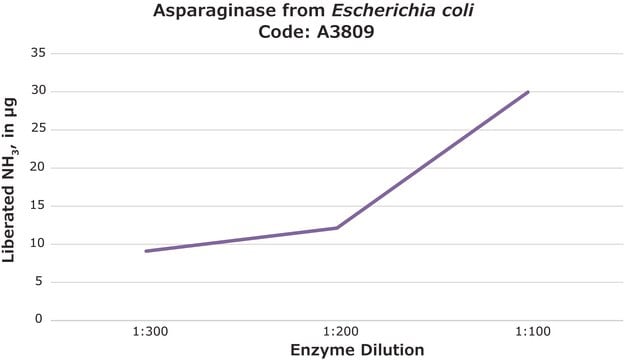
One unit will liberate 1.0 μmole of ammonia from L-asparagine per min at pH 8.6 at 37 °C.
Ta strona może zawierać tekst przetłumaczony maszynowo.
1 of 1
Ta pozycja | |||
|---|---|---|---|
| description lyophilized powder, 100-300 units/mg protein (biuret) | description Grade VII, lyophilized powder, 500-1,500 units/mg protein | description soluble powder, 75-150 units/mg solid | description Grade VIII, lyophilized powder, ≥500 units/mg protein |
| specific activity 100-300 units/mg protein (biuret) | specific activity 500-1,500 units/mg protein | specific activity 75-150 units/mg solid | specific activity ≥500 units/mg protein |
| form lyophilized powder | form lyophilized powder | form soluble powder | form lyophilized powder |
| storage temp. 2-8°C | storage temp. −20°C | storage temp. −20°C | storage temp. −20°C |
| Quality Level 200 | Quality Level 200 | Quality Level 200 | Quality Level 300 |
| composition Protein, ≥60% | composition Protein, ~10% Lowry | composition - | composition Protein, ≥60% biuret |
signalword
Warning
hcodes
Hazard Classifications
Repr. 2 - Skin Sens. 1
Klasa składowania
11 - Combustible Solids
wgk
WGK 3
flash_point_f
Not applicable
flash_point_c
Not applicable
ppe
Eyeshields, Faceshields, Gloves, type P3 (EN 143) respirator cartridges
Wybierz jedną z najnowszych wersji:
Masz już ten produkt?
Dokumenty związane z niedawno zakupionymi produktami zostały zamieszczone w Bibliotece dokumentów.
-
Is there any Glutaminase activity of Product No. A3809?
1 answer-
Helpful?
-
-
I would like to know the amino acid sequence of this enzyme (Product No. A3809) and the strain of E. coli from which this enzyme is derived.
1 answer-
This enzyme is obtained from a natural extraction of E. coli. It is not from a recombinant source. The strain of E. coli used is considered proprietary.
Helpful?
-
-
What is the actual quantity (in the gram) in 1 unite of the enzyme. Because, we want use the enzyme in gram. such as i have 300 unit of this enzyme. So please tell what is the exact quantity in gram
1 answer-
The activity of this product varies from lot to lot with the minimum amount in a 1000 unit vial being 3.33 mg. This is based on the maximum allowable activity of 300 units per milligram protein and the maximum 100% protein. The maximum amount will be 16 mg per 1000 unit vial. This is based on the minimum allowable activity of 100 units per milligram protein and the minimum allowable protein content of 60%. Please see the link below to access a sample or lot specific Certificate of Analysis:
https://www.sigmaaldrich.com/product/sigma/a3809#product-documentationHelpful?
-
-
I would like to obtain the asparaginase (A3809-1KU) enzymatic assay protocol.
1 answer-
Please see the protocol at the link below:
https://www.sigmaaldrich.com/deepweb/assets/sigmaaldrich/product/documents/369/983/a3809enz.pdfHelpful?
-
-
What is the source of this enzyme (Product No. A3809)?
1 answer-
This enzyme is obtained from a natural extraction of E. coli. It is not from a recombinant source.
Helpful?
-
-
How should this enzyme (Product No. A3809) be reconstituted?
1 answer-
Prior to determining the activity of this enzyme, Sigma reconstitutes it directly in deionized water. Solutions should be prepared fresh, as the stability of stock solutions has not been evaluated.
Helpful?
-
-
What is the molecular weight of this enzyme (Product No. A3809)?
1 answer-
This enzyme consists of a tetramer composed of four identical subunits of 34,080 Daltons each. The molecular weight of the tetramer is 136,320 Daltons.
Helpful?
-
-
What is the Department of Transportation shipping information for this product?
1 answer-
Transportation information can be found in Section 14 of the product's (M)SDS.To access the shipping information for this material, use the link on the product detail page for the product.
Helpful?
-
-
How does the storage temperature relate to shipping conditions?
1 answer-
The storage conditions that a Sigma-Aldrich catalog and label recommend for products are deliberately conservative. For many products, long-term storage at low temperatures will increase the time during which they are expected to remain in specification and therefore are labeled accordingly. Where short-term storage, shipping time frame, or exposure to conditions other than those recommended for long-term storage will not affect product quality, Sigma-Aldrich will ship at ambient temperature. The products sensitive to short-term exposure to conditions other than their recommended long-term storage are shipped on wet or dry ice. Ambient temperature shipping helps to control shipping costs for our customers. At any time, our customers can request wet- or dry-ice shipment, but the special handling is at customer expense if our product history indicates that the product is stable for regular shipment.
Helpful?
-