Przejdź do zawartości
Merck

44977

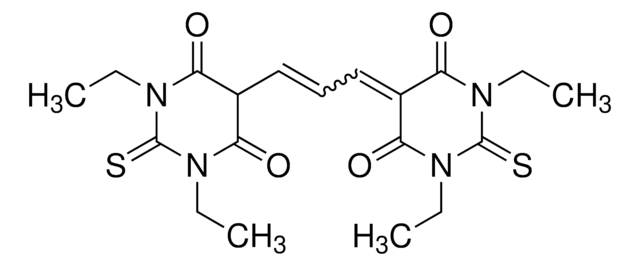
DISBAC2(3), Voltage Sensitive Probe

≥98% (HPLC)

Synonim(y):

5-[3-(1,3-Diethylhexahydro-4,6-dioxo-2-thioxo-5-pyrimidinyl)-2-propen-1-ylidene]-1,3-diethyldihydro-2-thioxo-4,6(1H,5H)-pyrimidinedione, Bis(1,3-diethylthiobarbituric acid)trimethine oxonol

Zaloguj się, aby wyświetlić ceny organizacyjne i kontraktowe.

Wybierz wielkość

1 MG

2810,00 zł

2810,00 zł


Skontaktuj się z Obsługą Klienta, aby uzyskać informacje na temat dostępności

Zamów zamówienie zbiorcze

Informacje o tej pozycji

Wzór empiryczny (zapis Hilla):
C19H24N4O4S2
Numer CAS:
Masa cząsteczkowa:
436.55
UNSPSC Code:
12352108
NACRES:
NA.32
PubChem Substance ID:
EC Number:
256-325-5
Beilstein/REAXYS Number:
1232950
MDL number:

Przejdź do

Pomoc techniczna
Potrzebujesz pomocy? Nasz zespół doświadczonych naukowców chętnie Ci pomoże.
Pozwól nam pomóc

InChI key

VJYNRXFXHKIGLT-MDZDMXLPSA-N

InChI

1S/C19H24N4O4S2/c1-5-20-14(24)12(15(25)21(6-2)18(20)28)10-9-11-13-16(26)22(7-3)19(29)23(8-4)17(13)27/h9-12H,5-8H2,1-4H3/b10-9+

SMILES string

CCN1C(=O)C(\C=C\C=C2\C(=O)N(CC)C(=S)N(CC)C2=O)C(=O)N(CC)C1=S

assay

≥98% (HPLC)

fluorescence

λex 535 nm; λem 560 nm in DMSO

suitability

complies for Infrared spectrum

storage temp.

−20°C

Quality Level

Porównaj podobne pozycje

Wyświetl pełne porównanie

Pokaż różnice

1 of 4

Ta pozycja
930709SML2683901099
suitability

complies for Infrared spectrum

suitability

-

suitability

-

suitability

-

fluorescence

λex 535 nm; λem 560 nm in DMSO

fluorescence

-

fluorescence

-

fluorescence

-

storage temp.

−20°C

storage temp.

2-8°C

storage temp.

−20°C

storage temp.

-

Quality Level

100

Quality Level

100

Quality Level

-

Quality Level

100

assay

≥98% (HPLC)

assay

≥95.0%

assay

≥98% (HPLC)

assay

-

Application

DISBAC2(3), Voltage Sensitive Probe is used for single-cell fluorescence imaging of transmembrane conductance and potential change.
Ta strona może zawierać tekst przetłumaczony maszynowo.

Klasa składowania

11 - Combustible Solids

wgk

WGK 3

flash_point_f

Not applicable

flash_point_c

Not applicable


Wybierz jedną z najnowszych wersji:

Certyfikaty analizy (CoA)

Lot/Batch Number

Nie widzisz odpowiedniej wersji?

Jeśli potrzebujesz konkretnej wersji, możesz wyszukać konkretny certyfikat według numeru partii lub serii.

Masz już ten produkt?

Dokumenty związane z niedawno zakupionymi produktami zostały zamieszczone w Bibliotece dokumentów.

Odwiedź Bibliotekę dokumentów

S Amoroso et al.
Biochimica et biophysica acta, 1239(1), 67-73 (1995-10-04)
In this study the effect of the A1 agonist 2-chloro-N6-cyclopentyladenosine (CCPA) on bis(1,3-diethylthiobarbituric acid)trimethine oxonol (bisoxonol)-monitored membrane potential in cerebrocortical nerve endings was evaluated. CCPA (30, 100 and 300 microM) caused a dose-dependent decrease of high K(+)- and veratridine-induced membrane
Alexander S Tatikolov et al.
Biophysical chemistry, 107(1), 33-49 (2004-02-12)
Non-covalent interactions between polymethine dyes of various types (cationic and anionic thiacarbocyanines as well as anionic oxonols and tetracyanopolymethines) and human serum albumin (HSA) were studied by means of absorption, fluorescence and circular dichroism (CD) spectroscopies. Complexation with the protein
M K Tanner et al.
Cytometry, 14(1), 59-69 (1993-01-01)
Immunosuppression by the fungal metabolite cyclosporin A (CsA) is characterized by functional inhibition, rather than destruction of cells. Because activation of immune cells involves intracellular signalling events associated with modulations of cell transmembrane potential (TMP), we tested the ability of
V Dall'Asta et al.
Experimental cell research, 231(2), 260-268 (1997-03-15)
Confocal laser scanning microscopy (CLSM) was employed to visualize and measure membrane potential changes in several types of cultured adherent cells, such as human fibroblasts, mouse mammary tumor C127 cells, and human saphenous vein endothelial cells, preloaded with the anionic
S Bouhdid et al.
Journal of applied microbiology, 109(4), 1139-1149 (2010-05-12)
To study cellular damage induced by Cinnamomum verum essential oil in Pseudomonas aeruginosa ATCC 27853 and Staphylococcus aureus ATCC 29213. The effect of cinnamon bark essential oil on these two strains was evaluated by plate counts, potassium leakage, flow cytometry

Questions

Reviews

No rating value

Active Filters

Nasz zespół naukowców ma doświadczenie we wszystkich obszarach badań, w tym w naukach przyrodniczych, materiałoznawstwie, syntezie chemicznej, chromatografii, analityce i wielu innych dziedzinach.

Skontaktuj się z zespołem ds. pomocy technicznej