

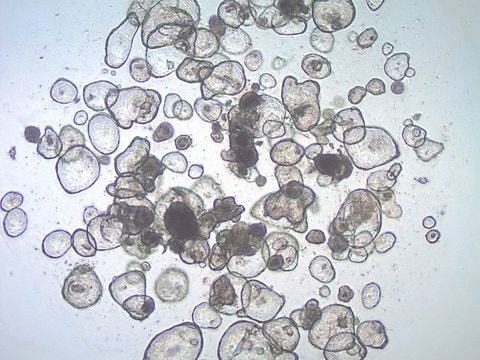
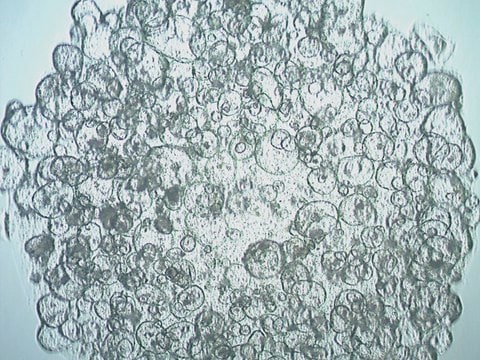
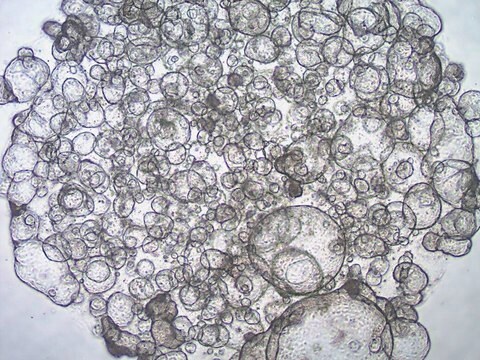
Traditional DNA/RNA isolation kits can be used to prepare genomic material for sequencing (RNA-seq, scRNA-seq, WGS, CHIP-seq etc). For some applications with large organoids, tissue specific DNA/RNA extraction kits are recommended. TRI Reagent (T9424) can be added to the dissociated organoids before RNA extraction and can be stored at -80 °C until future use.
SCC310

3dGRO® Organoidy jelita grubego, wiek 46 lat (14-881-CR)
Adenocarcinoma, Colon (Rectum), Age: 46, Male, Mutation: TP53, KRAS, APC
Synonim(y):
colon organoids
Zaloguj się, aby wyświetlić ceny organizacyjne i kontraktowe.
Wybierz wielkość
Zmień widok
| Do Państwa/SKU | Dostępność | Cena netto |
|---|---|---|
1 vial | Skontaktuj się z Obsługą Klienta, aby uzyskać informacje na temat dostępności | 11 850,00 zł |
Informacje o tej pozycji
NACRES:
NA.81
UNSPSC Code:
41106509
11 850,00 zł
Skontaktuj się z Obsługą Klienta, aby uzyskać informacje na temat dostępności
Pomoc techniczna
Potrzebujesz pomocy? Nasz zespół doświadczonych naukowców chętnie Ci pomoże.
Pozwól nam pomócbiological source
human colon (rectum)
description
Cryopreserved patient derived gastrointestinal organoids (PDOs)
packaging
vial of >1500 viable organoids cells
manufacturer/tradename
Millipore
gender
male
technique(s)
cell culture: suitable
application(s)
3D cell culture
control
colon (rectum)
relevant disease(s)
adenocardinoma
shipped in
liquid nitrogen
storage temp.
−196°C
General description
Organoidy pochodzące od pacjentów (PDO) to nowe modele komórkowe 3D in vitro, które zachowują oryginalną fizjologię tkanek i patologię molekularną, stanowiąc tym samym klinicznie istotną alternatywę dla tradycyjnych linii komórkowych 2D i skuteczne narzędzie do udoskonalania i ograniczania modeli zwierzęcych. PDO mogą być uzyskiwane z biopsji dorosłych pacjentów lub wyciętych tkanek zawierających natywne populacje komórek macierzystych LGR5+ i hodowane na podłożu bogatym w ECM przy użyciu specjalistycznych pożywek dla organoidów, takich jak pożywka kondycjonowana L-WRN. Organoidy pochodzące z tkanek dorosłych są fenotypowo i genetycznie stabilne w długoterminowej hodowli, prezentując bardziej dojrzałe fenotypy w porównaniu do organoidów pochodzących z iPSC. Co ważne, wykazano, że PDO są w stanie przewidzieć odpowiedź kliniczną pacjentów na chemioterapeutyki.
Obecnie oferujemy kompleksowy biobank wysoce scharakteryzowanych ludzkich organoidów żołądkowo-jelitowych pochodzących z tkanek od zdrowych i chorych pacjentów. Biobank organoidów jelitowych zawiera ponad 50 wysoce scharakteryzowanych organoidów jelitowych pochodzących zarówno od zdrowych, jak i chorych pacjentów z wielu regionów układu pokarmowego, w tym jelita cienkiego (dwunastnicy, jelita krętego), żołądka, odbytnicy i okrężnicy.
Charakterystyka linii komórkowej
Obecnie oferujemy kompleksowy biobank wysoce scharakteryzowanych ludzkich organoidów żołądkowo-jelitowych pochodzących z tkanek od zdrowych i chorych pacjentów. Biobank organoidów jelitowych zawiera ponad 50 wysoce scharakteryzowanych organoidów jelitowych pochodzących zarówno od zdrowych, jak i chorych pacjentów z wielu regionów układu pokarmowego, w tym jelita cienkiego (dwunastnicy, jelita krętego), żołądka, odbytnicy i okrężnicy.
Charakterystyka linii komórkowej
- Płeć: Mężczyzna
- Wiek: 46 lat
- Narząd: Okrężnica (odbytnica)
- Choroba: Gruczolakorak (TP53 Pro151Ser, KRAS Gly12Asp, APC Pro1443fs)
Biochem/physiol Actions
Człowiek, organoid
Packaging
≥1500 żywych organoidów/fiolkę
Preparation Note
Przechowywać w ciekłym azocie. Organoidy mogą być hodowane przez co najmniej 10 pasaży po wstępnym rozmrożeniu bez znaczącego wpływu na ekspresję markerów komórkowych i funkcjonalność.
Legal Information
3dGRO® is a trademark of Merck KGaA, Darmstadt, Germany.
3dGRO® organoids were derived utilizing HUB Organoid Technology.
Subject to local law, this product is intended to be sold for internal in vitro research use only subject to terms and conditions found here: www.sigmaaldrich.com/pdouse. This product may not be re-engineered or copied; used to make derivatives or modifications; used to develop, test, or manufacture a commercial product; used as a component in a commercial product; resold or licensed; used in any clinical applications or trials; or used in humans. A license or limited commercial use agreement is required for use by any for-profit entity, use in services, and use in sponsored academic research. For information regarding any such use, please contact organoids@milliporesigma.com.
3dGRO® organoids were derived utilizing HUB Organoid Technology.
Subject to local law, this product is intended to be sold for internal in vitro research use only subject to terms and conditions found here: www.sigmaaldrich.com/pdouse. This product may not be re-engineered or copied; used to make derivatives or modifications; used to develop, test, or manufacture a commercial product; used as a component in a commercial product; resold or licensed; used in any clinical applications or trials; or used in humans. A license or limited commercial use agreement is required for use by any for-profit entity, use in services, and use in sponsored academic research. For information regarding any such use, please contact organoids@milliporesigma.com.
3dGRO is a registered trademark of Merck KGaA, Darmstadt, Germany
Disclaimer
WYŁĄCZNIE DO CELÓW BADAWCZYCH. Ten produkt podlega regulacjom prawnym we Francji, jeśli jest przeznaczony do celów naukowych, w tym do importu i eksportu (art. L 1211-1 ust. 2 kodeksu zdrowia publicznego). Nabywca (tj. użytkownik końcowy) jest zobowiązany do uzyskania zezwolenia na import od francuskiego Ministerstwa Badań Naukowych, o którym mowa w artykule L1245-5-1 II Kodeksu Zdrowia Publicznego. Zamawiając ten produkt, użytkownik potwierdza, że uzyskał odpowiednie zezwolenie na import.
Ta strona może zawierać tekst przetłumaczony maszynowo.
1 of 1
Ta pozycja | |||
|---|---|---|---|
| application(s) 3D cell culture | application(s) 3D cell culture | application(s) 3D cell culture | application(s) 3D cell culture |
| technique(s) cell culture: suitable | technique(s) cell culture: suitable | technique(s) cell culture: suitable | technique(s) cell culture: suitable |
| relevant disease(s) adenocardinoma | relevant disease(s) (Normal) | relevant disease(s) (Normal) | relevant disease(s) (Normal) |
| biological source human colon (rectum) | biological source human (duodenum) | biological source human (duodenum) | biological source human (duodenum) |
| storage temp. −196°C | storage temp. −196°C | storage temp. −196°C | storage temp. −196°C |
| gender male | gender female | gender female | gender female |
Klasa składowania
10 - Combustible liquids
wgk
WGK 3
flash_point_f
Not applicable
flash_point_c
Not applicable
Wybierz jedną z najnowszych wersji:
Masz już ten produkt?
Dokumenty związane z niedawno zakupionymi produktami zostały zamieszczone w Bibliotece dokumentów.
-
How Do you Extract RNA/DNA from Organoids in Cultured in Matrigel?
1 answer-
Helpful?
-
-
How are organoids cultured?
1 answer-
Once isolated, organoids are cultured in specialized media embedded in a rich extracellular matrix (ECM) basement membrane extract hydrogel such as Growth Factor Reduced Matrigel. Media is replenished every other day and cells are passaged once per week (7-12 days) before cells become too large or necrotic. Cells can be passaged in either small clump fragments or as single cells using mechanical dissociation/enzyme-free passaging reagents. Depending on organoid type and confluency, split ratios of roughly 1:3-1:4 can be used when passaging organoids. For sensitive organoid types, ROCKi (Y27632) (SCM075) can be added during passaging to help in promoting cell viability.
Helpful?
-
-
How do you stain organoids with antibodies?
1 answer-
Organoids can be stained with antibodies for immunocytochemical (ICC)/Immunohistochemical (IHC) analysis using either whole-mount or paraffin embedding/sectioning techniques. It is critical to use antibodies prequalified for organoid analysis.
Helpful?
-