
MABS1270

Anti-Lipoprotein Lipase/LPL Antibody, clone 4-1a
clone 4-1a, from mouse
Synonim(y):
Lipoprotein lipase, hLPL, LPL
Wybierz wielkość
| Do Państwa/SKU | Dostępność | Cena netto |
|---|---|---|
100 μg | Przewidywany termin wysyłki03 czerwca 2026zKuehne + Nagel Sp. z o.o. | 1750,00 zł |
Informacje o tej pozycji
biological source
mouse
Quality Segment
conjugate
unconjugated
antibody form
purified immunoglobulin
antibody product type
primary antibodies
clone
4-1a, monoclonal
species reactivity
human, mouse, bovine, rat
technique(s)
ELISA: suitable, immunocytochemistry: suitable, immunofluorescence: suitable, immunohistochemistry: suitable (paraffin), western blot: suitable
isotype
IgG2aκ
NCBI accession no.
UniProt accession no.
shipped in
wet ice
target post-translational modification
unmodified
Gene Information
human ... LPL(4023)
General description
Immunogen
Application
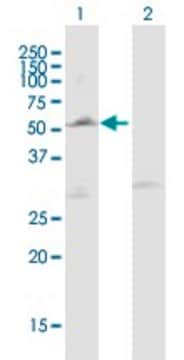
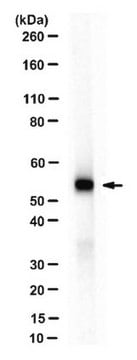
Western Blotting Analysis: A representative lot detected human plasma lipoprotein lipase (LPL) and bovine milk LPL by Western blotting. Clone 4-1a exhibited much reduced binding to murine or chicken LPL, and failed to detect human hepatic lipase (hHL) (Bensadoun, A., et al. (2014). Biochim. Biophys. Acta. 1841(7):970-976).
Western Blotting Analysis: A representative lot detected recombinant wild-type human LPL (rhLPL), as well as rhLPL with mutated Gln3 & Arg4. Clone 4-1a failed to react with rhLPL with mutated Ile8 or Asp9, nor rhLPL with either a.a. 5-15 or aa.16-25 deletion (Bensadoun, A., et al. (2014). Biochim. Biophys. Acta. 1841(7):970-976).
ELISA Analysis: A representative lot was employed as the capture antibody for the detection of human LPL by sandwich ELISA, using biotinylated clone 5D2 as the detcting antibody (Bensadoun, A., et al. (2014). Biochim. Biophys. Acta. 1841(7):970-976).
Immunocytochemistry Analysis: A representative lot detected the binding of human LPL to CHO and CHL cells transfected to express surface GPIHBP1, but not to mock transfected cells or cells transfected to express GPIHBP1 C65S mutant. Clone 4-1a does not compete against triglyceride-rich lipoproteins (TRLs) for binding the LPL-GPIHBP1 complex on cell surface (Bensadoun, A., et al. (2014). Biochim. Biophys. Acta. 1841(7):970-976).
Immunofluorescence Analysis: A representative lot detected hLPL immunoreactivity associated with GPIHBP1 on capillary endothelial cells in OCT-embedded, methanol/acetone-fixed frozen skeletal muscle sections from mice expressing muscle-specific human LPL transgene. Much lower immunoreactivity of the endogenous mLPL was detected in skeletal muscle sections from non-transgenic mice (Bensadoun, A., et al. (2014). Biochim. Biophys. Acta. 1841(7):970-976).
Note: Clone 4-1a exhibits much weaker affinity toward rat & murine LPL when compared with human LPL. Higher amount of sample loading (in Western blotting and ELISA) and/or high sensitivity detection method (e.g. HRP polymer or fluorescence detection in Western blotting and immunohistochemistry) is recommended when using this clone for detecting rat & murine LPL.
Signaling
Lipid Metabolism & Weight Regulation
Biochem/physiol Actions
Physical form
Preparation Note
Analysis Note
Immunohistochemistry Analysis: A 1:50 dilution of this antibody detected lipoprotein lipase/LPL immunoreactivity in mouse heart tissue sections.
Other Notes
Disclaimer
1 of 1
Ta pozycja | |||
|---|---|---|---|
| antibody form purified immunoglobulin | antibody form purified immunoglobulin | antibody form affinity isolated antibody | antibody form serum |
| species reactivity human, mouse, bovine, rat | species reactivity human | species reactivity - | species reactivity mouse, rat, human |
| conjugate unconjugated | conjugate unconjugated | conjugate unconjugated | conjugate unconjugated |
| biological source mouse | biological source mouse | biological source rabbit | biological source rabbit |
| clone 4-1a, monoclonal | clone polyclonal | clone polyclonal | clone polyclonal |
| Gene Information human ... LPL(4023) | Gene Information human ... LPL(4023) | Gene Information human ... LPL(57396) | Gene Information human ... PNLIP(5406) |


Still not finding the right product?
Wypróbuj nasze narzędzie Narzędzie selektora produktów, aby zawęzić opcje.
Klasa składowania
12 - Non Combustible Liquids
wgk
WGK 1
flash_point_f
Not applicable
flash_point_c
Not applicable
Certyfikaty analizy (CoA)
Poszukaj Certyfikaty analizy (CoA), wpisując numer partii/serii produktów. Numery serii i partii można znaleźć na etykiecie produktu po słowach „seria” lub „partia”.
Masz już ten produkt?
Dokumenty związane z niedawno zakupionymi produktami zostały zamieszczone w Bibliotece dokumentów.