Przejdź do zawartości
Merck

Przejdź do

ABT256

Anti-Collagen Type I (COL1A1) Antibody

rabbit polyclonal

Synonim(y):

Collagen alpha-1(I) chain, Alpha-1 type I collagen

Zaloguj się, aby wyświetlić ceny organizacyjne i kontraktowe.

Wybierz wielkość

Zmień widok
Gabaryty przesyłkiSKUDostępnośćCena netto
100 μL

Dostępne do wysyłki DZISIAJzKuehne + Nagel Sp. z o.o.

1890,00 zł

Informacje o tej pozycji

UNSPSC Code:
12352203
eCl@ss:
32160702
NACRES:
NA.41
Clone:
polyclonal
Species reactivity:
mouse, human, sheep
Application:
FACS, IHC, WB
Citations:
1

1890,00 zł


Dostępne do wysyłki DZISIAJSzczegóły


Pomoc techniczna
Potrzebujesz pomocy? Nasz zespół doświadczonych naukowców chętnie Ci pomoże.
Pozwól nam pomóc


Nazwa produktu

Anti-Telo-Collagen Type I, A1/COL1A1, from rabbit, purified by affinity chromatography

biological source

rabbit

Quality Level

antibody form

affinity isolated antibody

antibody product type

primary antibodies

clone

polyclonal

purified by

affinity chromatography

species reactivity

mouse, human, sheep

technique(s)

flow cytometry: suitable, immunohistochemistry: suitable, western blot: suitable

NCBI accession no.

UniProt accession no.

shipped in

wet ice

target post-translational modification

unmodified

Gene Information

human ... COL1A1(1277)

General description

Collagen alpha-1(I) chain (UniProt P02452; also known as Alpha-1 type I collagen) is encoded by the COL1A1 gene (Gene ID 1277) in human. Collagen is the major component of the extracellular matrix (ECM) and form the fibrils of tendons, ligaments, and bones. Type I collagen consists of two alpha I chains and one alpha 2 chain. Alpha-1 type I collagen is initially produced as an 1464-amino acid prepro-form with a signal peptide sequence (a.a. 1-22) and two propeptide sequences (a.a. 23-161 and a.a. 1219 –1464), the removal of which yields the mature alpha-1(I) chain. The mature alpha-1(I) chain is composed mostly of a large triple-helical region (a.a. 179-1192) sandwiched between two nonhelical segments known as the N-terminal telopeptide (a.a. 162-178; numbering based on the prepro-form) and the C-terminal telopeptide (a.a. 1193-1218; numbering based on the prepro-form). Collagen can be extracted from tissue via either enzymatic or non-enzymatic means. Collagen extracted using the proteolytic enzyme pepsin corresponds to the large triple-helical region, referred to as atelocollagen because both the N- and C-terminal telopeptides have been cleaved off by pepsin. On the other hand, collagen preparations obtained with non-enzymatic means (e.g. by acid extraction) have the intact telopeptides at both ends.
~180 kDa observed

Immunogen

Epitope: C-terminal telopeptide region
Linear peptide corresponding to sequence derived from human Collagen Type I, A1/COL1A1 C-terminal telopeptide region.

Application

Anti-Telo-Collagen Type I Antibody, A1/COL1A1 is an antibody against Telo-Collagen Type I for use in Western Blotting, Flow Cytometry, Immunohistochemistry.
Research Category
Cell Structure
Research Sub Category
Adhesion (CAMs)
Western Blotting Analysis: A representative lot detected Telo-Collagen Type I, A1/COL1A1 in mouse lung and skin tissue lysate.
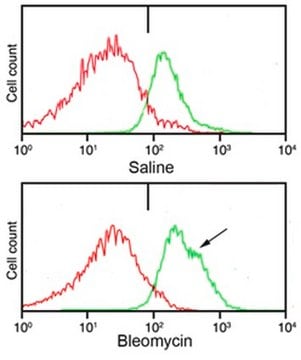
Flow Cytometry Analysis: A representative lot detected Telo-Collagen Type I, A1/COL1A1 in mouse lung tissue.
Immunohistochemistry Analysis: A representative lot detected Telo-Collagen Type I, A1/COL1A1 in mouse lung tissue.

Biochem/physiol Actions

Cat. No. ABT256 Anti-Telo-Collagen Type I, A1/COL1A1 was raised against a sequence derived from the C-terminal telopeptide (not the N-terminal telopeptide) region. This polyclonal antibody will detect prepro-, pro-, and mature collagen alpha-1(I) chain, but not atelocollagen prepared with proteolytic enzymes due to the absence of the C-terminal telopeptide sequence.
Predicted to react with a broad range of species based on high sequence homology, including mammalian, avian, and amphibian species.

Physical form

Affinity purified
Purified rabbit polyclonal in buffer containing PBS with 0.05% sodium azide.

Preparation Note

Stable for 1 year at 2-8°C from date of receipt.

Analysis Note

Evaluated by Western Blotting in mouse liver tissue lysate.

Western Blotting Analysis: A 1:1,000 dilution of this antibody detected Telo-Collagen Type I, A1/COL1A1 in 1 µg of mouse liver tissue lysate.

Other Notes

Concentration: Please refer to lot specific datasheet.

Disclaimer

Unless otherwise stated in our catalog or other company documentation accompanying the product(s), our products are intended for research use only and are not to be used for any other purpose, which includes but is not limited to, unauthorized commercial uses, in vitro diagnostic uses, ex vivo or in vivo therapeutic uses or any type of consumption or application to humans or animals.
Ta strona może zawierać tekst przetłumaczony maszynowo.

Porównaj podobne pozycje

Wyświetl pełne porównanie

Pokaż różnice

1 of 1

Ta pozycja
ABT257ABT123SAB4200678
antibody form

affinity isolated antibody

antibody form

affinity isolated antibody

antibody form

affinity isolated antibody

antibody form

purified immunoglobulin

Quality Level

100

Quality Level

100

Quality Level

100

Quality Level

300

biological source

rabbit

biological source

rabbit

biological source

rabbit

biological source

mouse

shipped in

wet ice

shipped in

wet ice

shipped in

wet ice

shipped in

dry ice

UniProt accession no.

P02452

UniProt accession no.

P02452

UniProt accession no.

P02452

UniProt accession no.

-

clone

polyclonal

clone

polyclonal

clone

polyclonal

clone

COL-1, monoclonal


Still not finding the right product?

Explore all of our products under

lub

Wypróbuj nasze narzędzie Narzędzie selektora produktów, aby zawęzić opcje.


Klasa składowania

12 - Non Combustible Liquids

wgk

WGK 2


Certyfikaty analizy (CoA)

Poszukaj Certyfikaty analizy (CoA), wpisując numer partii/serii produktów. Numery serii i partii można znaleźć na etykiecie produktu po słowach „seria” lub „partia”.

Masz już ten produkt?

Dokumenty związane z niedawno zakupionymi produktami zostały zamieszczone w Bibliotece dokumentów.

Odwiedź Bibliotekę dokumentów


Chloe M Stanton et al.
Disease models & mechanisms, 14(9) (2021-08-10)
Brittle cornea syndrome (BCS) is a rare recessive condition characterised by extreme thinning of the cornea and sclera. BCS results from loss-of-function mutations in the poorly understood genes ZNF469 or PRDM5. In order to determine the function of ZNF469 and


Numer pozycji handlu globalnego

SKUNUMER GTIN
ABT25604055977136654

Questions

Reviews

No rating value

Active Filters