Przejdź do zawartości
Merck

Przejdź do

ABN1016

Anti-CCM3/PDCD10

from rabbit, purified by affinity chromatography

Synonim(y):

Programmed cell death protein 10, Cerebral cavernous malformations 3 protein, TF-1 cell apoptosis-related protein 15

Zaloguj się, aby wyświetlić ceny organizacyjne i kontraktowe.

Wybierz wielkość

Zmień widok
Do Państwa/SKUDostępnośćCena netto
100 μL

Przewidywany termin wysyłki29 lipca 2026zKuehne + Nagel Sp. z o.o.

1650,00 zł

Informacje o tej pozycji

UNSPSC Code:
12352203
NACRES:
NA.43
eCl@ss:
32160702
Conjugate:
unconjugated
Clone:
polyclonal
Application:
WB
Citations:
-

1650,00 zł


Przewidywany termin wysyłki29 lipca 2026Szczegóły


Złóż zamówienie na produkt na zamówienie
Pomoc techniczna
Potrzebujesz pomocy? Nasz zespół doświadczonych naukowców chętnie Ci pomoże.
Pozwól nam pomóc


biological source

rabbit

Quality Segment

conjugate

unconjugated

antibody form

affinity isolated antibody

antibody product type

primary antibodies

clone

polyclonal

purified by

affinity chromatography

species reactivity

human

species reactivity (predicted by homology)

Xenopus (based on high sequence homology), rat (based on high sequence homology), mouse (based on high sequence homology)

technique(s)

western blot: suitable

NCBI accession no.

UniProt accession no.

shipped in

ambient

target post-translational modification

unmodified

Gene Information

human ... PDCD10(11235)

General description

Programmed cell death protein 10 (UniProt Q9BUL8; also known as Cerebral cavernous malformations 3 protein, TF-1 cell apoptosis-related protein 15) is encoded by the PDCD10 (also known as CCM3, TFAR15) gene (Gene ID 11235) in human. PDCD10/CCM3 is an ubiquitously expressed adaptor protein that plays a role in vascularization and vessel permeability, as well as in regulating cell survival and death. Both the N-terminal dimerization domain and the C-terminal focal adhesion targeting-homology (FAT-H) domain mediate its interaction with a diverse array of signaling partners. The FAT-H domain mediates PDCD10 interaction with CCM2 to form the KRIT1 CCM2 PDCD10 complex, as well as with striatin to form the striatin interacting phosphatase and kinase (STRIPAK) complex, while the dimerization domain mediates interactions with GCKIII serine/threonine kinases (MST4/MASK, STK24/MST3 and STK25). PDCD10 overexpression leads to increased cell migration, an essential process for blood vessel formation. Loss of either PDCD10 or STK24 increases neutrophil exocytosis as a result of disrupted interaction with UNC13D, a regulator of vesicle fusion. Loss-of-function mutations in CCM1/KRIT1, CCM2/OSM, or CCM3/PDCD10 gene cause cerebral cavernous malformations (CCMs).
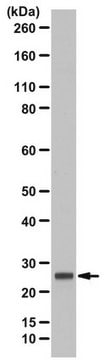
~25 kDa observed. 24.70 kDa calculated. Uncharacterized bands may be observed in some lysate(s).

Immunogen

Recombinant full-length human CCM3/PDCD10.

Application

Anti-CCM3/PDCD10 Antibody, Cat. No. ABN1016, is a highly specific rabbit polyclonal antibody that targets CCM3/PDCD10 and has been tested in Western Blotting.
Research Category
Neuroscience
Western Blotting Analysis: A 1:1,000 dilution from a representative detected 50 ng and 500 ng of recombinant human CCM3/PDCD10 (Courtesy of Kyle M. Draheim, Ph.D., Xiaofeng Li, Ph.D., Rong Zhang, David A.Calderwood, Ph.D. and Titus J. Boggon, Ph.D., Yale University, U.S.A.).

Western Blotting Analysis: A 1:1,000 dilution from a representative lot detected CCM3/PDCD10 in 100 µg of lysate from untreated, but not CCM3 shRNA-treated, EA.hy926 human umbilical vein endothelial cells (Courtesy of Kyle M. Draheim, Ph.D., Xiaofeng Li, Ph.D., Rong Zhang, David A.Calderwood, Ph.D. and Titus J. Boggon, Ph.D., Yale University, U.S.A.).

Biochem/physiol Actions

This polyclonal antibody detected the expected ~25 kDa target band in lysate from untreated, but not CCM3 shRNA-treated, EA.hy926 human umbilical vein endothelial cells (Courtesy of Kyle M. Draheim, Ph.D., Xiaofeng Li, Ph.D., Rong Zhang, David A.Calderwood, Ph.D. and Titus J. Boggon, Ph.D., Yale University, U.S.A.).

Physical form

Affinity purified.
Purified rabbit polyclonal antibody in buffer containing 0.1 M Tris-Glycine (pH 7.4) 150 mM NaCl with 0.05% sodium azide

Preparation Note

Stable for 1 year at 2-8°C from date of receipt.

Analysis Note

Evaluated by Western Blotting in EA.hy926 cell lysate.

Western Blotting Analysis: A 1:5,000 dilution of this antibody detected CCM3/PDCD10 in 10 µg of EA.hy926 human umbilical vein endothelial cell lysate.

Other Notes

Concentration: Please refer to lot specific datasheet.

Disclaimer

Unless otherwise stated in our catalog or other company documentation accompanying the product(s), our products are intended for research use only and are not to be used for any other purpose, which includes but is not limited to, unauthorized commercial uses, in vitro diagnostic uses, ex vivo or in vivo therapeutic uses or any type of consumption or application to humans or animals.
Ta strona może zawierać tekst przetłumaczony maszynowo.

Porównaj podobne pozycje

Wyświetl pełne porównanie

Pokaż różnice

1 of 1

Ta pozycja
SAB1305161MABT1229HPA017924
conjugate

unconjugated

conjugate

-

conjugate

unconjugated

conjugate

unconjugated

biological source

rabbit

biological source

rabbit

biological source

mouse

biological source

rabbit

antibody form

affinity isolated antibody

antibody form

affinity isolated antibody

antibody form

purified antibody

antibody form

affinity isolated antibody

Quality Level

100

Quality Level

100

Quality Level

100

Quality Level

100

UniProt accession no.

Q9BUL8

UniProt accession no.

Q9BUL8

UniProt accession no.

Q8WUM4

UniProt accession no.

Q14690

clone

polyclonal

clone

polyclonal

clone

12H2.1, monoclonal

clone

polyclonal


Still not finding the right product?

Wypróbuj nasze narzędzie Narzędzie selektora produktów, aby zawęzić opcje.


Klasa składowania

12 - Non Combustible Liquids

wgk

WGK 1

flash_point_f

Not applicable

flash_point_c

Not applicable


Certyfikaty analizy (CoA)

Poszukaj Certyfikaty analizy (CoA), wpisując numer partii/serii produktów. Numery serii i partii można znaleźć na etykiecie produktu po słowach „seria” lub „partia”.

Masz już ten produkt?

Dokumenty związane z niedawno zakupionymi produktami zostały zamieszczone w Bibliotece dokumentów.

Odwiedź Bibliotekę dokumentów


Questions

Reviews

No rating value

Active Filters