Przejdź do zawartości
Merck

Przejdź do

AB9328

Przeciwciało przeciw tioredoksynie 1

serum, Chemicon®

Synonim(y):

TRX1

Zaloguj się, aby wyświetlić ceny organizacyjne i kontraktowe.

Wybierz wielkość

Zmień widok
Gabaryty przesyłkiSKUDostępnośćCena netto
100 μL

Przewidywany termin wysyłki11 czerwca 2026zKuehne + Nagel Sp. z o.o.

2060,00 zł

Informacje o tej pozycji

UNSPSC Code:
12352203
NACRES:
NA.41
eCl@ss:
32160702
Conjugate:
unconjugated
Clone:
polyclonal
Application:
WB
Citations:
2

2060,00 zł


Przewidywany termin wysyłki11 czerwca 2026Szczegóły


Zamów zamówienie zbiorcze
Pomoc techniczna
Potrzebujesz pomocy? Nasz zespół doświadczonych naukowców chętnie Ci pomoże.
Pozwól nam pomóc


biological source

rabbit

Quality Segment

conjugate

unconjugated

antibody form

serum

antibody product type

primary antibodies

clone

polyclonal

species reactivity

mouse, rat

species reactivity (predicted by homology)

human (sequence homology 14/15)

manufacturer/tradename

Chemicon®

technique(s)

western blot: suitable

NCBI accession no.

UniProt accession no.

shipped in

dry ice

target post-translational modification

unmodified

Gene Information

human ... TXN(7295)

Immunogen

Syntetyczny peptyd ze szczurzej/mysiej tioredoksyny 1.

Application

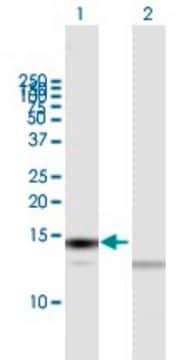
Immunoblotting: 1:1,000-1:5,000 przy użyciu ECL. Reaguje z białkiem ~12-14 kD tioredoksyny 1. Mogą być widoczne dodatkowe pasma >30 kD.

Sugerowane rozcieńczenie i bufor blokujący to TBST zawierający 5% beztłuszczowego mleka. Sugerowany procent żelu to 15%. Sugerowany czas inkubacji to noc.
Wykryj tioredoksynę 1 za pomocą tego przeciwciała anty-tioredoksyny 1 zatwierdzonego do stosowania w WB.
Research Category
Neuroscience
Research Sub Category
Oxidative Stress

Biochem/physiol Actions

Rozpoznaje tioredoksynę 1 (TRX1).

Physical form

Surowica królicza. Płyn. Nie zawiera konserwantów.

Preparation Note

Przechowywać w temperaturze -20°C w nierozcieńczonych podwielokrotnościach przez okres do 6 miesięcy od daty otrzymania. Unikać powtarzających się cykli zamrażania/rozmrażania.

Other Notes

Zastępuje: MABN1090

Legal Information

CHEMICON is a registered trademark of Merck KGaA, Darmstadt, Germany

Disclaimer

Unless otherwise stated in our catalog or other company documentation accompanying the product(s), our products are intended for research use only and are not to be used for any other purpose, which includes but is not limited to, unauthorized commercial uses, in vitro diagnostic uses, ex vivo or in vivo therapeutic uses or any type of consumption or application to humans or animals.
Ta strona może zawierać tekst przetłumaczony maszynowo.

Porównaj podobne pozycje

Wyświetl pełne porównanie

Pokaż różnice

1 of 1

Ta pozycja
SAB5300166SAB1305665SAB1404501
Quality Level

100

Quality Level

100

Quality Level

-

Quality Level

100

biological source

rabbit

biological source

mouse

biological source

rabbit

biological source

mouse

conjugate

unconjugated

conjugate

unconjugated

conjugate

-

conjugate

unconjugated

antibody form

serum

antibody form

ascites fluid

antibody form

IgG fraction of antiserum

antibody form

purified immunoglobulin

species reactivity

mouse, rat

species reactivity

human

species reactivity

human

species reactivity

human

Gene Information

human ... TXN(7295)

Gene Information

human ... TXN(7295)

Gene Information

human ... TXN(7295)

Gene Information

human ... TXN(7295)


Still not finding the right product?

Wypróbuj nasze narzędzie Narzędzie selektora produktów, aby zawęzić opcje.


Klasa składowania

10 - Combustible liquids

wgk

WGK 1

flash_point_f

Not applicable

flash_point_c

Not applicable


Certyfikaty analizy (CoA)

Poszukaj Certyfikaty analizy (CoA), wpisując numer partii/serii produktów. Numery serii i partii można znaleźć na etykiecie produktu po słowach „seria” lub „partia”.

Masz już ten produkt?

Dokumenty związane z niedawno zakupionymi produktami zostały zamieszczone w Bibliotece dokumentów.

Odwiedź Bibliotekę dokumentów


Powiązane treści

"Redox reactions are powerful chemical processes that involve the reduction and oxidation of proteins and metabolites found in living things. The mechanisms that regulate them are key to maintaining homeostasis and the balance between good health and disease pathology. Oxidative stress is the state where the delicate balance of redox biology is upset, and the pathology of oxidative stress are the cellular consequences to such an imbalance."

"Aging: getting older, exhibiting the signs of age, the decline in the physical (and mental) well-being over time, leading to death. Since the beginning of time, man has been obsessed with trying to slow down, stop, or even reverse the signs of aging. Many have gone as far as experimenting with nutritional regimens, eccentric exercises, fantastic rituals, and naturally occurring or synthetic wonder-elements to evade the signs of normal aging. Biologically speaking, what is aging? And what does the latest research tell us about the possibility of discovering the elusive “fountain of youth”? Many advances in our understanding of aging have come from systematic scientific research, and perhaps it holds the key to immortality. Scientifically, aging can be defined as a systems-wide decline in organismal function that occurs over time. This decline occurs as a result of numerous events in the organism, and these events can be classified into nine “hallmarks” of aging, as proposed by López-Otin et al. (2013). Several of the pathologies associated with aging are a direct result of these events going to extremes and may also involve aberrant activation of proliferation signals or hyperactivity. The hallmarks of aging have been defined based on their fulfillment of specific aging related criteria, such as manifestation during normal aging, acceleration of aging if experimentally induced or aggravated, and retardation of aging if prevented or blocked, resulting in increased lifespan. The nine hallmarks of aging are genomic instability, telomere attrition, epigenetic alterations, loss of proteostasis, deregulated nutrient sensing, mitochondrial dysfunction, cellular senescence, stem cell exhaustion, and altered intercellular communication. The biological processes underlying aging are complex. By understanding the hallmarks in greater detail, we can get closer to developing intervention strategies that can make the aging process less of a decline, and more of a recline."

Wyświetl wszystkie powiązane treści


Numer pozycji handlu globalnego

SKUNUMER GTIN
AB932804053252324673

Questions

Reviews

No rating value

Active Filters