Przejdź do zawartości
Merck

Przejdź do

454582

Anty-NMDAR 2B (984-1104) królicze pAb

lyophilized, Calbiochem®

Synonim(y):

Przeciwciało przeciwko podjednostce 2B receptora N-metylo-D-asparaginianu

Zaloguj się, aby wyświetlić ceny organizacyjne i kontraktowe.

Wybierz wielkość

Zmień widok
Gabaryty przesyłkiSKUDostępnośćCena netto
10 μg

Przewidywany termin wysyłki13 kwietnia 2026zKuehne + Nagel Sp. z o.o.

2600,00 zł

Informacje o tej pozycji

NACRES:
NA.43
UNSPSC Code:
12352203
Clone:
polyclonal
Species reactivity:
rat, fish, mouse, human
Application:
Citations:
7

2600,00 zł


Przewidywany termin wysyłki13 kwietnia 2026Szczegóły


Zamów zamówienie zbiorcze
Pomoc techniczna
Potrzebujesz pomocy? Nasz zespół doświadczonych naukowców chętnie Ci pomoże.
Pozwól nam pomóc


biological source

rabbit

Quality Level

antibody form

purified antibody

antibody product type

primary antibodies

clone

polyclonal

form

lyophilized

does not contain

preservative

species reactivity

rat, fish, mouse, human

manufacturer/tradename

Calbiochem®

storage condition

OK to freeze

dilution

(Immunoblotting (1:1000)
Immunohistochemistry (1:1000-1:2000)
Immunoprecipitation )

isotype

IgG

shipped in

ambient

storage temp.

−20°C

target post-translational modification

unmodified

General description

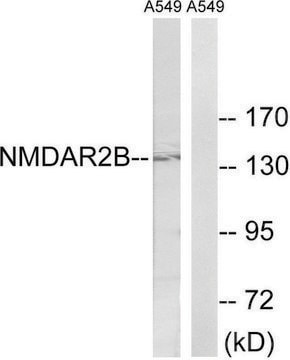
Oczyszczone immunologicznie królicze przeciwciało poliklonalne. Rozpoznaje podjednostkę ~180 kDa NMDAR2B receptora NMDA.
Rozpoznaje podjednostkę NR2B receptora NMDA o masie ~180 kDa.
To królicze pAb anty-NMDAR 2B (984-1104) jest zatwierdzone do stosowania w immunoblottingu, immunohistochemii, immunoprecypitacji w celu wykrycia NMDAR 2B (984-1104).

Immunogen

Mózg szczura
rekombinowane białko fuzyjne składające się z aminokwasów 984-1104 podjednostki NMDAR 2B mózgu szczura

Application

Immunoblotting (1:1000)

Immunohistochemistry (1:1000-1:2000)

Immunoprecypitacja (patrz komentarze)

Physical form

Liofilizowany z 5 mM wodorowęglanu amonu.

Preparation Note

Rozpuścić w 50 µl PBS. Po rekonstytucji pobrać porcję i zamrozić (-20°C). Unikać cykli zamrażania i rozmrażania odtworzonego roztworu.

Other Notes

Nie reaguje krzyżowo z NMDAR2A lub NMDAR2C. Objętość immunoprecypitacji specyficzna dla danej partii znajduje się w certyfikacie analizy. Zmienne związane z warunkami testu będą dyktować właściwe rozcieńczenie robocze.
Wang, Y.H., et al. 1995. J. Neurochem.65, 176.
Petralia, R.S., et al. 1994. J. Neurosci.14, 6102.
Ishii, T., et al. 1993. J. Biol. Chem.268, 2836.
Monyer, H., et al. 1992. Nature256, 1217.

Legal Information

CALBIOCHEM is a registered trademark of Merck KGaA, Darmstadt, Germany

Disclaimer

Toksyczność: Standardowa obsługa (A)
Ta strona może zawierać tekst przetłumaczony maszynowo.

Porównaj podobne pozycje

Wyświetl pełne porównanie

Pokaż różnice

1 of 1

Ta pozycja
AB1557P454578SAB4501306
antibody form

purified antibody

antibody form

affinity isolated antibody

antibody form

culture supernatant

antibody form

affinity isolated antibody

biological source

rabbit

biological source

rabbit

biological source

mouse

biological source

rabbit

Quality Level

100

Quality Level

100

Quality Level

100

Quality Level

-

species reactivity

rat, fish, mouse, human

species reactivity

mouse, rat, human

species reactivity

rat

species reactivity

mouse, rat, human

clone

polyclonal

clone

polyclonal

clone

R1JHL, monoclonal

clone

polyclonal

form

lyophilized

form

-

form

lyophilized

form

buffered aqueous solution


Still not finding the right product?

Wypróbuj nasze narzędzie Narzędzie selektora produktów, aby zawęzić opcje.


Klasa składowania

11 - Combustible Solids

wgk

WGK 1

flash_point_f

Not applicable

flash_point_c

Not applicable


Certyfikaty analizy (CoA)

Poszukaj Certyfikaty analizy (CoA), wpisując numer partii/serii produktów. Numery serii i partii można znaleźć na etykiecie produktu po słowach „seria” lub „partia”.

Masz już ten produkt?

Dokumenty związane z niedawno zakupionymi produktami zostały zamieszczone w Bibliotece dokumentów.

Odwiedź Bibliotekę dokumentów


Powiązane treści

Glutamate is an excitatory neurotransmitter found in the synaptic vesicles of glutamatergic synapses. The post-synaptic neurons in these synapses contain ionotropic and metabotropic glutamate receptors. Glutamate binds to AMPA (α-amino-3-hydroxy-5- methylisoxazole-4-propionic acid) subtype glutamate receptors, leading to sodium influx into the post-synaptic cell and resulting in neuronal excitability and synaptic transmission. The NMDA (N-methyl-d-aspartate) subtype glutamate receptors, on the other hand, regulate synaptic plasticity, and can influence learning and memory. The metabotropic g-protein coupled mGluRs modulate downstream calcium signaling pathways and indirectly influence the synapse’s excitability. The synaptic architecture includes intracellular scaffolding proteins (PSD-95, GRIP), intercellular cell adhesion molecules (NCAMs, N-Cadherins), and a variety of signaling proteins (CaMKII/PKA, PP1/PP2B). Processes critical for synaptic transmission and plasticity are influenced by these molecules and their interactions. When the function of these molecules is disrupted, it leads to synaptic dysfunction and degeneration, and can contribute to dementia as seen in Alzheimer’s disease.


Carrie R Ferrario et al.
PloS one, 7(8), e40898-e40898 (2012-08-08)
We previously showed that the time-dependent intensification ("incubation") of cue-induced cocaine seeking after withdrawal from extended-access cocaine self-administration is accompanied by accumulation of Ca(2+)-permeable AMPA receptors (CP-AMPARs) in the rat nucleus accumbens (NAc). These results suggest an enduring change in
Ainhoa Plaza-Zabala et al.
Neuroscience letters, 557 Pt B, 101-106 (2013-11-23)
Hypocretin peptides are critical for the effects of cocaine on excitatory synaptic strength in the ventral tegmental area (VTA). However, little is known about their role in cocaine-induced synaptic plasticity in the nucleus accumbens (NAc). First, we tested whether hypocretin-1
Leonardo Santana Novaes et al.
Translational psychiatry, 11(1), 18-18 (2021-01-09)
The persistence of anxiety and the deficit of fear memory extinction are both phenomena related to the symptoms of a trauma-related disorder, such as post-traumatic stress disorder (PTSD). Recently we have shown that single acute restraint stress (2 h) in rats


Numer pozycji handlu globalnego

SKUNUMER GTIN
454582-10UG04055977204162

Questions

Reviews

No rating value

Active Filters