

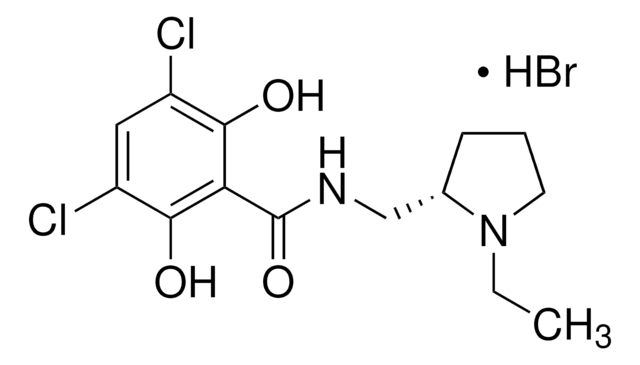

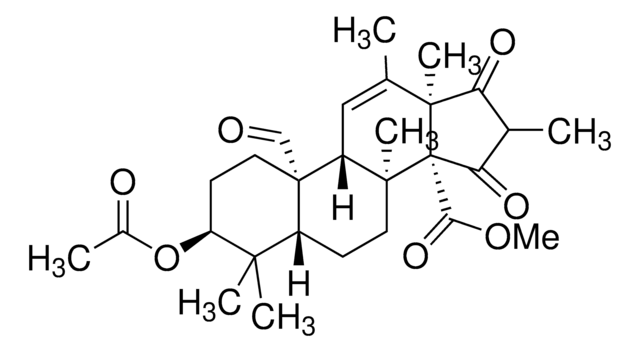
The molecular weight of methyllycaconitine is 682.80 g/mole. The molecular weight of citric acid is 192.124 g/mole. The overall molecular weight of the salt complex is 874.94 g/mole, which corresponds to 1 mole of methyllycaconitine and 1 mole of citric acid. This calculation does not account for water content or purity. The certificate of analysis provides details on the number of moles of citric acid for each lot, as well as water content and purity, which may vary from lot to lot. The free base consists of one mole of methyllycaconitine.
M168

Methyllycaconitine citrate salt
From Delphinium brownii seeds, ≥96% (HPLC), α7 nicotinic acetylcholine receptor (α7 nAChR) antagonist
Synonym(s):
MLA, [1α,4(S),6β,14α,16β]-20-Ethyl-1,6,14,16-tetramethoxy-4-[[[2-(3-methyl-2,5-dioxo-1-pyrrolidinyl)benzoyl]oxy]methyl]aconitane-7,8-diol citrate salt
Sign In to View Organizational & Contract Pricing.
Select a Size
Change View
| Size/SKU | Availability | Price |
|---|---|---|
5 mg | Please contact Customer Service for Availability | PLN 472.00 |
25 mg | Please contact Customer Service for Availability | PLN 1,780.00 |
About This Item
Empirical Formula (Hill Notation):
C37H50N2O10 · xC6H8O7
CAS Number:
Molecular Weight:
682.80 (salt-free basis)
UNSPSC Code:
12352200
PubChem Substance ID:
NACRES:
NA.77
MDL number:
Assay:
≥96% (HPLC)
Product Name
Methyllycaconitine citrate salt, from Delphinium brownii seeds, ≥96% (HPLC)
biological source
Delphinium brownii seeds
Quality Segment
assay
≥96% (HPLC)
color
white
solubility
H2O: 42 mg/mL
storage temp.
−20°C
SMILES string
O=C(OC[C@]12[C@@]([C@]3([C@H](CC1)OC)[C@@H]4N(C2)CC)([H])[C@@H]([C@]4(O)[C@]5(O)[C@]6([H])[C@@]3([H])C[C@@]([C@H](C5)OC)([H])[C@@H]6OC)OC)C7=CC=CC=C7N8C([C@@H](C)CC8=O)=O.OC(CC(CC(O)=O)(C(O)=O)O)=O
InChI
1S/C37H50N2O10.C6H8O7/c1-7-38-17-34(18-49-32(42)20-10-8-9-11-23(20)39-26(40)14-19(2)31(39)41)13-12-25(46-4)36-22-15-21-24(45-3)16-35(43,27(22)28(21)47-5)37(44,33(36)38)30(48-6)29(34)36;7-3(8)1-6(13,5(11)12)2-4(9)10/h8-11,19,21-22,24-25,27-30,33,43-44H,7,12-18H2,1-6H3;13H,1-2H2,(H,7,8)(H,9,10)(H,11,12)/t19-,21+,22+,24-,25-,27+,28-,29+,30-,33?,34-,35+,36-,37+;/m0./s1
InChI key
INBLZNJHDLEWPS-DDIMIZGISA-N
Application
Methyllycaconitine citrate salt has been used as an α7 nicotinic acetylcholine receptor (α7 nAChR) antagonist:
- to study its effects on inflammatory response in rats post nicotine treatment[1]
- to block the activity of galantamine[2]
- to study its effects on the hepatic branch of the vagus nerve (hVNS) in rats[3]
Biochem/physiol Actions
Methyllycaconitine (MLA) is an α7 nicotinic acetylcholine receptor (α7 nAChR) antagonist. It is a norditerpenoid alkaloid synthesized by several species of Delphinium.[4] MLA binds to the binding site of neuronal α-bungarotoxin.[5] Low doses of MLA are associated with improvement of cognition in animals.[4]
Features and Benefits
This compound is featured on the Acetylcholine Receptors (Nicotinic) page of the Handbook of Receptor Classification and Signal Transduction. To browse other handbook pages, click here.
1 of 1
This Item | |||
|---|---|---|---|
| assay ≥96% (HPLC) | assay ≥98% (HPLC) | assay ≥98% (HPLC) | assay ≥95% (HPLC) |
| Quality Level 100 | Quality Level 100 | Quality Level 100 | Quality Level - |
| storage temp. −20°C | storage temp. - | storage temp. room temp | storage temp. −20°C |
| solubility H2O: 42 mg/mL | solubility H2O: 10 mg/mL | solubility DMSO: 5 mg/mL (clear solution; warmed) | solubility - |
| color white | color white | color white to beige | color white to beige |
| biological source Delphinium brownii seeds | biological source - | biological source - | biological source - |
Storage Class
11 - Combustible Solids
wgk
WGK 3
flash_point_f
Not applicable
flash_point_c
Not applicable
ppe
Eyeshields, Gloves, type N95 (US)
Choose from one of the most recent versions:
Already Own This Product?
Find documentation for the products that you have recently purchased in the Document Library.
-
The COA states “1.0 mol” of salt content, is that per mole of MLA? I need to know the exact MW of the salt complex in order to make a solution of known molarity. Do I assume there is one citrate molecule for each of MLA?
1 answer-
Helpful?
-