

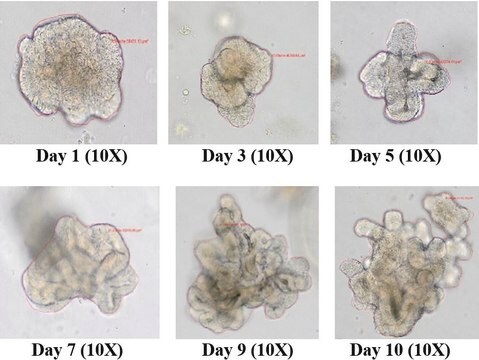
Colon spheroids will form at the end of Day 12, which will be embedded in Matrigel® matrix using the 3dGRO™ Human Colon Organoid Expansion Media (SCM304) to generate mature colonic organoids. By day 10-12 in culture, colon organoids occupy 85-90% of the dome, and are ready to be passaged. For reference, below is the link to In Vitro Differentiation of Human iPS Cells Into Colon Organoids in Serum-Free Cell Culture Conditions:
SCC300

3dGRO® Human iPSC Derived Colon Organoids
Normal, Dermal Fibroblast, Age: Neonatal, Male, Mutation: None
Synonym(s):
colon organoids, human organoids
Sign In to View Organizational & Contract Pricing.
Select a Size
Change View
| Size/SKU | Availability | Price |
|---|---|---|
1 vial | Please contact Customer Service for Availability | PLN 13,060.00 |
About This Item
NACRES:
NA.81
UNSPSC Code:
41106514
biological source
human (dermal fibroblast)
form
liquid
packaging
vial of >1500 viable organoids
gender
male
technique(s)
cell culture: suitable
application(s)
3D cell culture
control
(dermal fibroblast)
relevant disease(s)
(Normal)
storage temp.
−196°C
General description
Human intestinal organoids are self-organizing, 3D structures that can be expanded in long-term culture and differentiate into intestinal epithelial cell types. Epithelial intestinal organoids, often referred to as enteroids or “mini-guts”, maintain the physiological characteristics of the gastrointestinal system and have been a useful cell culture tool to model intestinal development and disease including the study of colon cancer, celiac disease, inflammatory bowel diseases and host microbiome interactions. Organoids can be propagated from patient biopsies and from embryonic (ES) and induced pluripotent stem cells (iPS cells).
3dGRO® Human iPSC Derived Colon Organoids are derived from integration-free human iPS cells (Cat. No. SCC271) reprogrammed using the Simplicon RNA reprogramming technology (Cat. No. SCR550). Human iPS cells were differentiated using a multi-step process from definitive endoderm to posterior hind-gut endoderm and eventually into colon organoids (Figure 1.). The organoids express colon-specific markers including the posterior hindgut marker CDX2, a-carbonic anydrase II (CA-II), a-carbonic anhydrase IV (CA-IV), and goblet cell markers Mucin-2 and Mucin-5B. 3dGRO® human iPSC derived colon organoids can be propagated long-term by passaging every 10-12 days using 3dGRO® Human Colon Organoid Expansion Medium (Cat. No. SCM304).
3dGRO® Human iPSC Derived Colon Organoids are derived from integration-free human iPS cells (Cat. No. SCC271) reprogrammed using the Simplicon RNA reprogramming technology (Cat. No. SCR550). Human iPS cells were differentiated using a multi-step process from definitive endoderm to posterior hind-gut endoderm and eventually into colon organoids (Figure 1.). The organoids express colon-specific markers including the posterior hindgut marker CDX2, a-carbonic anydrase II (CA-II), a-carbonic anhydrase IV (CA-IV), and goblet cell markers Mucin-2 and Mucin-5B. 3dGRO® human iPSC derived colon organoids can be propagated long-term by passaging every 10-12 days using 3dGRO® Human Colon Organoid Expansion Medium (Cat. No. SCM304).
Preparation Note
3dGRO® Human iPSC Derived Colon Organoids should be stored in liquid nitrogen.
Analysis Note
- Each vial contains ≥1500 organoids.
- Mycoplasma: Negative
- Genotyped by STR analysis: Pass
- Human species verified
- Organoids are negative for HPV-16, HPV-18, Hepatitis A, B, C, and HIV-1 & 2 viruses by PCR.
- Cell viability test: Pass
Legal Information
3dGRO® is a trademark of Merck KGaA, Darmstadt, Germany.
3dGRO® organoids were derived utilizing HUB Organoid Technology.
Subject to local law, this product is intended to be sold for internal in vitro research use only subject to terms and conditions found here: www.sigmaaldrich.com/pdouse. This product may not be re-engineered or copied; used to make derivatives or modifications; used to develop, test, or manufacture a commercial product; used as a component in a commercial product; resold or licensed; used in any clinical applications or trials; or used in humans. A license or limited commercial use agreement is required for use by any for-profit entity, use in services, and use in sponsored academic research. For information regarding any such use, please contact [email protected].
3dGRO® organoids were derived utilizing HUB Organoid Technology.
Subject to local law, this product is intended to be sold for internal in vitro research use only subject to terms and conditions found here: www.sigmaaldrich.com/pdouse. This product may not be re-engineered or copied; used to make derivatives or modifications; used to develop, test, or manufacture a commercial product; used as a component in a commercial product; resold or licensed; used in any clinical applications or trials; or used in humans. A license or limited commercial use agreement is required for use by any for-profit entity, use in services, and use in sponsored academic research. For information regarding any such use, please contact [email protected].
3dGRO is a registered trademark of Merck KGaA, Darmstadt, Germany
Disclaimer
RESEARCH USE ONLY. This product is regulated in France when intended to be used for scientific purposes, including for import and export activities (Article L 1211-1 paragraph 2 of the Public Health Code). The purchaser (i.e. enduser) is required to obtain an import authorization from the France Ministry of Research referred in the Article L1245-5-1 II. of Public Health Code. By ordering this product, you are confirming that you have obtained the proper import authorization.
1 of 1
This Item | |
|---|---|
| biological source human (dermal fibroblast) | biological source - |
| application(s) 3D cell culture | application(s) cell analysis |
| relevant disease(s) (Normal) | relevant disease(s) - |
| technique(s) cell culture: suitable | technique(s) cell culture | stem cell: suitable |
| storage temp. −196°C | storage temp. - |
| packaging vial of >1500 viable organoids | packaging pkg of 50 mL |
Storage Class
12 - Non Combustible Liquids
wgk
WGK 1
flash_point_f
does not flash
flash_point_c
does not flash
Regulatory Listings
Regulatory Listings are mainly provided for chemical products. Only limited information can be provided here for non-chemical products. No entry means none of the components are listed. It is the user’s obligation to ensure the safe and legal use of the product.
64-17-5
CAS No.
Certificates of Analysis (COA)
Search for Certificates of Analysis (COA) by entering the products Lot/Batch Number. Lot and Batch Numbers can be found on a product’s label following the words ‘Lot’ or ‘Batch’.
Already Own This Product?
Find documentation for the products that you have recently purchased in the Document Library.
-
How long before it is ready to use?
1 answer-
Helpful?
-
-
How are organoids cultured?
1 answer-
Once isolated, organoids are cultured in specialized media embedded in a rich extracellular matrix (ECM) basement membrane extract hydrogel such as Growth Factor Reduced Matrigel. Media is replenished every other day and cells are passaged once per week (7-12 days) before cells become too large or necrotic. Cells can be passaged in either small clump fragments or as single cells using mechanical dissociation/enzyme-free passaging reagents. Depending on organoid type and confluency, split ratios of roughly 1:3-1:4 can be used when passaging organoids. For sensitive organoid types, ROCKi (Y27632) (SCM075) can be added during passaging to help in promoting cell viability.
Helpful?
-
-
How Do you Extract RNA/DNA from Organoids in Cultured in Matrigel?
1 answer-
Traditional DNA/RNA isolation kits can be used to prepare genomic material for sequencing (RNA-seq, scRNA-seq, WGS, CHIP-seq etc). For some applications with large organoids, tissue specific DNA/RNA extraction kits are recommended. TRI Reagent (T9424) can be added to the dissociated organoids before RNA extraction and can be stored at -80 °C until future use.
Helpful?
-
-
How do you stain organoids with antibodies?
1 answer-
Organoids can be stained with antibodies for immunocytochemical (ICC)/Immunohistochemical (IHC) analysis using either whole-mount or paraffin embedding/sectioning techniques. It is critical to use antibodies prequalified for organoid analysis.
Helpful?
-