
03-102

RIPAb+ HuR - RIP Validated Antibody and Primer Set
from rabbit
Synonym(s):
ELAV-like protein 1, Hu-antigen R
Select a Size
| Size/SKU | Availability | Price |
|---|---|---|
10 assays | Estimated to ship onJune 03, 2026fromKuehne + Nagel Sp. z o.o. | PLN 2,410.00 |
About This Item
biological source
rabbit
Quality Segment
clone
polyclonal
species reactivity
mouse, human, rat
manufacturer/tradename
RIPAb+, Upstate®
technique(s)
RIP: suitable, immunocytochemistry: suitable, immunohistochemistry: suitable, immunoprecipitation (IP): suitable, western blot: suitable
NCBI accession no.
UniProt accession no.
shipped in
dry ice
Gene Information
human ... ELAVL1(1994)
General description
The RIPAb+ HuR set includes the HuR antibody, a negative control antibody (purified Rabbit IgG), and positive qPCR primers which amplify a 100 bp fragment of the human beta actin (ACTB) cDNA. The HuR and negative control antibodies are supplied in a scalable "per RIP" reaction size and can be used to functionally validate the precipitation HuR-associated RNAs.
Immunogen
Application
RIP lysate from MCF7 cells (2 X 10⁶ cell equivalents per IP) was subjected to immunoprecipitation using 0.5 μg of either a normal rabbit IgG or Anti-HuR antibody. Precipitated proteins were resolved by electrophoresis, transferred to nitrocellulose and probed with anti-HuR (1.0 μg/mL).
Proteins were visualized using One-Step IP-Western kit (GenScript Cat. # L00231) (Please see figures).
Western Blot Analysis:
3T3/A31 lysate was resolved by electrophoresis, transferred to PVDF membranes and probed with HuR, hu (1:500 dilution). Proteins were visualized using a Donkey anti-Rabbit conjugated to HRP and visualized using a chemiluminescence detection system. (Please see figures).
Immunoprecipitation Analysis:
10 ug of this antibody immunoprecipitated HuR from 500 ug of 3T3/A31 RIPA lysate (Please see figures).
mmunocytochemistry Analysis:
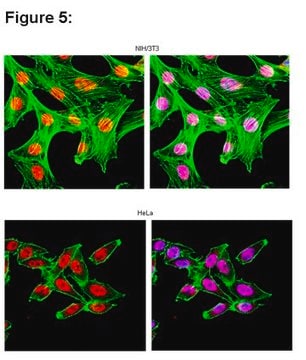
Confocal IF analysis of HeLa, NIH/3T3 using anti-HuR (Red). Actin filaments have been labeled with AlexaFluor 488 -Phalloidin (Green). Nucleus is stained with DAPI (Blue) (Please see figures).
Physical form
Normal Rabbit IgG. One vial containing 125 μg purified rabbit IgG in 125 μL storage buffer containing 0.1% sodium azide. Store at -20°C.
RIP Primers, ACTB. One vial containing 75 μL of 5 μM of each primer specific for human beta actin (ACTB). Store at -20°C.
FOR: TTG TTA CAG GAA GTC CCT TGC C
REV: ATG CTA TCA CCT CCC CTG TGT G
Analysis Note
Included negative control rabbit IgG antibody and control primers specific for human beta actin (ATCB).
RIP Lysate prepared from HeLa cells (2 x 10⁷ cell equivalents per IP) were subjected to immunoprecipitation using 5 µg of either a normal Rabbit IgG or Anti-HuR antibody and the Magna RIP Kit (Cat. # 17-700).
Successful immunoprecipitation of HuR-associated RNA was verified by qPCR using RIP Primers, ACTB (Please see figures).
Please refer to the Magna RIP® (Cat. # 17-700) or EZ-Magna RIP (Cat. # 17-701) protocol for experimental details.
Legal Information
1 of 1
This Item | |||
|---|---|---|---|
| technique(s) RIP: suitable, immunohistochemistry: suitable, western blot: suitable, immunocytochemistry: suitable, immunoprecipitation (IP): suitable | technique(s) immunoprecipitation (IP): suitable (RNA binding protein), western blot: suitable | technique(s) RIP: suitable, immunoprecipitation (IP): suitable, western blot: suitable | technique(s) immunoprecipitation (IP): suitable (RNA binding protein), western blot: suitable |
| UniProt accession no. | UniProt accession no. - | UniProt accession no. | UniProt accession no. - |
| NCBI accession no. | NCBI accession no. - | NCBI accession no. | NCBI accession no. - |
| Quality Level 100 | Quality Level 100 | Quality Level 100 | Quality Level 100 |
| manufacturer/tradename RIPAb+, Upstate® | manufacturer/tradename - | manufacturer/tradename RIPAb+, Upstate® | manufacturer/tradename - |
| species reactivity mouse, human, rat | species reactivity mouse, rabbit, human, Xenopus | species reactivity human | species reactivity bovine, human, rabbit, mouse, pig |


Storage Class
12 - Non Combustible Liquids
flash_point_f
Not applicable
flash_point_c
Not applicable
wgk
WGK 2
Certificates of Analysis (COA)
Search for Certificates of Analysis (COA) by entering the products Lot/Batch Number. Lot and Batch Numbers can be found on a product’s label following the words ‘Lot’ or ‘Batch’.
Already Own This Product?
Find documentation for the products that you have recently purchased in the Document Library.