
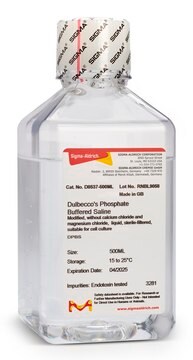

This product has an osmolarity range of 275–304 mOsm/kg.
D8537

Disolución salina tamponada con fosfatos de Dulbecco
liquid, Modified, without calcium chloride and magnesium chloride, liquid, sterile-filtered, suitable for cell culture
Dulbecco’s Phosphate Buffered Saline
1 of 6 reviewers received a sample product or took part in a promotion
Sinónimos:
DPBS
Iniciar sesión para ver los precios por organización y contrato.
Seleccione un Tamaño
Cambiar Vistas
| A ustedes/SKU | Disponibilidad | Precio |
|---|
Acerca de este artículo
En este momento no podemos mostrarle ni los precios ni la disponibilidad
Servicio técnico
¿Necesita ayuda? Nuestro equipo de científicos experimentados está aquí para ayudarle.
Permítanos ayudarleNombre del producto
Disolución salina tamponada con fosfatos de Dulbecco, Modified, without calcium chloride and magnesium chloride, liquid, sterile-filtered, suitable for cell culture
Quality Segment
sterility
sterile-filtered
form
liquid
technique(s)
cell culture | mammalian: suitable
impurities
endotoxin, tested
components
glucose: no (Dextro)
sodium pyruvate: no
shipped in
ambient
storage temp.
room temp
General description
La disolución salina tamponada con fosfato de Dulbecco (DPBS) es una disolución salina equilibrada (BSS) utilizada para la manipulación y el cultivo de células de mamífero. El tampón DPBS se utiliza para irrigar, lavar y diluir las células de mamífero mientras se mantiene el equilibrio osmótico. Proporciona agua e iones inorgánicos esenciales para el metabolismo celular normal. El DPBS con calcio y magnesio facilita la unión y el agrupamiento celulares. El PBS de Dulbecco sin estos iones puede utilizarse para lavar y enjuagar las células suspendidas. El tampón de fosfato mantiene el pH en el intervalo fisiológico.
Application
La disolución salina tamponada con fosfato de Dulbecco se ha utilizado:
- para la dilución de glóbulos rojos recién extraídos para estudiar la captura del agregado de eritrocitos.
- para lavar los pocillos de una placa de microvaloración.[1]
- para lavar las células antes de resuspenderlas en tampón de lisis para el aislamiento del ADN[2]
- como componente del medio de conservación de embriones para la vitrificación de embriones.
1 of 1
Este artículo | |||
|---|---|---|---|
| technique(s) cell culture | mammalian: suitable | technique(s) cell culture | mammalian: suitable | technique(s) cell culture | mammalian: suitable | technique(s) cell culture | mammalian: suitable |
| Quality Level 300 | Quality Level 400 | Quality Level 400 | Quality Level 500 |
| form liquid | form liquid | form liquid | form liquid |
| storage temp. room temp | storage temp. - | storage temp. - | storage temp. room temp |
| impurities endotoxin, tested | impurities - | impurities - | impurities - |
| sterility sterile-filtered | sterility sterile-filtered | sterility sterile-filtered | sterility sterile-filtered |
Still not finding the right product?
Explore all of our products under Disolución salina tamponada con fosfatos de Dulbecco
Clase de almacenamiento
12 - Non Combustible Liquids
flash_point_f
Not applicable
flash_point_c
Not applicable
Elija entre una de las versiones más recientes:
¿Ya tiene este producto?
Encuentre la documentación para los productos que ha comprado recientemente en la Biblioteca de documentos.
-
Eu gostaria de saber a osmolaridade da solução de DMPBS.
1 answer-
Helpful?
-
-
Quería saber si éste producto se puede considerar RNAsa free para realizar durante la hibridación in situ
1 answer-
This product is a sterile-filtered M Quality Level 300 product. It is not molecular biology grade and does not have specifications such as RNase and DNase free. Therefore, this product cannot be considered RNase free for use in in situ hybridization.
Helpful?
-
-
Bonjour, pourriez-vous m'indiquer le numéro de CAS de la solution de phosphate saline dulbecco sous forme liquide
1 answer-
This item is a multi-component product. A CAS number cannot be applied to this type of product. The Safety Data Sheet document includes the individual CAS numbers of those components that may be potentially hazardous.
Helpful?
-
-
Hi, is this product GMP-grade or are GMP-garde material is used for the production of this?
1 answer-
This product is not GMP-grade. Unfortunately. a GMP-grade version of this product is not available.
Helpful?
-
-
What is the concentration of the product in Molarity?
1 answer-
This is a multi-component formulation. A 'molarity' is not reported for this type of product. See below for the list of components:
Product D8537 contains:
Potassium chloride: 0.2 g/l
Potassium phosphate monobasic: 0.2 g/l
Sodium chloride: 8 g/l
Sodium Phosphate dibasic: 1.15 g/lPlease see the link below for additional information:
https://www.sigmaaldrich.com/deepweb/assets/sigmaaldrich/product/documents/124/464/d8537for.pdfHelpful?
-
-
What is the bottle thread type on the 1L bottle (D8537-1L)
1 answer-
The product is packaged in a square PET bottle with an HDPE cap. The cap specifications are as follows:
Thread Type 38-430
Thread Diameter 37.3 mmHelpful?
-
-
What is the formulation for Product D8537, Dulbecco's Phosphate?
1 answer-
The formulation for 1 liter is 8 g Sodium Chloride, 0.2 g Potassium Phosphate, monobasic, 1.15 g Sodium Phosphate, dibasic, and 0.2 g Potassium Chloride.
Helpful?
-
-
Is Product D8537, Dulbecco's Phosphate, a 1X or 10 X concentration?
1 answer-
This is a 1X concentration. The 10X concentration is listed under product D1408.
Helpful?
-
-
What is the pH of a solution of Product D8537, Dulbecco's Phosphate?
1 answer-
The pH will be in the range of 7.1-7.5, according to the specification sheet.
Helpful?
-
-
What is a Salt Toxicity Test?
1 answer-
The Cell Culture assay is called a Salt Toxicity Test (previously called Cell Culture Salt Testing). A more complete description is below:Cells are harvested and counted. They are resuspended in DPBS and incubated at 37°C, 5% CO2 for 1 hour. The cells are counted and %viability determined. The cells are then cultured for an additional 7 hours (total of 8 hours). The cells are counted again and the % viability determined. The viability at 1 hr has to be >95% of the original viability. The viability at 8 hrs must be >75% of the original viability.
Helpful?
-