
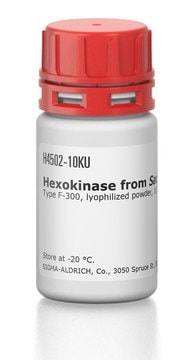
H4502

Hexokinase from Saccharomyces cerevisiae
Type F-300, lyophilized powder, ≥130 units/mg protein (biuret)
Synonym(s):
Hexokinase D, Hexokinasetype IV, ATP:D-Hexose-6-phosphotransferase, Hexokinase from yeast
Select a Size
| Size/SKU | Availability | Price |
|---|---|---|
500 units | Check Cart for Availability | $88.10 |
1000 units | Check Cart for Availability | $106.00 |
2500 units | Check Cart for Availability | $178.00 |
10000 units | Check Cart for Availability | $531.00 |
About This Item
biological source
Saccharomyces cerevisiae
Quality Segment
type
Type F-300
form
lyophilized powder
specific activity
≥130 units/mg protein (biuret)
mol wt
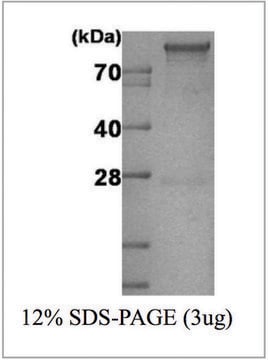
110 kDa
purified by
crystallization
storage condition
(Keep container tightly closed in a dry and well-ventilated place)
color
white
anion traces
sulfate (SO42-): free
foreign activity
ATPase, myokinase, glucose-6-phosphate dehydrogenase, 6-phosphogluconic dehydrogenase and phosphoglucose isomerase ≤0.01%
storage temp.
−20°C
Gene Information
bakers yeast ... HXK1(850614), HXK2(852639)
General description
Application
- for digesting glucose for measuring glucose content in the root and stem samples of Quercus velutina[3]
- to treat ADP (adenosine diphosphate) solution along with D-glucose to remove the contaminating ATP (adenosine triphosphate)
- in 4-(2-hydroxyethyl)-1-piperazineethanesulfonic acid buffer (pH 7.5) for ADP-[13CU]glucose synthesis
Biochem/physiol Actions
The rate of phosphorylation varies with different hexoses (pH 7.5, 30 °C).
D-fructose KM: 0.33 mM
D-glucose KM: 0.12 mM
D-mannose KM: 0.05 mM
Yeast hexokinase exists as two similar isoforms, PI and PII (A and B), with isoelectric points of 5.25 and 4, respectively.
Molecular Weight: ~ 54 kDa (monomer)
~110 kDa (dimer)
Optimal pH: 7.5 to 9.0
Extinction Coefficient: E1% = 8.85 (PI) and 9.47 (PII) at 280 nm
Activators: Hexokinase requires Mg2+ ions (KM = 2.6 mM) for activity. Hexokinase is activated by catecholamines and related compounds.
Inhibitors: sorbose-1-phosphate, polyphosphates, 6-deoxy-6-fluoroglucose, 2-C-hydroxy-methylglucose, xylose, lyxose, and thiol reactive compounds (Hg2+ and 4-chloromercuribenzoate)
Physical form
Preparation Note
Analysis Note
Other Notes
1 of 1
This Item | |||
|---|---|---|---|
| specific activity ≥130 units/mg protein (biuret) | specific activity ≥350 units/mg protein | specific activity - | specific activity ≥300 units/mg protein |
| Gene Information bakers yeast ... HXK1(850614), HXK2(852639) | Gene Information bakers yeast ... HXK1(850614), HXK2(852639) | Gene Information human ... HXK1(3098) | Gene Information - |
| biological source Saccharomyces cerevisiae | biological source Saccharomyces cerevisiae | biological source human | biological source Saccharomyces cerevisiae |
| form lyophilized powder | form lyophilized powder | form liquid | form lyophilized powder (contains buffer salts) |
| storage temp. −20°C | storage temp. 2-8°C | storage temp. −70°C | storage temp. −20°C |
| mol wt 110 kDa | mol wt dimer 110 kDa | mol wt 104.6 kDa | mol wt Mw 141-151 kDa |

Still not finding the right product?
Explore all of our products under Hexokinase from Saccharomyces cerevisiae
Storage Class
11 - Combustible Solids
wgk
WGK 3
flash_point_f
Not applicable
flash_point_c
Not applicable
ppe
Eyeshields, Gloves, type N95 (US)
Choose from one of the most recent versions:
Already Own This Product?
Find documentation for the products that you have recently purchased in the Document Library.