Skip to Content
Merck

C5366

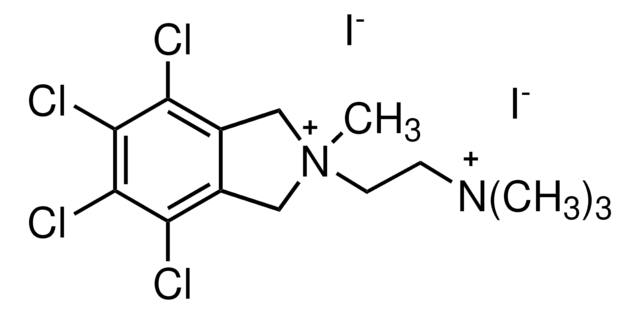
Chlorisondamine diiodide

≥98% (HPLC), nicotinic acetylcholine receptor antagonist, solid

Synonym(s):

4,5,6,7-Tetrachloro-2,3-dihydro-2-methyl-2-[2-(trimethylammonio)ethyl]-2H-isoindolium diiodide

Sign In to View Organizational & Contract Pricing.

Select a Size

Pricing and availability is not currently available.

About This Item

Empirical Formula (Hill Notation):
C14H20Cl4I2N2
CAS Number:
Molecular Weight:
611.94
UNSPSC Code:
12352116
PubChem Substance ID:
NACRES:
NA.77
MDL number:
Assay:
≥98% (HPLC)
Form:
solid
Quality level:
Storage condition:
protect from light

Skip To

Technical Service
Need help? Our team of experienced scientists is here for you.
Let Us Assist

Product Name

Chlorisondamine diiodide, ≥98% (HPLC), white, solid

SMILES string

[I-].[I-].C[N+](C)(C)CC[N+]1(C)Cc2c(Cl)c(Cl)c(Cl)c(Cl)c2C1

InChI key

FPNVAOZHQUJJJQ-UHFFFAOYSA-L

InChI

1S/C14H20Cl4N2.2HI/c1-19(2,3)5-6-20(4)7-9-10(8-20)12(16)14(18)13(17)11(9)15;;/h5-8H2,1-4H3;2*1H/q+2;;/p-2

assay

≥98% (HPLC)

form

solid

storage condition

protect from light

color

white

solubility

H2O: ≥2 mg/mL, DMSO: >20 mg/mL

storage temp.

2-8°C

Quality Level

Related Categories

Compare Similar Items

View Full Comparison

Show Differences

1 of 4

This Item
SML1402A9605N8914
form

solid

form

powder

form

solid

form

powder

assay

≥98% (HPLC)

assay

≥98% (HPLC)

assay

≥98% (HPLC)

assay

≥98% (HPLC)

storage temp.

2-8°C

storage temp.

2-8°C

storage temp.

2-8°C

storage temp.

2-8°C

solubility

H2O: ≥2 mg/mL, DMSO: >20 mg/mL

solubility

DMSO: 5 mg/mL, clear

solubility

DMSO: >10 mg/mL, H2O: insoluble

solubility

DMSO: >20 mg/mL

storage condition

protect from light

storage condition

-

storage condition

desiccated

storage condition

protect from light

color

white

color

white to light brown

color

dark purple

color

yellow

Application

Chlorisondamine diiodide has been used:
  • as a nicotinic receptor antagonist to test its effect on trinitrobenzene sulfonic acid (TNBS)-induced colitis[1]
  • as an irreversible nicotinic acetylcholine(nAChR) blocker to pre-treat brain samples to test its effect on cytochrome P450 2B (CYP2B) induction[2]
  • as a ganglionic blocker to test its effect on regulating corticosterone levels in rat with chronic stress[3]

Biochem/physiol Actions

Chlorisondamine diiodide mediates ganglionic and central blockade.[4]
Irreversible, long-lasting nicotinic acetylcholine receptor antagonist.

Features and Benefits

This compound is a featured product for Neuroscience research. Click here to discover more featured Neuroscience products. Learn more about bioactive small molecules for other areas of research at sigma.com/discover-bsm.
This compound is featured on the Acetylcholine Receptors (Nicotinic) page of the Handbook of Receptor Classification and Signal Transduction. To browse other handbook pages, click here.

pictograms

Exclamation markEnvironment

signalword

Warning

hcodes

Hazard Classifications

Acute Tox. 4 Oral - Aquatic Acute 1

Storage Class

11 - Combustible Solids

wgk

WGK 2

flash_point_f

Not applicable

flash_point_c

Not applicable

ppe

dust mask type N95 (US), Eyeshields, Gloves


Choose from one of the most recent versions:

Certificates of Analysis (COA)

Lot/Batch Number

Don't see the Right Version?

If you require a particular version, you can look up a specific certificate by the Lot or Batch number.

Already Own This Product?

Find documentation for the products that you have recently purchased in the Document Library.

Visit the Document Library

Colin S Cunningham et al.
Pharmacology, biochemistry, and behavior, 179, 27-33 (2019-02-10)
Mecamylamine is a non-competitive nicotinic acetylcholine receptor (nAChR) antagonist that has been prescribed for hypertension and as an off-label smoking cessation aid. Here, we examined pharmacological mechanisms underlying the interoceptive effects (i.e., discriminative stimulus effects) of mecamylamine (5.6 mg/kg s.c.)
A Bai et al.
Scandinavian journal of immunology, 66(5), 538-545 (2007-10-24)
Inflammatory bowel diseases (IBD) are characterized by proinflammatory cytokines, tissue damage and loss of neuron in inflamed mucosa, which implies the cholinergic anti-inflammatory pathway may be destroyed during the process of inflammatory response. In the study, we identified the effect
Steven A Lowrance et al.
Psychoneuroendocrinology, 68, 163-170 (2016-03-15)
Exposure to chronic stress often elevates basal circulating glucocorticoids during the circadian nadir and leads to exaggerated glucocorticoid production following exposure to subsequent stressors. While glucocorticoid production is primarily mediated by the hypothalamic-pituitary-adrenal (HPA) axis, there is evidence that the
Kathryn K Chadman et al.
The Journal of pharmacology and experimental therapeutics, 308(1), 73-78 (2003-10-21)
Chlorisondamine and mecamylamine are nicotinic antagonists that produce both ganglionic and central blockade. Chlorisondamine, when administered as a large systemic dose, produces a persistent central block, despite being charged. The present study evaluated the cardiovascular effects of chlorisondamine. Shortly after
Jibran Y Khokhar et al.
Brain research, 1348, 1-9 (2010-07-06)
CYP2B is a drug-metabolizing enzyme expressed in the liver and brain that metabolizes a variety of centrally acting drugs (e.g. propofol, bupropion and nicotine), endogenous neurochemicals (e.g. serotonin and testosterone) and toxins (e.g. chlorpyrifos). Human CYP2B6 is found at higher

Questions

Reviews

No rating value

Active Filters

Our team of scientists has experience in all areas of research including Life Science, Material Science, Chemical Synthesis, Chromatography, Analytical and many others.

Contact Technical Service