


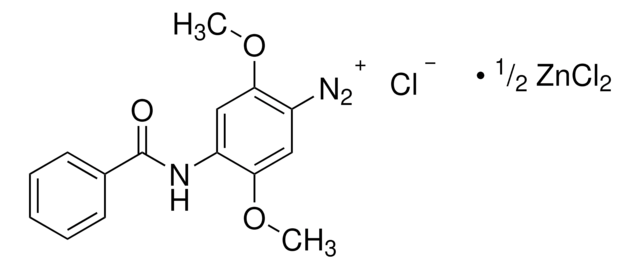

There is no available data sheet. The Certificate of Analysis does state that when Fast Blue BB is dissolved in water, the color of the solution will be various shades of yellow. In use Fast Blue BB acts as a coupling agent in a variety of technics. In practice Fast Blue BB is used in conjunction with various napthol/napthyl substates. The color observed should be blue - not yellow.
44670

Fast Blue BB Salt hemi(zinc chloride) salt
suitable for microscopy
Synonym(s):
4-Amino-2,5-diethoxybenzanilide diazotated zinc double salt, 4-Benzoylamino-2,5-diethoxybenzenediazonium chloride hemi(zinc chloride) salt
Sign In to View Organizational & Contract Pricing.
Select a Size
Change View
| Size/SKU | Availability | Price |
|---|
About This Item
Linear Formula:
C17H18N3O3Cl · 1/2 ZnCl2
CAS Number:
Molecular Weight:
415.94
EC Number:
226-817-4
UNSPSC Code:
12171500
NACRES:
NA.47
PubChem Substance ID:
MDL number:
Colour Index Number:
37175
Beilstein/REAXYS Number:
1845288
Pricing and availability is not currently available.
form
powder
Quality Segment
technique(s)
microbe id | staining: suitable
mp
157 °C
solubility
hot water: 0.01 g/10 mL
εmax
≥100 at 390-400 nm in water, ≥200 at 325-335 nm in water
suitability
suitable for microscopy
application(s)
diagnostic assay manufacturing
hematology
histology
storage temp.
room temp
SMILES string
[Cl-].[Cl-].Cl[Zn]Cl.CCOc1cc([N+]#N)c(OCC)cc1NC(=O)c2ccccc2.CCOc3cc([N+]#N)c(OCC)cc3NC(=O)c4ccccc4
InChI
1S/2C17H17N3O3.4ClH.Zn/c2*1-3-22-15-11-14(20-18)16(23-4-2)10-13(15)19-17(21)12-8-6-5-7-9-12;;;;;/h2*5-11H,3-4H2,1-2H3;4*1H;/q;;;;;;+2/p-2
InChI key
CMFRFQODFZBKTI-UHFFFAOYSA-L
General description
Fast blue BB salt hemi(zinc chloride) salt is suitable as a common coloring agent for TLC (thin layer chromatography) analysis of cannabis. It is also suitable for histochemistry studies. It is of 415.9kDa.
Application
Fast blue BB salt hemi(zinc chloride) salt has been used to prepare substrate solution for tissue-blot enzyme-immunoassay procedure. It has been used in immunohistochemical staining.
1 of 1
This Item | |||
|---|---|---|---|
| suitability suitable for microscopy | suitability - | suitability - | suitability - |
| technique(s) microbe id | staining: suitable | technique(s) microbe id | staining: suitable | technique(s) microbe id | staining: suitable | technique(s) microbe id | staining: suitable |
| form powder | form powder | form powder | form crystalline |
| application(s) diagnostic assay manufacturing | application(s) diagnostic assay manufacturing | application(s) diagnostic assay manufacturing | application(s) diagnostic assay manufacturing |
| solubility hot water: 0.01 g/10 mL | solubility H2O: 1 mg/mL | solubility H2O: 10 mg/mL | solubility water: 1 mg/mL, clear to hazy, yellow-green |
| storage temp. room temp | storage temp. 2-8°C | storage temp. −20°C | storage temp. −20°C |
Still not finding the right product?
Explore all of our products under Fast Blue BB Salt hemi(zinc chloride) salt
signalword
Warning
hcodes
pcodes
Hazard Classifications
Acute Tox. 4 Oral
Storage Class
11 - Combustible Solids
wgk
WGK 3
flash_point_f
Not applicable
flash_point_c
Not applicable
ppe
Eyeshields, Gloves, type P3 (EN 143) respirator cartridges
Choose from one of the most recent versions:
Already Own This Product?
Find documentation for the products that you have recently purchased in the Document Library.
-
Hello, I would like to ask about product Fast Blue BB (Cat. No. 44670). I know this substrate generally produces a blue color, but the datasheet mentions “very yellow”. Could you please clarify what the actual color of the reaction product is?
1 answer-
Helpful?
-