Passa al contenuto
Merck

MABE1925

Anti-acetyl SMC3 (Lys105/106) Antibody

purified antibody, clone 209f/A7, from mouse

Sinonimo/i:

Acetyl SMC3 Detection Antibody, Anti-SMC3 Antibody, Anti-acetyl SMC3

Autenticati per visualizzare i prezzi organizzativi e contrattuali.

Scegli un formato


Informazioni su questo articolo

NACRES:
NA.41
UNSPSC Code:
12352203
Clone:
209f/A7, monoclonal
Species reactivity:
human
Application:
IF, WB
Citations:
-
Servizio Tecnico
Hai bisogno di aiuto? Il nostro team di scienziati qualificati è a tua disposizione.
Permettici di aiutarti
Servizio Tecnico
Hai bisogno di aiuto? Il nostro team di scienziati qualificati è a tua disposizione.
Permettici di aiutarti

biological source

mouse

Quality Level

antibody form

purified antibody

antibody product type

primary antibodies

clone

209f/A7, monoclonal

mol wt

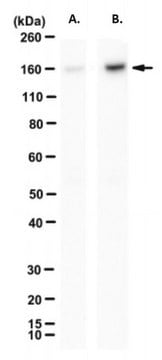
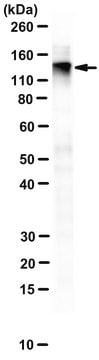
calculated mol wt 141.54 kDa, observed mol wt ~160 kDa

species reactivity

human

species reactivity (predicted by homology)

bovine, monkey

packaging

antibody small pack of 100 μg

technique(s)

immunofluorescence: suitable, western blot: suitable

isotype

IgG

shipped in

dry ice

storage temp.

2-8°C

target post-translational modification

acetylation (Lys105/Lys106)

General description

Structural maintenance of chromosomes protein 3 (UniProt: Q9UQE7; also known as SMC protein 3, SMC-3, Basement membrane-associated chondroitin proteoglycan, Bamacan, Chondroitin sulfate proteoglycan 6, Chromosome-associated polypeptide, hCAP) is encoded by the SMC3 (also known as BAM, BMH, CSPG6, SMC3L1) gene (Gene ID: 9126) in human. SMC-3 is a central component of cohesion, a complex required for chromosome cohesion during the cell cycle. Cohesin complexes are composed of the SMC1 and SMC3 heterodimer attached via their SMC hinge domain, RAD21 which link them, and a STAG protein, which interacts with RAD21. Human SMC3 is reported to be acetylated by ESCO1 and ESCO2. Acetylation of SMC3 at lysine 105 and 106 by ESCO1 is important for genomic stability and S phase sister chromatid cohesion. ESCO1 is reported to require precocious dissociation of sisters protein 5 (Pds5), a cohesion regulatory subunit bound to RAD21, to acetylate SMC3 and stabilize chromatin. However, ESCO2 function is not affected by Pds5. Although total SMC3 levels remain stable during cell cycle, acetylated SMC3 declines rapidly during mitosis. The deacetylation of SMC3 is brought about by HDAC8 following anaphase stage. This is important for recycling of cohesin and enables its reloading in interphase for both mitotic and non-mitotic functions. (Ref.: Dasgupta, T., et al. (2016). J. Biol. Chem. 291(24); 12761-12770; Deardorff, MA., et al. (2012). Nature. 489(7415); 313-317; Minamino, M., et al. (2015). Curr. Biol. 25(13); 1694-1706).

Immunogen

KLH-conjugated linear peptide corresponding to 19 amino acids surrounding acetylated lysine 105 and 106 from the N-terminal region of human Structural maintenance of chromosomes protein 3 (SMC3).

Application

Quality Control Testingvaluated by Western Blotting in HeLa S3 cells treated with Esco1 and Esco2.Western Blotting Analysis: A 1:1,000 dilution of this antibody detected acetyl SMC3 (Lys105/106) in HeLa S3 cells treated with with Esco1 and Esco2, but not in cells treated with siRNA oligos.Tested ApplicationsWestern Blotting Analysis: A representative lot detected acetyl SMC3 (Lys105/106) in Western Blotting applications (Nishiyama, T., et. al. (2010). Cell. 143(5):737-49; Deardorff, M.A., et. al. (2012). Nature. 489(7415):313-7; Minamino, M., et. al. (2015). Curr Biol. 25(13):1694-706; Dasgupta, T., et. al. (2016). J Biol Chem. 291(24):12761-70; Srinivasan, M., et. al. (2018). Cell. 173(6):1508-1519).Immunofluorescence Analysis: A representative lot detected acetyl SMC3 (Lys105/106) in Immunofluorescence applications (Dasgupta, T., et. al. (2016). J Biol Chem. 291(24):12761-70).ChIP-seq Analysis: A representative lot detected acetyl SMC3 (Lys105/106) in ChIP-seq applications (Srinivasan, M., et. al. (2018). Cell. 173(6):1508-1519; Hill, L., et. al. (2020). Nature. 584(7819):142-147).Note: Actual optimal working dilutions must be determined by end user as specimens, and experimental conditions may vary with the end user
Anti-acetyl SMC3 (Lys105/106), clone 209f/A7, Cat. No. MABE1925, is a mouse monoclonal antibody that detects acetylated Structural maintenance of chromosomes protein 3 (SMC3) and is tested for use in ChIP-seq, Immunofluorescence, and Western Blotting.

Biochem/physiol Actions

Clone 209f/A7 is a mouse monoclonal antibody that specifically targets Structural maintenance of chromosomes protein 3 (SMC3). It targets acetylated Lysines 105 and 106.

Physical form

Purified mouse monoclonal antibody IgG1 in buffer containing 0.1 M Tris-Glycine (pH 7.4), 150 mM NaCl with 0.05% sodium azide.

Preparation Note

Stable for 1 year at +2°C to +8°C from date of receipt.

Other Notes

Concentration: Please refer to the Certificate of Analysis for the lot-specific concentration.

Disclaimer

Unless otherwise stated in our catalog or other company documentation accompanying the product(s), our products are intended for research use only and are not to be used for any other purpose, which includes but is not limited to, unauthorized commercial uses, in vitro diagnostic uses, ex vivo or in vivo therapeutic uses or any type of consumption or application to humans or animals.

Non trovi il prodotto giusto?  

Prova il nostro Motore di ricerca dei prodotti.

Classe di stoccaggio

12 - Non Combustible Liquids

wgk

WGK 1

flash_point_f

Not applicable

flash_point_c

Not applicable


Certificati d'analisi (COA)

Cerca il Certificati d'analisi (COA) digitando il numero di lotto/batch corrispondente. I numeri di lotto o di batch sono stampati sull'etichetta dei prodotti dopo la parola ‘Lotto’ o ‘Batch’.

Possiedi già questo prodotto?

I documenti relativi ai prodotti acquistati recentemente sono disponibili nell’Archivio dei documenti.

Visita l’Archivio dei documenti

Numero articolo commerciale globale

SKUGTIN
MABE1925-100UG04065266020687
MABE1925-25UG04065266020694

Il team dei nostri ricercatori vanta grande esperienza in tutte le aree della ricerca quali Life Science, scienza dei materiali, sintesi chimica, cromatografia, discipline analitiche, ecc..

Contatta l'Assistenza Tecnica