


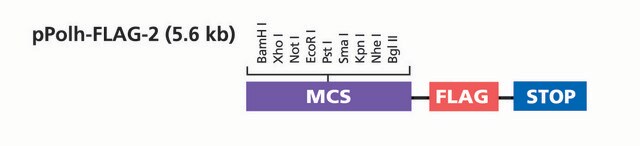
The actual yield of purified FLAG-tagged protein from a 10 cm dish using the CELLMM2 kit will depend on the expression level of the protein in the cells. The kit’s resin can bind up to 600–1000 µg per 1 mL, but typical yields from mammalian cells are often in the 100–500 µg range per dish. For precise yield, measuring the protein concentration in the lysate before and after purification is recommended.
CELLMM2

FLAG® M Purification Kit
For Mammalian expression systems.
Synonym(s):
Anti-ddddk, Anti-dykddddk
Sign In to View Organizational & Contract Pricing.
Select a Size
Pricing and availability is not currently available.
About This Item
NACRES:
NA.32
UNSPSC Code:
12352200
Skip To
1 of 4
This Item | TP0010 | FLAGIPT1 | E6155 |
|---|---|---|---|
| technique(s) protein extraction: suitable | technique(s) - | technique(s) immunoprecipitation (IP): suitable | technique(s) - |
| shipped in wet ice | shipped in - | shipped in wet ice | shipped in dry ice |
| storage temp. −20°C | storage temp. 2-8°C | storage temp. −20°C | storage temp. −20°C |
| Quality Level 200 | Quality Level 200 | Quality Level 300 | Quality Level 200 |
Application
The FLAG Purification Kit utilizes CelLytic™ Reagents for rapid and efficient cell lysis and protein extraction and ANTI-FLAG® M2 affinity gel for affinity purification of active FLAG fusion proteins.
Learn more product details in our FLAG® application portal.
Learn more product details in our FLAG® application portal.
Features and Benefits
- Includes ready to use reagents, columns, and a detailed protocol for affinity purification of FLAG fusion proteins.
- ANTI-FLAG M2 Affinity Gel allows efficient binding of FLAG fusion proteins without the need for preliminary steps and calibrations.
- Two alternatives for efficient elution conditions (by acidic conditions or by competition with FLAG peptide).
Packaging
Sufficient for 3-5 uses of 1-ml affinity purification column.
Other Notes
Kit contains CelLytic™ M for cell lysis and protein extraction from Mammalian cells.
Legal Information
ANTI-FLAG is a registered trademark of Merck KGaA, Darmstadt, Germany
CelLytic is a trademark of Sigma-Aldrich Co. LLC
FLAG is a registered trademark of Merck KGaA, Darmstadt, Germany
Kit Components Also Available Separately
Product No.
Description
SDS
- C2978CelLytic™ M, Cell Lysis Reagent, Suitable for Mammalian cell lysis and protein solubilization.
- SAE0194Purified 3xFLAG® peptide, ≥95% (HPLC), lyophilized powder
- A2220ANTI-FLAG® M2 Affinity Gel, purified immunoglobulin, buffered aqueous glycerol solution
- C2103Chromatography columns, general-purpose, volume 10 mL, Overall H 5 in.
Storage Class
10 - Combustible liquids
Choose from one of the most recent versions:
Already Own This Product?
Find documentation for the products that you have recently purchased in the Document Library.
Amitava Mukherjee et al.
PLoS pathogens, 7(3), e1001311-e1001311 (2011-03-26)
The host innate immune response to viral infections often involves the activation of parallel pattern recognition receptor (PRR) pathways that converge on the induction of type I interferons (IFNs). Several viruses have evolved sophisticated mechanisms to attenuate antiviral host signaling
Severa Bunda et al.
Proceedings of the National Academy of Sciences of the United States of America, 111(36), E3785-E3794 (2014-08-27)
Mutations in Ras GTPase and various other components of the Ras signaling pathways are among the most common genetic alterations in human cancers and also have been identified in several familial developmental syndromes. Over the past few decades it has
Erik G Puffenberger et al.
PloS one, 7(1), e28936-e28936 (2012-01-27)
The Clinic for Special Children (CSC) has integrated biochemical and molecular methods into a rural pediatric practice serving Old Order Amish and Mennonite (Plain) children. Among the Plain people, we have used single nucleotide polymorphism (SNP) microarrays to genetically map
M D Mostaqul Huq et al.
Molecular & cellular proteomics : MCP, 6(4), 677-688 (2007-01-09)
Retinoic acid receptors (RARs) belong to the nuclear receptor superfamily. The mechanism of ligand-dependent activation of RARs is well known. The effect of protein phosphorylation on the activity of RARs has also been demonstrated. However, it is unclear whether other
Takeshi Into et al.
Molecular and cellular biology, 28(4), 1338-1347 (2007-12-19)
Nitric oxide (NO) has been thought to regulate the immune system through S nitrosylation of the transcriptional factor NF-kappaB. However, regulatory effects of NO on innate immune responses are unclear. Here, we report that NO has a capability to control
Related Content
-
What is the approximate yield of protein (in ug) if you start with a one 10 cm dish?
1 answer-
Helpful?
-
Active Filters
Our team of scientists has experience in all areas of research including Life Science, Material Science, Chemical Synthesis, Chromatography, Analytical and many others.
Contact Technical Service