Skip to Content
Merck

Skip To

13264

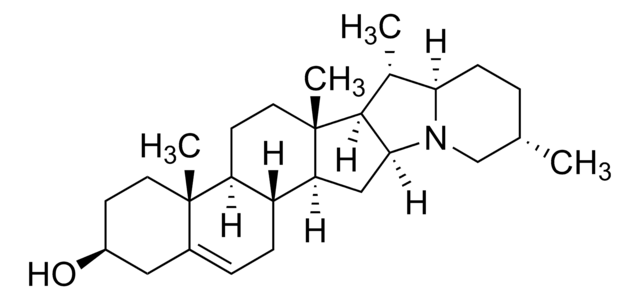
Solanidine

≥97.0% (HPLC)

Synonym(s):

(3β)-Solanid-5-en-3-ol, Solatubine

Sign In to View Organizational & Contract Pricing.

Select a Size

Change View
Pack SizeSKUAvailabilityPrice

About This Item

Empirical Formula (Hill Notation):
C27H43NO
CAS Number:
Molecular Weight:
397.64
NACRES:
NA.25
PubChem Substance ID:
UNSPSC Code:
12352201
EC Number:
201-309-5
MDL number:
Pricing and availability is not currently available.
Technical Service
Need help? Our team of experienced scientists is here for you.
Let Us Assist


Quality Level

assay

≥97.0% (HPLC)

form

powder or crystals

technique(s)

HPLC: suitable

storage temp.

room temp

SMILES string

C[C@H]1CC[C@@H]2[C@@H](C)[C@H]3[C@H](C[C@H]4[C@@H]5CC=C6C[C@@H](O)CC[C@]6(C)[C@H]5CC[C@]34C)N2C1

InChI

1S/C27H43NO/c1-16-5-8-23-17(2)25-24(28(23)15-16)14-22-20-7-6-18-13-19(29)9-11-26(18,3)21(20)10-12-27(22,25)4/h6,16-17,19-25,29H,5,7-15H2,1-4H3/t16-,17+,19-,20+,21-,22-,23+,24-,25-,26-,27-/m0/s1

InChI key

JVKYZPBMZPJNAJ-OQFNDJACSA-N

Biochem/physiol Actions

A poisonous steroid alkaloid derived from cholesterol and L-Arginine that is present in plants of the Solanaceae family. Solanidine is an inhibitor of serum cholinesterases in humans.

Packaging

Bottomless glass bottle. Contents are inside inserted fused cone.

Compare Similar Items

View Full Comparison

Show Differences

1 of 1

This Item
SML1141PHL85774PHL80004
assay

≥97.0% (HPLC)

assay

≥95% (HPLC)

assay

≥97.0% (HPLC)

assay

≥98.0% (HPLC)

technique(s)

HPLC: suitable

technique(s)

-

technique(s)

-

technique(s)

-

Quality Level

100

Quality Level

100

Quality Level

-

Quality Level

-

form

powder or crystals

form

powder

form

solid

form

-

storage temp.

room temp

storage temp.

2-8°C

storage temp.

-

storage temp.

-


Still not finding the right product?

Explore all of our products under Solanidine


pictograms

Health hazardExclamation mark

signalword

Warning

Hazard Classifications

Acute Tox. 4 Oral - Aquatic Chronic 4 - Repr. 2

Storage Class

11 - Combustible Solids

wgk

WGK 3


Choose from one of the most recent versions:

Certificates of Analysis (COA)

Lot/Batch Number

Don't see the Right Version?

If you require a particular version, you can look up a specific certificate by the Lot or Batch number.

Already Own This Product?

Find documentation for the products that you have recently purchased in the Document Library.

Visit the Document Library


Nobuyuki Kozukue et al.
Journal of agricultural and food chemistry, 56(24), 11920-11928 (2008-12-05)
Steroidal glycoalkaloids are naturally occurring, secondary plant metabolites that are found in foods, including potatoes and tomatoes. Their content in plants is controlled by both genetic and environmental factors. Glycoalkaloid profiles can be passed to progenies during breeding and hybridization
M Friedman et al.
Food and chemical toxicology : an international journal published for the British Industrial Biological Research Association, 30(8), 689-694 (1992-08-01)
To assess whether reported toxicities of potato-derived glycoalkaloids could be the result of interactions with cellular DNA, the genotoxic effects of alpha-solanine, alpha-chaconine and solanidine were studied, using the Ames test (Salmonella strains TA98 and TA100), the mouse peripheral blood
J Laurila et al.
Journal of agricultural and food chemistry, 47(7), 2738-2742 (1999-12-20)
A combined derivatization method for gas chromatographic/mass spectrometric (GC/MS) analysis of steroidal glycoalkaloid (SGA) aglycons was developed using both trimethylsilylation and pentafluoropropionylation. In comparison with underivatized or only silylated aglycons, the new technique produces more specific and abundant fragmentation for


Global Trade Item Number

SKUGTIN
13264-1MG04061838729095
13264-5MG04061833045503

Questions

Reviews

No rating value

Active Filters