Skip to Content
Merck

Skip To

MABE342

Anti-Puromycin Antibody, clone 4G11

clone 4G11, from mouse

Sign In to View Organizational & Contract Pricing.

Select a Size

Change View
Pack SizeSKUAvailabilityPrice

About This Item

UNSPSC Code:
12352203
NACRES:
NA.41
eCl@ss:
32160702
Clone:
4G11, monoclonal
Species reactivity:
human
Application:
FACS, ICC, IF, WB
Citations:
21
Pricing and availability is not currently available.
Technical Service
Need help? Our team of experienced scientists is here for you.
Let Us Assist


biological source

mouse

Quality Level

antibody form

purified immunoglobulin

antibody product type

primary antibodies

clone

4G11, monoclonal

species reactivity

human

species reactivity (predicted by homology)

all

technique(s)

flow cytometry: suitable, immunocytochemistry: suitable, immunofluorescence: suitable, western blot: suitable

isotype

IgG1κ

shipped in

wet ice

target post-translational modification

unmodified

Gene Information

human ... NPEPPS(9520)

General description

Puromycin is an aminonucleoside antibiotic, derived from the Streptomyces alboniger bacterium, that functions as a protein synthesis inhibitor that blocks translation through premature chain termination in the ribosome. Monoclonal antibodies to puromycin may be used with standard immunochemical methods to directly monitor translation, a method known as surface sensing of translation (SUnSET). Part of the molecule resembles the 3′ end of the aminoacylated tRNA, making it useful for protein translation analysis. Puromycin induces DNA fragmentation in thymocytes and in human HL-60 leukemia cells.
Puromycin is incorporated in neosynthesized proteins. In the presense of Puromycin only, this antibody detects Puromycin-incorporated neosynthesized proteins at multiple molecular weights. However, a decrease in signal is observed in the co-presense of Cycloheximide, an inhibitor of protein biosynthesis in eukaryotic organisms.

Application

Anti-Puromycin antibody, clone 4G11 detects puromycin incorporated into protein. Monoclonal antibodies to puromycin may also be used with standard immunochemical methods.
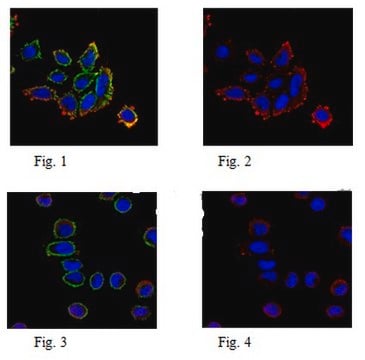
Immunocytochemistry Analysis: A 1:2,000 dilution from a representative lot detected Puromycin-incorporated neosynthesized proteins in HeLa cells treated with Puromycin. However, a decrease in signal is observed with the addition of Cycloheximide, an inhibitor of protein biosynthesis in eukaryotic organisms.

Western Blotting Analysis: A representative lot from an independent laboratory detected Puromycin-incorporated neosynthesized proteins in WB (David, A., et al. (2012). J Cell Biol. 197(1):45-57.; Schmidt, E., K., et al. (2009). Nat Methods. 6(4):275-277.).

Immunofluorescence Analysis: A representative lot from an independent laboratory detected Puromycin-incorporated neosynthesized proteins in IF (David, A., et al. (2012). J Cell Biol. 197(1):45-57.; Schmidt, E., K., et al. (2009). Nat Methods. 6(4):275-277.).

Fluorescence Activated Cell Sorting Analysis: A representative lot from an independent laboratory detected Puromycin-incorporated neosynthesized proteins in FACS (David, A., et al. (2012). J Cell Biol. 197(1):45-57.; Schmidt, E., K., et al. (2009). Nat Methods. 6(4):275-277.).

Alexa Fluor is a registered trademark of Life Technologies.

Biochem/physiol Actions

Demonstrated to react with Human test sample, preincubated with Puromycin. Predicted to react with all species when test sample is incubated with Puromycin.

Physical form

Format: Purified

Analysis Note

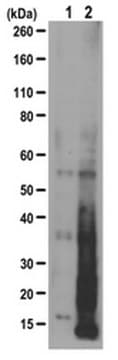
Evaluated by Western Blotting in HEK293 cell lysates treated with Puromycin and Cyclohexamide, or with Puromycin only.

Western Blotting Analysis: A 1:12,500 dilution of this antibody detected Puromycin-incorporated neosynthesized proteins in HEK293 cell lysates treated with Puromycin only. This antibody also detected small mounts of puromycin in HEK293 cells treated with Puromycin and Cyclohexamide.

Legal Information

ALEXA FLUOR is a trademark of Life Technologies

Compare Similar Items

View Full Comparison

Show Differences

1 of 1

This Item
MABE341AB3258MABC1800
biological source

mouse

biological source

rat

biological source

goat

biological source

mouse

antibody form

purified immunoglobulin

antibody form

purified antibody

antibody form

purified immunoglobulin

antibody form

purified antibody

Gene Information

human ... NPEPPS(9520)

Gene Information

human ... NPEPPS(9520)

Gene Information

human ... NPEPPS(9520)

Gene Information

human ... EZHIP(340602)

clone

4G11, monoclonal

clone

17H1, monoclonal

clone

polyclonal

clone

1G11, monoclonal

species reactivity

human

species reactivity

human

species reactivity

rat, mouse

species reactivity

human

isotype

IgG1κ

isotype

IgG2aκ

isotype

-

isotype

IgG2aκ


Still not finding the right product?

Try our Product Selector Tool to narrow your options


Storage Class

12 - Non Combustible Liquids

wgk

WGK 1

flash_point_f

Not applicable

flash_point_c

Not applicable


Certificates of Analysis (COA)

Search for Certificates of Analysis (COA) by entering the products Lot/Batch Number. Lot and Batch Numbers can be found on a product’s label following the words ‘Lot’ or ‘Batch’.

Already Own This Product?

Find documentation for the products that you have recently purchased in the Document Library.

Visit the Document Library


J Max Michel et al.
Experimental physiology, 108(10), 1268-1281 (2023-08-17)
We recently reported that vastus lateralis (VL) cross-sectional area (CSA) increases after 7 weeks of resistance training (RT, 2 days/week), with declines occurring following 7 weeks of subsequent treadmill high-intensity interval training (HIIT) (3 days/week). Herein, we examined the effects of this training paradigm
Paul A Roberson et al.
Frontiers in nutrition, 7, 628405-628405 (2021-02-02)
Introduction: Amino acid transporters are essential for cellular amino acid transport and promoting protein synthesis. While previous literature has demonstrated the association of amino acid transporters and protein synthesis following acute resistance exercise and amino acid supplementation, the chronic effect
Lei Yue et al.
PLoS pathogens, 17(8), e1009838-e1009838 (2021-08-10)
Through evolution, Hepatitis B Virus (HBV) developed highly intricate mechanisms exploiting host resources for its multiplication within a constrained genetic coding capacity. Yet a clear picture of viral hitchhiking of cellular processes with spatial resolution is still largely unsolved. Here


Global Trade Item Number

SKUGTIN
MABE34204053252909221

Questions

Reviews

No rating value

Active Filters