Accéder au contenu
Merck

Passer à

MABS1981

Anti-TfR2 Antibody, clone 9F8-1C11

clone 9F8 1C11, from mouse

Synonyme(s) :

Transferrin receptor protein 2

Se connecter pour consulter les tarifs organisationnels et contractuels.

Sélectionner une taille de conditionnement

Changer de vue
À vous/RéférenceDisponibilitéPrix

A propos de cet article

UNSPSC Code:
12352203
NACRES:
NA.43
eCl@ss:
32160702
Conjugate:
unconjugated
Clone:
9F8 1C11, monoclonal
Application:
ICC, IP, WB
Citations:
-
Le tarif et la disponibilité ne sont pas disponibles actuellement.
Service technique
Besoin d'aide ? Notre équipe de scientifiques expérimentés est là pour vous.
Laissez-nous vous aider


biological source

mouse

Quality Segment

conjugate

unconjugated

antibody form

purified immunoglobulin

antibody product type

primary antibodies

clone

9F8 1C11, monoclonal

species reactivity

human

technique(s)

immunocytochemistry: suitable, immunoprecipitation (IP): suitable, western blot: suitable

isotype

IgG1κ

NCBI accession no.

UniProt accession no.

shipped in

ambient

target post-translational modification

unmodified

Gene Information

human ... TFR2(7036)

General description

Transferrin receptor protein 2 (UniProt: Q9UP52; also known as TfR2) is encoded by the TFR2 gene (Gene ID: 70360 in human. TfR2 is a single-pass type II membrane glycoprotein that plays a critical role in iron metabolism. It has a large C-terminal ectodomain and a small N-terminal cytoplasmic domain and shares 45% amino acid sequence with extracellular region of transferrin receptor (TfR). This homodimeric membrane receptor binds 2 molecules of transferrin and is internalized into endosomes that are acidified, resulting in the release of iron from transferrin. TfR2 contains a cytoplasmic internalization motif similar to TfR, and has 2 cysteines, which form inter subunit disulfide bonds, in the ectodomain proximal to the transmembrane domain. TfR2 mediates cellular uptake of transferrin-bound iron in a non-iron dependent manner. Both TfR and TfR2 bind diferric transferrin better than apo-transferrin at neutral pH. However, TFR2 displays about 25-fold lower affinity for transferrin compared to TfR and its expression is not controlled by cellular levels of iron. TfR2 is also suggested to be involved in involved in hepatocyte function and erythrocyte differentiation. Mutations in TFR2 gene are known to cause hemochromatosis 3 that is characterized by an iron overload where excess iron is deposited in several organs leading to organ failure. (Ref.: Kawabata H., et al (1999). J. Biol. Chem. 274 (30): 20826-20832; Vogt, TM et al. (2003). Blood 101(5):2008-2014.
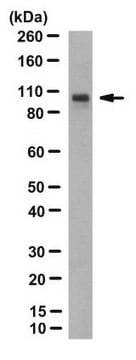
~108 kDa observed; 88.76 kDa calculated. Uncharacterized bands may be observed in some lysate(s).

Immunogen

Epitope: extracellular domain
Purified ectodomains of the human TfR2.

Application

Anti-TfR2, clone 9F8-1C11 Antibody, Cat. No. MABS1981, is a highly specific mouse monoclonal antibody, that targets Tfr2 and has been tested in Western Blotting, Immunoprecipitation, and Immunocytochemistry.
Immunocytochemistry Analysis: A representative lot detected Tfr2 in Immunocytochmeistry applications (Vogt, T.M., et. al. (2003). Blood. 101(5):2008-14; Zhao, N., et. al. (2013). Biochemistry. 52(19):3310-9).

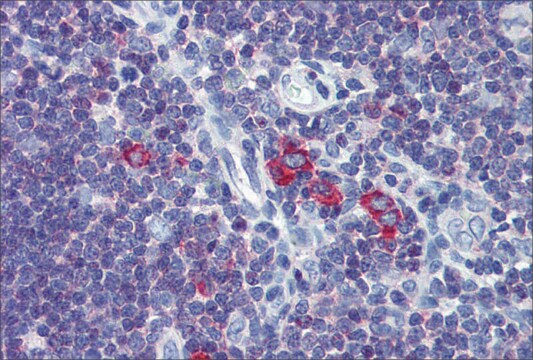
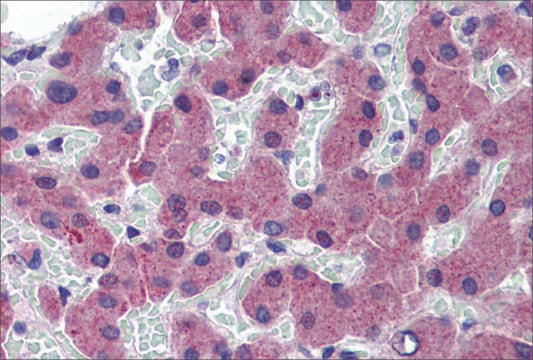
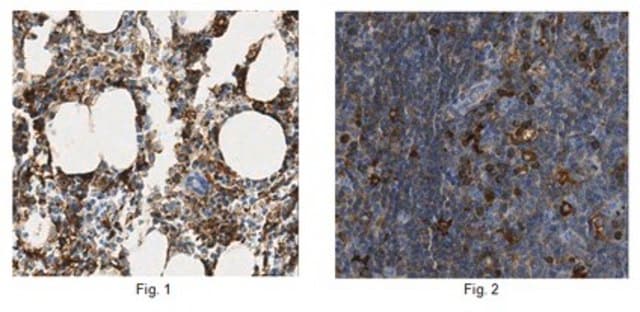
Immunohistochemistry Analysis: A representative lot detected Tfr2 in Immunohistochemistry applications (Vogt, T.M., et. al. (2003). Blood. 101(5):2008-14).

Western Blotting Analysis: A representative lot detected Tfr2 in Western Blotting applications (Vogt, T.M., et. al. (2003). Blood. 101(5):2008-14; Byrne, S.L., et. al. (2013). PLoS One. 8(7):e70199; Zhao, N., et. al. (2013). Biochemistry. 52(19):3310-9).

Immunoprecipitation Analysis: A representative lot detected Tfr2 in Immunoprecipitation applications (Vogt, T.M., et. al. (2003). Blood. 101(5):2008-14; Johnson, M.B., et. al. (2004). Blood. 104(13):4287-93).
Research Category
Epigenetics & Nuclear Function

Biochem/physiol Actions

Clone 9F8-1C11 sprcifically detects human TfR2 and does exhibit reactivity with TfR.

Physical form

Protein G purified
Purified mouse monoclonal antibody IgG1 in buffer containing 0.1 M Tris-Glycine (pH 7.4), 150 mM NaCl with 0.05% sodium azide.
Format: Purified

Preparation Note

Stable for 1 year at 2-8°C from date of receipt.

Analysis Note

Evaluated by Western Blotting in K562 cell lysate.

Western Blotting Analysis: 1 µg/mL of this antibody detected Tfr2 in 10 µg of K562 cell lysaste.

Other Notes

Concentration: Please refer to lot specific datasheet.

Disclaimer

Unless otherwise stated in our catalog or other company documentation accompanying the product(s), our products are intended for research use only and are not to be used for any other purpose, which includes but is not limited to, unauthorized commercial uses, in vitro diagnostic uses, ex vivo or in vivo therapeutic uses or any type of consumption or application to humans or animals.

Comparer avec des articles similaires

Voir la comparaison complète

Montrer les différences

1 of 1

Cet article
SAB2102414SAB2102415MABC602
antibody form

purified immunoglobulin

antibody form

affinity isolated antibody

antibody form

affinity isolated antibody

antibody form

purified immunoglobulin

conjugate

unconjugated

conjugate

unconjugated

conjugate

-

conjugate

unconjugated

species reactivity

human

species reactivity

mouse, human, rabbit, rat

species reactivity

bovine, guinea pig, rabbit, horse, mouse, dog, human, rat

species reactivity

human

biological source

mouse

biological source

-

biological source

-

biological source

mouse

Gene Information

human ... TFR2(7036)

Gene Information

human ... TFR2(7036)

Gene Information

human ... TFR2(7036)

Gene Information

human ... FTH1(2495)

clone

9F8 1C11, monoclonal

clone

polyclonal

clone

polyclonal

clone

1-2.3.1.2, monoclonal


Still not finding the right product?

Essayez notre Outil de sélection de produits pour affiner vos choix.


Classe de stockage

12 - Non Combustible Liquids

wgk

WGK 1

flash_point_f

Not applicable

flash_point_c

Not applicable


Certificats d'analyse (COA)

Recherchez un Certificats d'analyse (COA) en saisissant le numéro de lot du produit. Les numéros de lot figurent sur l'étiquette du produit après les mots "Lot" ou "Batch".

Déjà en possession de ce produit ?

Retrouvez la documentation relative aux produits que vous avez récemment achetés dans la Bibliothèque de documents.

Consulter la Bibliothèque de documents


Questions

Évaluations

Aucune valeur de notation

Filtres actifs