Saltar al contenido
Merck

Saltar a

M4308

Monoclonal Anti-MDM2 antibody produced in mouse

clone SMP14, ascites fluid

Sinónimos:

Anti-ACTFS, Anti-HDMX, Anti-LSKB, Anti-hdm2

Iniciar sesión para ver los precios por organización y contrato.

Seleccione un Tamaño

Cambiar Vistas
A ustedes/SKUDisponibilidadPrecio
100 μL
Póngase en contacto con nuestro Servicio de Atención al Cliente para disponibilidad
493,00 €
0.2 mL
Póngase en contacto con nuestro Servicio de Atención al Cliente para disponibilidad
648,00 €

Acerca de este artículo

UNSPSC Code:
12352203
NACRES:
NA.41
MDL number:
Conjugate:
unconjugated
Clone:
SMP14, monoclonal
Application:
ARR, ELISA (i), ICC, IHC (f), IHC (p), IP, WB
Citations:
21

493,00 €


Póngase en contacto con nuestro Servicio de Atención al Cliente para disponibilidad

Solicite una orden a granel
Servicio técnico
¿Necesita ayuda? Nuestro equipo de científicos experimentados está aquí para ayudarle.
Permítanos ayudarle


biological source

mouse

Quality Segment

conjugate

unconjugated

antibody form

ascites fluid

antibody product type

primary antibodies

clone

SMP14, monoclonal

mol wt

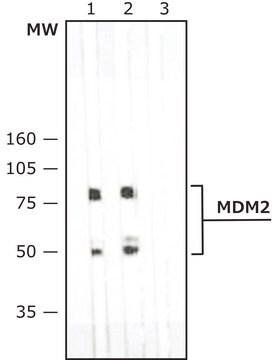
antigen ~90 kDa (additional band of approx. 55 kDa)

contains

15 mM sodium azide

species reactivity

human, rat, mouse (weak)

technique(s)

immunocytochemistry: suitable, immunohistochemistry (formalin-fixed, paraffin-embedded sections): suitable, immunohistochemistry (frozen sections): suitable, immunoprecipitation (IP): suitable, indirect ELISA: suitable, microarray: suitable, western blot: 1:1,000 using a whole extract of transfected 293T (human embryonal kidney) cells expressing human MDM2

isotype

IgG1

UniProt accession no.

shipped in

dry ice

storage temp.

−20°C

target post-translational modification

unmodified

Gene Information

human ... MDM2(4193)
mouse ... Mdm2(17246)
rat ... Mdm2(246362)

General description

Monoclonal Anti-MDM2 (mouse IgG1 isotype) is derived from the SMP14 hybridoma produced by the fusion of mouse myeloma cells and splenocytes from a BALB/c mouse. The murine double minute (mdm2), an E3 ubiquitin ligase comprises an N-terminal p53 domain. The C-terminal domain encompasses the really interesting new gene (RING) domain, nuclear localization signal (NLS), nucleolar localization signal (NoLS) and a nuclear export signal (NES). MDM2 is mapped to the human chromosome 12q15. It is expressed as different splice variants.

Immunogen

synthetic peptide corresponding to amino acids 154-167 of human MDM2 conjugated to KLH.

Application

Monoclonal Anti-MDM2 antibody produced in mouse has been used in:
  • immunoblotting[1]
  • immunoprecipitation (1 μg/ml)
  • fluorescence-activated cell sorting (FACS)
  • immunofluorescence (1:200)[2]
  • immunohistochemistry[3]
  • confocal immunofluorescence[4]
  • immunocytochemistry
  • enzyme-linked immunosorbent assay (ELISA)

Biochem/physiol Actions

Detects the MDM2 protein alone or in complex with E2F1, p53, and retinoblastoma proteins. A slight cross-reactivity is observed with cytokeratins 6, 14, and 16.
Murine double minute (mdm2) mediates the transactivation of the tumor suppressor p53. MDM2 binds to the histone acetyltransferase p300 transcriptional coactivator/histone acetylase to mediate the degradation of p53. The nuclear localization signal of MDM2 mediates its shuttling from the nucleus to the cytoplasm and mediates p53 degradation. In addition to its relationships with p53, MDM2 activates cell proliferation by stimulating the S-phase-inducing transcription factors, E2F1/dimerization partner 1 (DP1). The amplification of the MDM2 gene is detected in the esophagogastric, liver, colon, breast and lung carcinomas. A disturbance in the optimal levels of the MDM2/p53 axis may have an impact on premature aging. Monoclonal antibody reacting specifically with MDM2 is an essential tool in defining the interactions and distributions of MDM2, its function in signaling pathways and mutual regulation of p53.

Physical form

Monoclonal Anti-MDM2 is supplied as ascites fluid containing 15 mM sodium azide.

Preparation Note

For continuous use, store at 2-8 °C for up to one month. For extended storage, freeze in working aliquots. Repeated freezing and thawing is not recommended. Storage in "frost-free" freezers is not recommended. If slight turbidity occurs upon prolonged storage, clarify the solution by centrifugation before use. Working dilution samples should be discarded if not used within 12 hours.

Disclaimer

Unless otherwise stated in our catalog or other company documentation accompanying the product(s), our products are intended for research use only and are not to be used for any other purpose, which includes but is not limited to, unauthorized commercial uses, in vitro diagnostic uses, ex vivo or in vivo therapeutic uses or any type of consumption or application to humans or animals.

Comparar elementos similares

Ver comparación completa

Mostrar Diferencias

1 of 1

Este artículo
M8558SAB1404968SAB1401358
clone

SMP14, monoclonal

clone

MD-219, monoclonal

clone

1C8, monoclonal

clone

1B2, monoclonal

antibody form

ascites fluid

antibody form

purified immunoglobulin

antibody form

purified immunoglobulin

antibody form

purified immunoglobulin

conjugate

unconjugated

conjugate

unconjugated

conjugate

unconjugated

conjugate

unconjugated

biological source

mouse

biological source

mouse

biological source

mouse

biological source

mouse

species reactivity

human, rat, mouse (weak)

species reactivity

mouse

species reactivity

human

species reactivity

human

Gene Information

human ... MDM2(4193)
mouse ... Mdm2(17246)
rat ... Mdm2(246362)

Gene Information

mouse ... Mdm2(17246)

Gene Information

human ... PUM2(23369)

Gene Information

human ... SDC2(6383)


Still not finding the right product?

o

Pruebe nuestra Herramienta de selección de productos para limitar sus opciones


Clase de almacenamiento

10 - Combustible liquids

wgk

nwg

flash_point_f

Not applicable

flash_point_c

Not applicable


Elija entre una de las versiones más recientes:

Certificados de análisis (COA)

Lot/Batch Number

It looks like we've run into a problem, but you can still download Certificates of Analysis from our Documentos section.

Si necesita más asistencia, póngase en contacto con Atención al cliente

¿Ya tiene este producto?

Encuentre la documentación para los productos que ha comprado recientemente en la Biblioteca de documentos.

Visite la Librería de documentos


Preguntas

Revisiones

Sin puntuación

Filtros activos