Saltar al contenido
Merck

C199

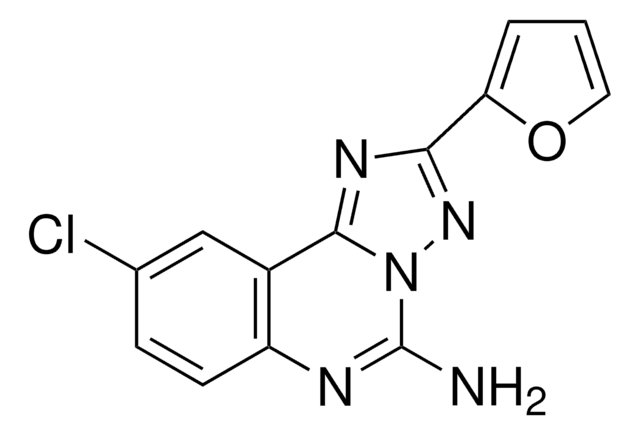
CGS-15943

≥98% (HPLC), Adenosine receptor antagonist, solid

Sinónimos:

9-Chloro-2-(2-furanyl)-[1,2,4]triazolo[1,5-c]quinazolin-5-amine

Iniciar sesión para ver los precios por organización y contrato.

Seleccione un Tamaño

En este momento no podemos mostrarle ni los precios ni la disponibilidad

Acerca de este artículo

Fórmula empírica (notación de Hill):
C13H8ClN5O
Número CAS:
Peso molecular:
285.69
UNSPSC Code:
12352202
PubChem Substance ID:
NACRES:
NA.77
MDL number:
Assay:
≥98% (HPLC)
Form:
solid
Quality level:

Saltar a

Servicio técnico
¿Necesita ayuda? Nuestro equipo de científicos experimentados está aquí para ayudarle.
Permítanos ayudarle

Nombre del producto

CGS-15943, solid

assay

≥98% (HPLC)

Quality Level

form

solid

color

white

solubility

DMSO: >10 mg/mL, H2O: insoluble

storage temp.

room temp

SMILES string

Nc1nc2ccc(Cl)cc2c3nc(nn13)-c4ccco4

InChI

1S/C13H8ClN5O/c14-7-3-4-9-8(6-7)12-17-11(10-2-1-5-20-10)18-19(12)13(15)16-9/h1-6H,(H2,15,16)

InChI key

MSJODEOZODDVGW-UHFFFAOYSA-N

Categorías relacionadas

Comparar elementos similares

Ver comparación completa

Mostrar Diferencias

1 of 4

Este artículo
S4568S6451Z0153
assay

≥98% (HPLC)

assay

≥98% (HPLC)

assay

≥98% (HPLC)

assay

≥98% (HPLC)

form

solid

form

solid

form

powder

form

powder

Quality Level

100

Quality Level

100

Quality Level

100

Quality Level

100

storage temp.

room temp

storage temp.

-

storage temp.

2-8°C

storage temp.

room temp

solubility

DMSO: >10 mg/mL, H2O: insoluble

solubility

DMSO: soluble >10 mg/mL, H2O: insoluble

solubility

DMSO: ≥20 mg/mL

solubility

DMSO: >15 mg/mL

color

white

color

off-white

color

light tan to tan

color

white to tan

Application

CGS-15943 has been used as a non-selective adenosine receptor antagonist to study its effects on the proliferation of pancreatic ductal adenocarcinoma (PDAC) cells and hepatocellular carcinoma (HCC)[1]. It has also been used as a non-selective adenosine receptor antagonist to investigate the mechanism underlying adenosine inhibition on cholangiocarcinoma (CCA) cells.[2]

Biochem/physiol Actions

CGS-15943 is a potent and non-selective adenosine receptor antagonist. It exhibits anti-carcinogenic and anti-apoptotic activity.[1]

ppe

Eyeshields, Gloves, type N95 (US)

Clase de almacenamiento

11 - Combustible Solids

wgk

WGK 3

flash_point_f

Not applicable

flash_point_c

Not applicable


Elija entre una de las versiones más recientes:

Certificados de análisis (COA)

Lot/Batch Number

¿No ve la versión correcta?

Si necesita una versión concreta, puede buscar un certificado específico por el número de lote.

¿Ya tiene este producto?

Encuentre la documentación para los productos que ha comprado recientemente en la Biblioteca de documentos.

Visite la Librería de documentos

Elise M Weerts et al.
Psychopharmacology, 168(1-2), 155-163 (2003-04-02)
Caffeine and the adenosine A(1) and A(2A) receptor antagonist CGS15943 produce many behavioral effects that are similar to those produced by classic stimulant drugs (e.g. cocaine and amphetamines). The current study evaluated whether CGS15943 would maintain self-administration and reinstate extinguished
Soo-Kyung Kim et al.
Journal of medicinal chemistry, 46(23), 4847-4859 (2003-10-31)
A three-dimensional model of the human A(2A) adenosine receptor (AR) and its docked ligands was built by homology to rhodopsin and validated with site-directed mutagenesis and the synthesis of chemically complementary agonists. Different binding modes of A(2A)AR antagonists and agonists
J m Li et al.
The Journal of surgical research, 80(2), 357-364 (1999-01-08)
Adenosine is a potent vasodilator of vascular smooth muscle. Endothelium-derived nitric oxide (NO) elicits vasodilation. We have previously reported that adenosine stimulates the production of NO from porcine carotid arterial endothelial cells (PCAEC) via a receptor-mediated mechanism. This study was
Lazaros C Foukas et al.
The Journal of biological chemistry, 277(40), 37124-37130 (2002-07-30)
We investigated the effects of methylxanthines on enzymatic activity of phosphoinositide 3-kinases (PI3Ks). We found that caffeine inhibits the in vitro lipid kinase of class I PI3Ks (IC(50) = 75 microm for p110 delta, 400 microm for p110 alpha and
A C Ngai et al.
American journal of physiology. Heart and circulatory physiology, 280(5), H2329-H2335 (2001-04-12)
The purpose of this study was to investigate the receptor subtypes that mediate the dilation of rat intracerebral arterioles elicited by adenosine. Penetrating arterioles were isolated from the rat brain, cannulated with the use of a micropipette system, and luminally

Número de artículo de comercio global

SKUGTIN
C199-25MG04061833474914

Preguntas

Revisiones

Sin puntuación

Filtros activos

Nuestro equipo de científicos tiene experiencia en todas las áreas de investigación: Ciencias de la vida, Ciencia de los materiales, Síntesis química, Cromatografía, Analítica y muchas otras.

Póngase en contacto con el Servicio técnico