
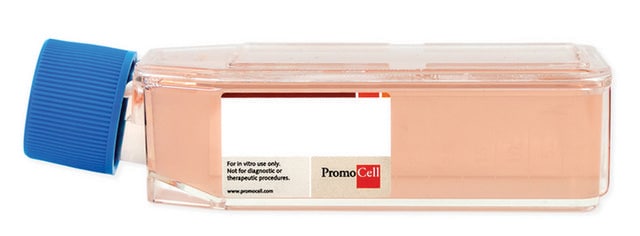

PromoCell’s human pericytes derived from microvessels of the human placenta are cryopreserved at the end of secondary culture (P1) and after thawing are considered P2. The number of populations doublings is not determined for each individual cell lot, however they are guarenteed to be grown for at least 15 population doublings.
C-12981

Human Pericytes from Placenta (hPC-PL)
500,000 proliferating cells
Iniciar sesión para ver los precios por organización y contrato.
Seleccione un Tamaño
Cambiar Vistas
| A ustedes/SKU | Disponibilidad | Precio |
|---|---|---|
1 ea | Póngase en contacto con nuestro Servicio de Atención al Cliente para disponibilidad | 1570,00 € |
Acerca de este artículo
NACRES:
NA.81
UNSPSC Code:
41106514
Biological source:
placenta
Morphology:
( pericytes)
1570,00 €
Póngase en contacto con nuestro Servicio de Atención al Cliente para disponibilidad
Servicio técnico
¿Necesita ayuda? Nuestro equipo de científicos experimentados está aquí para ayudarle.
Permítanos ayudarlebiological source
placenta
packaging
pkg of 500,000 cells
morphology
( pericytes)
technique(s)
cell culture | mammalian: suitable
shipped in
ambient
storage temp.
room temp
General description
Lot specific orders are not able to be placed through the web. Contact your local sales rep for more details.
Application
Human Pericytes are isolated from human placenta tissue and provided in a proliferating format. Pericytes are multipotent mesenchymal-like cells found in association with small blood vessel walls. They are important for angiogenesis, the structural integrity of the microvasculature, and blood flow regulation. However, they can also develop into malignant tumors called hemangiopericytomas. To date, pericytes have demonstrated the ability to differentiate into adipocytes, osteoblasts, fibroblasts, smooth muscle cells, and phagocytes (macrophages).
Biochem/physiol Actions
Placenta
Preparation Note
Click here for more information.
Analysis Note
Rigid quality control tests are performed for each lot of Pericytes. The cells are tested for morphology, adherence rate, and viability. Furthermore, they are characterized by flow cytometric analysis for a comprehensive panel ofmarkers, e.g. CD31, CD34, CD105, and CD146. In addition, all cells have been tested for the absence of HIV-1, HIV-2, HBV, HCV, and microbial contaminants (fungi, bacteria, and mycoplasma).
Other Notes
Recommended Plating Density: 4000 cells per cm2Tested markers: CD146+, CD105+, CD31-, CD34-
Recommended Primary Cell Culture Media:Link
Disclaimer
Although tested negative for HIV-1, HIV-2, HBV, HCV, HTLV-1 and HTLV-2, the cells – like all products of human origin – should be handled as potentially infectious. No test procedure can completely guarantee the absence of infectious agents.
1 of 1
Este artículo | |||
|---|---|---|---|
| biological source placenta | biological source human placenta | biological source human placenta | biological source human lung |
| technique(s) cell culture | mammalian: suitable | technique(s) cell culture | mammalian: suitable | technique(s) - | technique(s) cell culture | mammalian: suitable |
| morphology ( pericytes) | morphology ( pericytes) | morphology (pericyte) | morphology (fibroblast) |
| packaging pkg of 500,000 cells | packaging pkg of 500,000 cells | packaging pkg of 1,000,000 cells | packaging pkg of 500,000 cells |
| storage temp. room temp | storage temp. −196°C | storage temp. −20°C | storage temp. −196°C |
| shipped in ambient | shipped in dry ice | shipped in dry ice | shipped in dry ice |
Still not finding the right product?
Explore all of our products under Human Pericytes from Placenta (hPC-PL)
Clase de almacenamiento
12 - Non Combustible Liquids
wgk
WGK 3
flash_point_f
Not applicable
flash_point_c
Not applicable
Elija entre una de las versiones más recientes:
¿Ya tiene este producto?
Encuentre la documentación para los productos que ha comprado recientemente en la Biblioteca de documentos.
-
How long do pericytes grow in culture?
1 respuesta-
¿Le ha resultado útil?
-
-
How are pericytes isolated?
1 respuesta-
Pericyte isolation generally starts with enzymatic digestion of tissue with Trypsin EDTA, usually followed by the isolation of microvessel fragments via successive filtration steps. Pure pericyte cultures can be obtained through either positive or negative immuno-selection via the use of magnetic beads or flow cytometry using the antibody markers above.
¿Le ha resultado útil?
-
-
What markers are used to characterize pericytes?
1 respuesta-
Pericytes are positive for CD146, PDGFRβ, αSMA, CD13, NG2, Desmin, and negative for CD31, CD34, CD45, and CD56.
¿Le ha resultado útil?
-