Saltar al contenido
Merck

B3170

Monoclonal Anti-Bcl-2 antibody produced in mouse

clone Bcl-2-100, ascites fluid

Sinónimos:

Anti-BCL-2

Iniciar sesión para ver los precios por organización y contrato.

Seleccione un Tamaño

En este momento no podemos mostrarle ni los precios ni la disponibilidad

Acerca de este artículo

UNSPSC Code:
12352203
NACRES:
NA.41
MDL number:
Conjugate:
unconjugated
Clone:
Bcl-2-100, monoclonal
Application:
ARR, EM, ICC, IHC (f), IHC (p), IP, WB
Citations:
41

Saltar a

Servicio técnico
¿Necesita ayuda? Nuestro equipo de científicos experimentados está aquí para ayudarle.
Permítanos ayudarle

biological source

mouse

conjugate

unconjugated

antibody form

ascites fluid

antibody product type

primary antibodies

clone

Bcl-2-100, monoclonal

mol wt

antigen 26 kDa

contains

15 mM sodium azide

species reactivity

human

should not react with

mouse

technique(s)

electron microscopy: suitable, immunocytochemistry: suitable, immunohistochemistry (formalin-fixed, paraffin-embedded sections): suitable, immunohistochemistry (frozen sections): suitable, immunoprecipitation (IP): suitable, microarray: suitable, western blot: 1:1,000 using human HeLa cell extract

isotype

IgG1

UniProt accession no.

shipped in

dry ice

storage temp.

−20°C

target post-translational modification

unmodified

Quality Level

Gene Information

human ... BCL2(596)

¿Está buscando productos similares? Visita Guía de comparación de productos

Comparar elementos similares

Ver comparación completa

Mostrar Diferencias

1 of 4

Este artículo
PRS3335SAB4500005SAB5700676
species reactivity

human

species reactivity

human, mouse

species reactivity

human

species reactivity

human, mouse, rat

Gene Information

human ... BCL2(596)

Gene Information

human ... BCL2(596)

Gene Information

human ... BCL2(596)

Gene Information

human ... BCL2(596)

antibody form

ascites fluid

antibody form

affinity isolated antibody

antibody form

affinity isolated antibody

antibody form

affinity isolated antibody

biological source

mouse

biological source

rabbit

biological source

rabbit

biological source

rabbit

clone

Bcl-2-100, monoclonal

clone

polyclonal

clone

polyclonal

clone

polyclonal

conjugate

unconjugated

conjugate

unconjugated

conjugate

unconjugated

conjugate

-

General description

BCL2 (B-cell lymphoma 2) consists of pro- and antiapoptotic functions. It belongs to BCL2 family of proteins. It is mapped to human chromosome 18q21.3.

Immunogen

synthetic peptide corresponding to residues 41-54 of the Bcl-2 protein, conjugated to thyroglobulin.

Application

Anti-BCL2 (Ab-56) antibody has been used in western blotting and immunocytochemistry.
Applications in which this antibody has been used successfully, and the associated peer-reviewed papers, are given below.
Western Blotting (1 paper)
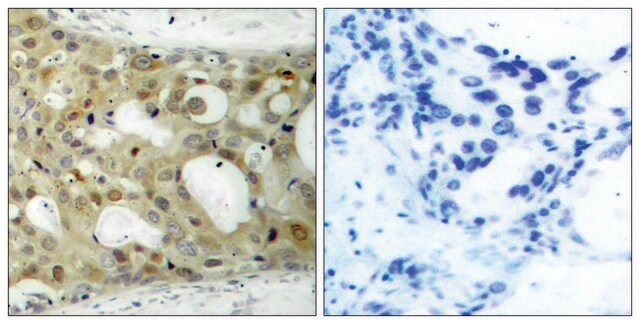
Monoclonal Anti-Bcl-2 antibody produced in mouse is suitable for western blotting at a concentration of 1:1,000 by using human HeLa cell extract. It is also suitable for immunohistochemistry by using formalin-fixed, paraffin-embedded tissue sections or frozen sections. Further, the antibody may be used for the localization of Bcl-2, by implementing numerous assays like- microarray, electron microscopy and immunoprecipitation.

Biochem/physiol Actions

BCL2 (B-cell lymphoma 2) plays an important role in the growth and progression of cancer. Overexpression of BCL2 (B-cell lymphoma 2) results in poor clinical predictions in diffuse large B-cell lymphoma (DLBCL). Bcl2 is highly essential for the survival of kidney and melanocyte stem cells and mature lymphocytes. It may control Bcl2 multiple initiator caspases.
Protooncogene BCL2 encodes a 26 kD integral outer mitochondrial membrane protein expressed in sub-cellular components such as the mitochondria and nucleus. While mitochondrial BCL2 inhibits apoptosis, BCL2 present in the nucleus may activate cell death. It may also regulate autophagy during starvation. Additionally, BCL2 facilitates the survival of central and peripheral neurons grown in culture in the absence of neurotrophic factors.

Disclaimer

Unless otherwise stated in our catalog or other company documentation accompanying the product(s), our products are intended for research use only and are not to be used for any other purpose, which includes but is not limited to, unauthorized commercial uses, in vitro diagnostic uses, ex vivo or in vivo therapeutic uses or any type of consumption or application to humans or animals.

¿No encuentra el producto adecuado?  

Pruebe nuestro Herramienta de selección de productos.

related product

Referencia del producto
Descripción
Precios

Clase de almacenamiento

10 - Combustible liquids

wgk

nwg

flash_point_f

Not applicable

flash_point_c

Not applicable


Elija entre una de las versiones más recientes:

Certificados de análisis (COA)

Lot/Batch Number

¿No ve la versión correcta?

Si necesita una versión concreta, puede buscar un certificado específico por el número de lote.

¿Ya tiene este producto?

Encuentre la documentación para los productos que ha comprado recientemente en la Biblioteca de documentos.

Visite la Librería de documentos

BCL2 expression in DLBCL: reappraisal of immunohistochemistry with new criteria for therapeutic biomarker evaluation
Tsuyama N, et al.
Blood, 130(4), 489-500 (2017)
The protein PprI provides protection against radiation injury in human and mouse cells
Shi Y, et al.
Scientific Reports (2016)
Raquel Vinhas et al.
Molecular therapy. Nucleic acids, 7, 408-416 (2017-06-19)
Introduction of tyrosine kinase inhibitors for chronic myeloid leukemia treatment is associated with a 63% probability of maintaining a complete cytogenetic response, meaning that over 30% patients require an alternative methodology to overcome resistance, tolerance, or side effects. Considering the
BCL2 genotypes and prostate cancer survival
Renner W, et al.
Strahlentherapie und Onkologie : Organ der Deutschen Rontgengesellschaft ... [Et Al], 193(6), 466-471 (2017)
The Bcl2 family: regulators of the cellular life-or-death switch
Cory S and Adams JM
Nature Reviews. Cancer, 2(9), 647-656 (2002)

Artículos

Quantitative and qualitative western blotting to validate knockdown by esiRNA.

Preguntas

Revisiones

Sin puntuación

Filtros activos

Nuestro equipo de científicos tiene experiencia en todas las áreas de investigación: Ciencias de la vida, Ciencia de los materiales, Síntesis química, Cromatografía, Analítica y muchas otras.

Póngase en contacto con el Servicio técnico