

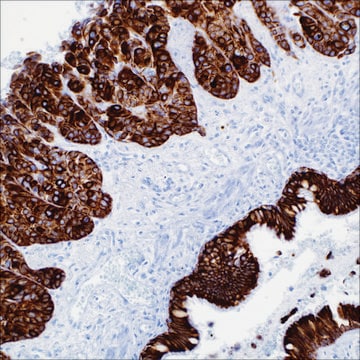
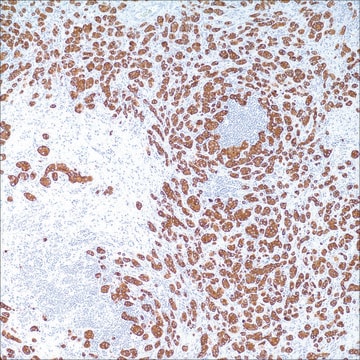

The CAM 5.2 antibody is commonly used for cytokeratins 8 and, to a lesser extent, CK7, but not for cytokeratin 18 or 19 (Am J Clin Pathol 2010;133:514). It specifically targets low molecular weight cytokeratins.
452M-9

Cytokeratin (CAM 5.2) Mouse Monoclonal Antibody
Iniciar sesión para ver los precios por organización y contrato.
Seleccione un Tamaño
Cambiar Vistas
| A ustedes/SKU | Disponibilidad | Precio |
|---|
Acerca de este artículo
NACRES:
NA.41
UNSPSC Code:
12352203
Conjugate:
unconjugated
Clone:
CAM 5.2, monoclonal
Application:
IHC (p)
Citations:
5
En este momento no podemos mostrarle ni los precios ni la disponibilidad
Servicio técnico
¿Necesita ayuda? Nuestro equipo de científicos experimentados está aquí para ayudarle.
Permítanos ayudarlebiological source
mouse
conjugate
unconjugated
antibody form
culture supernatant
antibody product type
primary antibodies
clone
CAM 5.2, monoclonal
description
For In Vitro Diagnostic Use in Select Regions (See Chart)
form
buffered aqueous solution
species reactivity
human
packaging
vial of 0.1 mL concentrate (452M-94), vial of 0.5 mL concentrate (452M-95), bottle of 1.0 mL predilute (452M-97), vial of 1.0 mL concentrate (452M-96), bottle of 7.0 mL predilute (452M-98)
manufacturer/tradename
Cell Marque®
technique(s)
immunohistochemistry (formalin-fixed, paraffin-embedded sections): 1:25-1:100
isotype
IgG2aκ
control
appendix, hepatocellular carcinoma
shipped in
wet ice
storage temp.
2-8°C
visualization
cytoplasmic
General description
Anti-CAM 5.2 is a mouse monoclonal antibody that was generated by using the human colorectal carcinoma cell line HT24. Anti-CAM 5.2 reacts with cytokeratins 7 and 8, which are expressed in simple and glandular epithelia and transitional epithelium. Anti-CAM 5.2 reacts with most normal epithelium and with most carcinomas, including those arising in the lung, liver, pancreas, GI tract, breast, genitourinary system, female reproductive organs, and some endocrine organs.[1] This antibody can be used as an aid to identify epithelial differentiation in normal and neoplastic tissues.
Physical form
Solution in Tris Buffer, pH 7.3-7.7, with 1% BSA and <0.1% Sodium Azide
Preparation Note
Download the IFU specific to your product lot and formatNote: This requires a keycode which can be found on your packaging or product label.
Other Notes
Cytokeratin (CAM 5.2) Positive Control Slides, Product No. 452S, are available for immunohistochemistry (formalin-fixed, paraffin-embedded sections).
For Technical Service please contact: 800-665-7284 or email: [email protected]
Legal Information
Cell Marque is a registered trademark of Merck KGaA, Darmstadt, Germany
1 of 1
Este artículo | |||
|---|---|---|---|
| species reactivity human | species reactivity human | species reactivity human | species reactivity human |
| antibody form culture supernatant | antibody form culture supernatant | antibody form culture supernatant | antibody form culture supernatant |
| conjugate unconjugated | conjugate unconjugated | conjugate unconjugated | conjugate unconjugated |
| clone CAM 5.2, monoclonal | clone OSCAR, monoclonal | clone 35betaH11, monoclonal | clone AE3, monoclonal |
| biological source mouse | biological source mouse | biological source mouse | biological source mouse |
| shipped in wet ice | shipped in wet ice | shipped in wet ice | shipped in wet ice |
Still not finding the right product?
Pruebe nuestra Herramienta de selección de productos para limitar sus opciones
Elija entre una de las versiones más recientes:
¿Ya tiene este producto?
Encuentre la documentación para los productos que ha comprado recientemente en la Biblioteca de documentos.
-
Are there any keratins present in CAM 5.2?
1 respuesta-
¿Le ha resultado útil?
-