Application
Each vial contains ≥1X10⁶ viable cells.Cells are tested negative for infectious diseases by a Mouse Essential CLEAR Panel by Charles River Animal Diagnostic Services.Cells are verified to be of mouse origin and negative for inter-species contamination from rat, human, Chinese hamster, Golden Syrian hamster, and Non-human Primate (NHP) as assessed by a Contamination Clear panel by Charles River Animal Diagnostic ServicesCells are negative for mycoplasma contamination.
Mammary epithelial cell differentiation and reorganization occurs throughout development and in the adult organ during pregnancy and menopause. During these periods in the adult life there is an increased risk for breast cancer, which is the most frequent cancer in women. Breast cancer can be curable when detected at early stages, but it is considered incurable in advance stages with metastasis. The extracellular matrix (ECM) in mammary tissue influences growth and differentiation during development, differentiation, and carcinogenesis (1). Epithelial cells sense ECM modifications through transmembrane receptors like integrins that can influence the expression of malignant phenotypes like increased proliferation and loss of contact inhibition growth (1).The SCp2 cell line was isolated from the heterogenous CID9 cells by limiting dilution cloning (2). CID9 cells were isolated from a midpregnancy mouse mammary gland. SCp2 cells require exogenously added ECM and lactogenic hormones to express b-casein, under these conditions the cells arrest growth, aggregate, and form alveolar structures that express high levels of milk proteins (2). SCp2 cells are useful to study normal and abnormal mammary epithelial cell phenotypes because their growth and differentiation can be controlled in culture. Activated mutants of M-Ras have been introduced in normal SCp2 cells to study transformation, invasion, and tumor formation in vivo (3).SCp2 is a murine mammary epithelial cell line that originated from limiting dilution cloning of heterogenous CID9 cells.1. Int J Biochem Cell Biol 2007, 39(11): 1987-1994.2. Proc Natl Acad Sci USA 1994, 91(26): 12378-12382.3. Oncogene 2004, 23(6): 1187-1196.
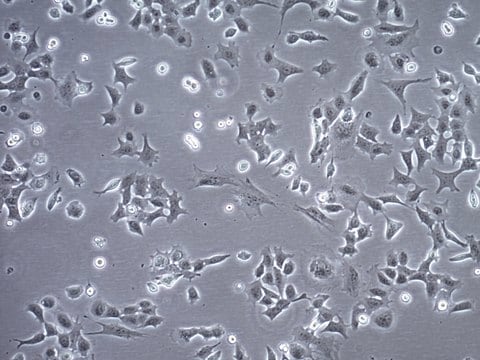
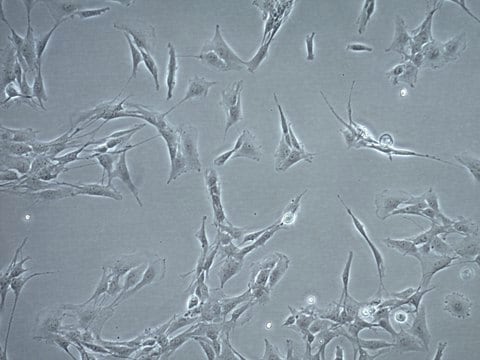
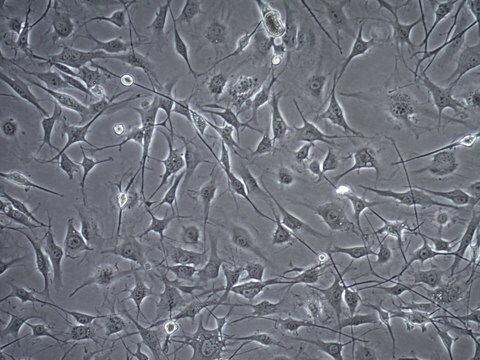
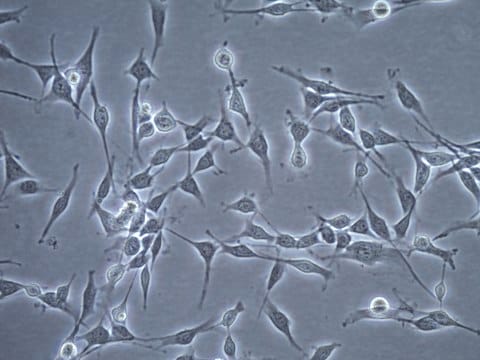
SCp2 Mouse Mammary Epithelial Cell Line originated by limiting dilution cloning from CID9 cells, a heterogeneous cell population derived from a midpregnancy mouse mammary gland. They grow well in the presence of serum and attach to plastic. When serum is removed and lactogenic hormones (Insulin, prolactin, and hydrocortisone) and basement membrane components are added to the culture, the cells arrest growth, aggregate, and form alveolar structures that express high levels of milk proteins. SCp2 cells are useful to study normal and abnormal mammary epithelial cell phenotypes because their growth and differentiation can be controlled in culture. They have also been used to study normal development and function of the mammary gland and then compare their response to that of malignant cell lines. References:1. Desprez, P. Y., et al. (1993). Isolation of functional cell lines from a mouse mammary epithelial cell strain: the importance of basement membrane and cell-cell interaction. Mol. Cell. Differ, 1, 99-110.2. Roskelley, C. D., et al. (1994). Extracellular matrix-dependent tissue-specific gene expression in mammary epithelial cells requires both physical and biochemical signal transduction. Proceedings of the National Academy of Sciences, 91(26), 12378-12382.3. Desprez, P. Y., et al. (1998). A novel pathway for mammary epithelial cell invasion induced by the helix-loop-helix protein Id-1. Molecular and Cellular Biology, 18(8), 4577-4588.
Other Notes
Subject to local law, this product is intended to be sold for internal in vitro research use only subject to terms and conditions found here: www.sigmaaldrich.com/restrictedcelluse. This product may not be: re-engineered or copied; used to make derivatives, modifications or functional equivalents; used to obtain patents or other IP claiming use of the product; used to develop, test, or manufacturer a commercial product; used as a component in a commercial product; resold or licensed; used in any clinical applications or trials; or used in humans. A license or limited commercial use agreement is required for use by any for-profit entity, use in services, and use in sponsored academic research. For information regarding any such use, please contact licensing@milliporesigma.com.
Disclaimer
Unless otherwise stated in our catalog or other company documentation accompanying the product(s), our products are intended for research use only and are not to be used for any other purpose, which includes but is not limited to, unauthorized commercial uses, in vitro diagnostic uses, ex vivo or in vivo therapeutic uses or any type of consumption or application to humans or animals.