
PC176

Anti-Serotonin 2A (5-HT2A) Receptor (22-41) Rabbit pAb
liquid, Calbiochem®
Seleccione un Tamaño
| A ustedes/SKU | Disponibilidad | Precio |
|---|---|---|
100 μL | Póngase en contacto con nuestro Servicio de Atención al Cliente para disponibilidad | 583,00 € |
Acerca de este artículo
583,00 €
biological source
rabbit
Quality Segment
antibody form
affinity isolated antibody
antibody product type
primary antibodies
clone
polyclonal
form
liquid
contains
≤0.1% sodium azide as preservative
species reactivity
mouse, sheep, rat
manufacturer/tradename
Calbiochem®
storage condition
OK to freeze, avoid repeated freeze/thaw cycles
dilution
(Frozen Sections (1:300-1:500)
Immunoblotting (1:500-1:1000)
Free Floating Sections
Paraffin Sections (s; heat pre-treatment required))
isotype
IgG
shipped in
wet ice
storage temp.
−20°C
target post-translational modification
unmodified
Gene Information
rat ... Htr2A(29595)
General description
Immunogen
Application

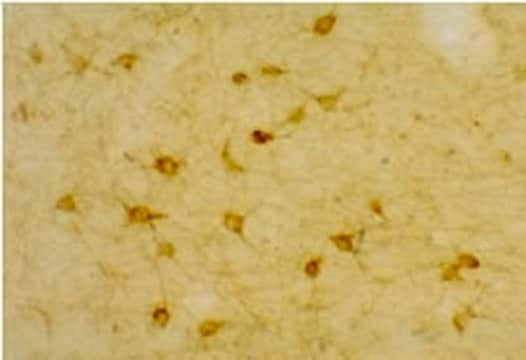
Frozen Sections (1:300-1:500)
Immunoblotting (1:500-1:1000)
Free Floating Sections (see application references)
Paraffin Sections (see application references; heat pre-treatment required)
Physical form
Preparation Note
Other Notes
Teitler, M. and Herrick-Davis, K. 1994. Crit. Rev. Neurobiol.8, 175.
Legal Information
Disclaimer
1 of 1
Este artículo | |||
|---|---|---|---|
| Quality Level 100 | Quality Level 100 | Quality Level 100 | Quality Level - |
| antibody form affinity isolated antibody | antibody form serum | antibody form purified antibody | antibody form serum |
| biological source rabbit | biological source rabbit | biological source rabbit | biological source rabbit |
| species reactivity mouse, sheep, rat | species reactivity human, mouse, rat | species reactivity mouse, human | species reactivity human |
| clone polyclonal | clone polyclonal | clone polyclonal | clone polyclonal |
| form liquid | form lyophilized | form liquid | form liquid |
Still not finding the right product?
Pruebe nuestra Herramienta de selección de productos para limitar sus opciones
Clase de almacenamiento
12 - Non Combustible Liquids
wgk
WGK 2
flash_point_f
Not applicable
flash_point_c
Not applicable
Certificados de análisis (COA)
Busque Certificados de análisis (COA) introduciendo el número de lote del producto. Los números de lote se encuentran en la etiqueta del producto después de las palabras «Lot» o «Batch»
¿Ya tiene este producto?
Encuentre la documentación para los productos que ha comprado recientemente en la Biblioteca de documentos.