Saltar al contenido
Merck

Saltar a

MABC632

Anti-MAP3K5 Antibody, clone 2E4

ascites fluid, clone 2E4, from mouse

Sinónimos:

Mitogen-activated protein kinase kinase kinase 5, Apoptosis signal-regulating kinase 1, ASK-1, MAPK/ERK kinase kinase 5, MEK kinase 5, MEKK 5

Iniciar sesión para ver los precios por organización y contrato.

Seleccione un Tamaño

Cambiar Vistas
A ustedes/SKUDisponibilidadPrecio
100 μL
Póngase en contacto con nuestro Servicio de Atención al Cliente para disponibilidad
340,00 €

Acerca de este artículo

UNSPSC Code:
12352203
NACRES:
NA.41
eCl@ss:
32160702
Conjugate:
unconjugated
Clone:
2E4, monoclonal
Application:
ELISA, FACS, ICC, IHC, WB
Citations:
1

340,00 €


Póngase en contacto con nuestro Servicio de Atención al Cliente para disponibilidad

Solicite una orden a granel
Servicio técnico
¿Necesita ayuda? Nuestro equipo de científicos experimentados está aquí para ayudarle.
Permítanos ayudarle


biological source

mouse

Quality Segment

conjugate

unconjugated

antibody form

ascites fluid

antibody product type

primary antibodies

clone

2E4, monoclonal

species reactivity

human

technique(s)

ELISA: suitable, flow cytometry: suitable, immunocytochemistry: suitable, immunohistochemistry: suitable, western blot: suitable

isotype

IgG1

NCBI accession no.

UniProt accession no.

shipped in

wet ice

target post-translational modification

unmodified

Gene Information

human ... MAP3K5(4217)

General description

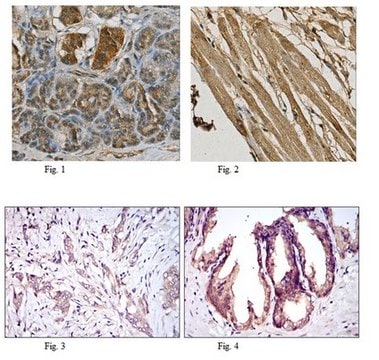
Mitogen-activated protein kinase kinase kinase 5 (MAP3K5), also known as, MAPK/ERK kinase 5 (MEK Kinase 5; MEKK 5) or Apoptosis signal-regulating kinase 1 (ASK-1) protein, is a serine/threonine kinase that is part of the MAP kinase signal transduction pathway. The MAP kinase pathway is central to several signaling cascades the help determine everything from cell fate in differentiation to cell survival in apoptosis. MAP3K5 is critical for innate immune response against numerous pathogens and MAP3K5 also mediates cells responses to various cellular stresses such as oxidative stress, and responses mediated by inflammatory signaling agents such as TNF or LPS. Moreover, MAP3K5 has has been found to be involved in cancer, diabetes, cardiovascular and neurodegenerative diseases. MAP3K5 is membrane associated though not membrane bound directly. Its expression thus is primarily endoplasmic reticulum but can become strongly perinuclear under some conditions. Found in most tissues, it is abundant in heart and pancreas. It′s activity is regulated via phosphorylation-dephosphorylation processes as well as though its interactions with a many other protein partners to form numerous multimolecular cell signaling complexes. EMD-Millipore’s Anti-MAP3K5 mouse monoclonal, clone 2E4, has been tested in western blotting against recombinant human MAP3K5 protein, and in paraffin-embedded immunohistochemistry with human cancer tissues, and in immunofluorescent immunocytochemistry, and flow cytometry on human HeLa cells in culture.
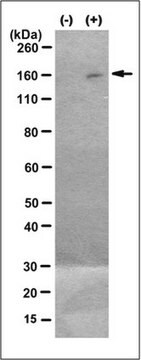
~155 kDa observed. Uncharacterized bands may appear in some lysate(s).

Immunogen

Purified recombinant fragment of human MAP3K5 expressed in E. coli.

Application

Anti-MAP3K5 Antibody, clone 2E4 is a highly specific mouse monoclonal antibody, that targets MAP3K5 & has been tested in western blotting, IHC, ICC, Flow Cytometry & ELISA.
Immunohistochemistry Analysis: A 1:100-1,000 dilution from a representative lot detected MAP3K5 in human pancreas, heart, breast cancer, and prostate tissues.

Immunocytochemistry Analysis: A 1:200-1,000 dilution from a representative lot detected MAP3K5 in HeLa cells.

Flow Cytometry Analysis: A 1:200-400 dilution from a representative lot detected MAP3K5 in HeLa cells.

ELISA: A representative lot detected MAP3K5 in ELISA (Direct).

Optimal working dilutions must be determined by end user
Research Category
Apoptosis & Cancer
Research Sub Category
Apoptosis - Additional

Physical form

Mouse monoclonal IgG2b ascitic fluid containing up to 0.1% sodium azide.
Unpurified

Preparation Note

Stable for 1 year at -20°C from date of receipt.
Handling Recommendations: Upon receipt and prior to removing the cap, centrifuge the vial and gently mix the solution. Aliquot into microcentrifuge tubes and store at -20°C. Avoid repeated freeze/thaw cycles, which may damage IgG and affect product performance.

Analysis Note

Control
HepG2 cell lysate
Evaluated by Western Blotting in HepG2 cell lysate.

Western Blotting Analysis: A 1:1,000 dilution of this antibody detected MAP3K5 in 10 µg of HepG2 cell lysate.

Disclaimer

Unless otherwise stated in our catalog or other company documentation accompanying the product(s), our products are intended for research use only and are not to be used for any other purpose, which includes but is not limited to, unauthorized commercial uses, in vitro diagnostic uses, ex vivo or in vivo therapeutic uses or any type of consumption or application to humans or animals.

Comparar elementos similares

Ver comparación completa

Mostrar Diferencias

1 of 1

Este artículo
MABS494SAB4500223SAB4502413
antibody form

ascites fluid

antibody form

purified antibody

antibody form

affinity isolated antibody

antibody form

affinity isolated antibody

clone

2E4, monoclonal

clone

PA214, monoclonal

clone

polyclonal

clone

polyclonal

species reactivity

human

species reactivity

human, mouse

species reactivity

mouse, human

species reactivity

mouse, human, rat

Gene Information

human ... MAP3K5(4217)

Gene Information

human ... MAP3K5(4217)

Gene Information

human ... MAP3K1(4214)

Gene Information

human ... MAP2K6(5608)

biological source

mouse

biological source

rabbit

biological source

rabbit

biological source

rabbit

conjugate

unconjugated

conjugate

-

conjugate

unconjugated

conjugate

unconjugated


Still not finding the right product?

Pruebe nuestra Herramienta de selección de productos para limitar sus opciones


Clase de almacenamiento

12 - Non Combustible Liquids

wgk

nwg

flash_point_f

Not applicable

flash_point_c

Not applicable


Certificados de análisis (COA)

Busque Certificados de análisis (COA) introduciendo el número de lote del producto. Los números de lote se encuentran en la etiqueta del producto después de las palabras «Lot» o «Batch»

¿Ya tiene este producto?

Encuentre la documentación para los productos que ha comprado recientemente en la Biblioteca de documentos.

Visite la Librería de documentos


Preguntas

Revisiones

Sin puntuación

Filtros activos