Saltar al contenido
Merck

Saltar a

ABE2909

Anti-phospho Histone H4 (Tyr51)

from rabbit

Sinónimos:

H4, H4Y51, H4pY51

Iniciar sesión para ver los precios por organización y contrato.

Seleccione un Tamaño

Cambiar Vistas
Talla/SKUDisponibilidadPrecio

Acerca de este artículo

UNSPSC Code:
12352203
NACRES:
NA.41
eCl@ss:
32160702
Clone:
polyclonal
Species reactivity:
human
Application:
ICC, IF, WB
Citations:
-
Para consultas sobre este producto ABE2909, póngase en contacto con su oficina o distribuidor locales de Merck. Póngase en contacto con el Servicio técnico
Servicio técnico
¿Necesita ayuda? Nuestro equipo de científicos experimentados está aquí para ayudarle.
Permítanos ayudarle


biological source

rabbit

Quality Segment

antibody form

affinity isolated antibody

antibody product type

primary antibodies

clone

polyclonal

species reactivity

human

packaging

antibody small pack of 25 μL

technique(s)

immunocytochemistry: suitable, immunofluorescence: suitable, western blot: suitable

isotype

IgG

UniProt accession no.

shipped in

ambient

target post-translational modification

phosphorylation (pTyr51)

Gene Information

human ... HIST2H4B(554313)

General description

11.38 kDa calculated.
Histone H4 (UniProt: P62805 ) is encoded by the HIST14A (also known as H4/A, H4FA, HIST1H4B, H4/I, H4FI, HIST1H4C, H4/G, H4FG, HIST1H4D, H4/B, H4FB, HIST1H4E, H4/J, H4FJ, HIST1H4F, H4/C, H4FC, HIST1H4H, H4/H, H4FH, HIST1H4I, H4/M, H4FM, HIST1H4J, H4/E, H4FE, HIST1H4K, H4/D, H4FD, HIST1H4L, H4/K, H4FK, HIST2H4A, H4/N, H4F2, H4FN, HIST2H4, HIST2H4B, H4/O, H4FO, HIST4H4) gene (Gene ID: 121504, 554313, 8294, 8359, 8360, 8361, 8362, 8363, 8364, 8365, 8366, 8367, 8368, 8370) in human. Histones play a central role in transcription regulation, DNA repair, DNA replication and chromosomal stability. DNA accessibility is regulated via a complex set of post-translational modifications of histones, also called histone code, and nucleosome remodeling. Histone H4 is one of the main histone proteins that contribute to the chromatin structure in both prokaryotic and eukaryotic cells. Histone H4 can undergo several different types of epigenetic modifications that influence cellular processes, including methylation, acetylation, and phosphorylation. Acetylation at Lys6, Lys9, Lys13 and Lys17 is shown to occur in coding regions of the genome but not in heterochromatin. Monomethylation and asymmetric dimethylation at Arg4 is reported to favor acetylation at Lys9 and Lys13. Histone H4 can be phosphorylated by Tie2 on Tyr51, which is shown to preferentially occur in the presence of core histones. The phosphorylated H4 (H4Y51) is recognized by the proto-oncogene ABL1. Histone H4 is also phosphorylated on Ser48 by PAK2, which is shown to increase the association of H3.3-H4 with the histone chaperone HIRA, thus promoting nucleosome assembly of H3.3-H4 and inhibiting nucleosome assembly of H3.1-H4. Chromosomal aberrations involving histone H4 causes of B-cell non-Hodgkin lymphomas. (Ref.: Hossain, MB., et al. (2016). Sci. Adv. 2; e1501290).

Immunogen

Epitope: unknown
Two linear peptides (phosphorylated on Tyr 51 and non-phosphorylated) corresponding to 11 amino acids from the internal region of human Histone H4.

Application

Anti-phospho Histone H4 (Tyr51) Antibody, Cat. No. ABE2909, is a highly specific rabbit polyclonal antibody that targets Histone H4 phosphorylated on Tyr51 and has been tested for use in in Immunocytochemistry, Immunofluorescence, and Western Blotting.
Research Category
Epigenetics & Nuclear Function
Western Blotting Analysis: A representative lot detected Tyr51 phosphorylation of Histone H4 in the presence of active recombinant Tie2, following analysis by Western blotting. (Hossain, MB., et al. (2016). Sci. Adv. 2; e1501290).

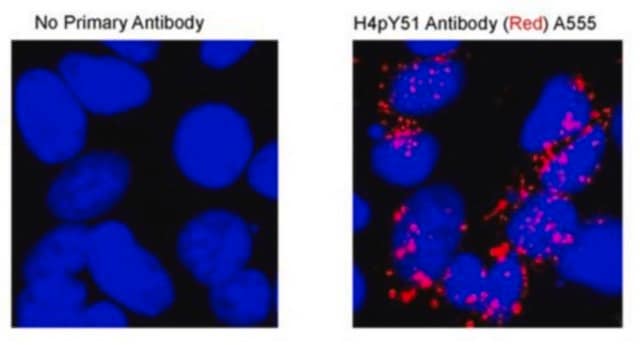
Immunofluorescence Analysis: A representative lot detected phospho Histone H4 (Tyr51) in HEK293 Tie2 cells treated with Angiopoietin 1 (ANG1) and ionizing radiation (Hossain, MB., et al. (2016). Sci. Adv. 2; e1501290).


Biochem/physiol Actions

This rabbit polyclonal antibody detects Histone H4 phosphorylated on Tyrosine 51. It targets an epitope within 11 amino acids surrounding phosphotyrosine 51.

Physical form

Affinity Purified
Format: Purified
Purified rabbit polyclonal antibody containing PBS without preservatives and 40% glycerol.

Preparation Note

Stable for 1 year at -20°C from date of receipt.

Handling Recommendations: Upon receipt and prior to removing the cap, centrifuge the vial and gently mix the solution. Aliquot into microcentrifuge tubes and store at -20°C. Avoid repeated freeze/thaw cycles, which may damage IgG and affect product performance.

Analysis Note

Evaluated by Immunocytochemistry in HEK293 Tie2-myc cells treated with Angiopoietin 1 (ANG1).

Immunocytochemistry Analysis: A 1:250 dilution of this antibody detected phospho Histone H4 (Tyr51) in HEK293 Tie2-myc cells treated with Angiopoietin 1 (ANG1).

Other Notes

Concentration: Please refer to lot specific datasheet.

Disclaimer

Unless otherwise stated in our catalog or other company documentation accompanying the product(s), our products are intended for research use only and are not to be used for any other purpose, which includes but is not limited to, unauthorized commercial uses, in vitro diagnostic uses, ex vivo or in vivo therapeutic uses or any type of consumption or application to humans or animals.

Comparar elementos similares

Ver comparación completa

Mostrar Diferencias

1 of 1

Este artículo
SAB5700097SAB5700175SAB5700195
description

from rabbit

description

-

description

-

description

-

antibody form

affinity isolated antibody

antibody form

affinity isolated antibody

antibody form

affinity isolated antibody

antibody form

affinity isolated antibody

Quality Level

100

Quality Level

100

Quality Level

100

Quality Level

100

biological source

rabbit

biological source

rabbit

biological source

rabbit

biological source

rabbit

species reactivity

human

species reactivity

human, mouse, rat

species reactivity

mouse, human, rat

species reactivity

human, rat, mouse

clone

polyclonal

clone

polyclonal

clone

polyclonal

clone

polyclonal

technique(s)

western blot: suitable, immunofluorescence: suitable, immunocytochemistry: suitable

technique(s)

immunohistochemistry: 1:50-1:200, western blot: 1:500-1:2000, immunofluorescence: 1:50-1:200

technique(s)

immunohistochemistry: 1:50-1:200, immunoprecipitation (IP): 1:50-1:200, western blot: 1:500-1:2000, immunofluorescence: 1:50-1:200, ChIP: 1:20-1:100

technique(s)

immunohistochemistry: 1:50-1:200, western blot: 1:500-1:2000, immunofluorescence: 1:50-1:200


Still not finding the right product?

Pruebe nuestra Herramienta de selección de productos para limitar sus opciones


Clase de almacenamiento

12 - Non Combustible Liquids

¿Qué está pasando?

WGK 2

Punto de inflamación (°F)

does not flash

Punto de inflamación (°C)

does not flash


Elija entre una de las versiones más recientes:

Certificados de análisis (COA)

Lot/Batch Number

It looks like we've run into a problem, but you can still download Certificates of Analysis from our Documentos section.

Si necesita más asistencia, póngase en contacto con Atención al cliente

¿Ya tiene este producto?

Encuentre la documentación para los productos que ha comprado recientemente en la Biblioteca de documentos.

Visite la Librería de documentos


Preguntas

Revisiones

Sin puntuación

Filtros activos