Saltar al contenido
Merck

Saltar a

09-142

Anti-phospho-ACK1 (Tyr284) Antibody

Upstate®, from rabbit

Sinónimos:

TNK2, tyrosine kinase non-receptor 2, p21cdc42Hs, activated Cdc42-associated kinase 1, activated p21cdc42Hs kinase

Iniciar sesión para ver los precios por organización y contrato.

Seleccione un Tamaño

Cambiar Vistas
A ustedes/SKUDisponibilidadPrecio

Acerca de este artículo

UNSPSC Code:
12352203
NACRES:
NA.41
eCl@ss:
32160702
Clone:
polyclonal
Species reactivity:
human
Application:
DB, inhibition assay
Citations:
15
El producto 09-142 no se vende actualmente en su país Póngase en contacto con el Servicio técnico
Servicio técnico
¿Necesita ayuda? Nuestro equipo de científicos experimentados está aquí para ayudarle.
Permítanos ayudarle


biological source

rabbit

Quality Segment

antibody form

affinity purified immunoglobulin

clone

polyclonal

purified by

affinity chromatography

species reactivity

human

manufacturer/tradename

Upstate®

technique(s)

dot blot: suitable, inhibition assay: suitable

isotype

IgG

NCBI accession no.

UniProt accession no.

shipped in

wet ice

target post-translational modification

phosphorylation (pTyr284)

Gene Information

human ... TNK2(10188)

General description

Activated CDC42 kinase 1 (UniProt: Q07912; also known as ACK-1, Tyrosine kinase non-receptor protein 2) is encoded by the TNK2 (also known as ACK1) gene (Gene ID: 10188) in human. ACK-1 is a non-receptor tyrosine-protein kinase that is implicated in cell spreading and migration, cell survival, cell growth, and proliferation. It transduces extracellular signals to cytosolic and nuclear effectors. It is known to phosphorylate AKT1 (on tyrosine 176), androgen receptor (AR; on tyrosine 267), and WWOX (on tyrosine 287). It is also reported to phosphorylate MCF2, thereby enhancing its activity as a guanine nucleotide exchange factor (GEF) toward Rho family proteins. It has also been implicated in trafficking and clathrin-mediated endocytosis through binding to epidermal growth factor receptor (EGFR) and clathrin. It binds to both poly- and mono-ubiquitin and regulates ligand-induced degradation of EGFR, thereby contributing to the accumulation of EGFR at the limiting membrane of early endosomes. Its protein kinase domain is localized in amino acids 126-385 and its SH3 domain resides in amino acids 388-448. It also contains a SAM-like domain that is reported to be essential for NEDD4-mediated ubiquitination and promotes its membrane localization and dimerization to allow for autophosphorylation . It undergoes phosphorylation on tyrosine 284 and the phosphorylated form shows a significant increase in expression in prostate cancer breast cancers during progressive stages. (Ref.: Mahajan, K., et al. (2010). PLoS One. 5(3); e9646; Prieto-Echagüe, V., et al. (2010). BMC Biochem. 22; 42; van der Horst, E., et al. (2005). Proc. Natl. Acad. Sci. USA. 102(44); 15901-15906).
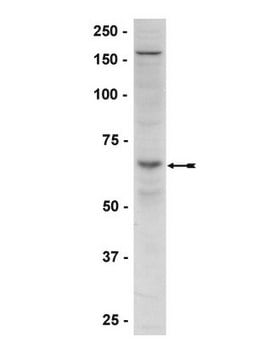
~160 kDa observed; 114.57 kDa calculated. Uncharacterized bands may be observed in some lysate(s).

Immunogen

KLH-conjugated linear peptide corresponding to 9 amino acids surrounding human phospho ACK1 (Y284).

Application

Anti-phospho-ACK1 (Tyr284), Cat. No. 09-142, is a rabbit polyclonal antibody that detects ACK1 phosphorylated on tyrosine 284 and is tested for use in Dot Blot, Peptide Inhibition Assay, and Western Blotting.


Quality Control Testing

Evaluated by Western Blotting in A431 cell lysate.Western Blotting Analysis: A 1:250 dilution of this antibody detected phospho-ACK1(Tyr284) in A431 cell lysate.


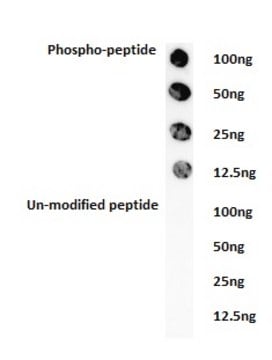
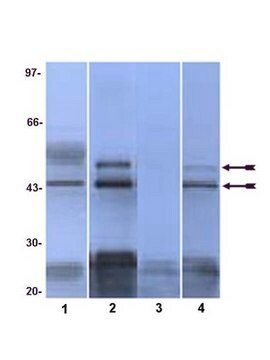
Tested ApplicationsDot Blot Analysis: Anti-phospho-ACK1 (Tyr284)) antibody 09-142 detected Phospho-ACK1 (Tyr284) peptide, but not the unmodified ACK1 peptide.Peptide Inhibition Assay: Target band detection in a lysate from A431 cells was prevented by preblocking of a representative lot with the immunogen phosphopeptide, but not the corresponding non-phosphopeptide.Note: Actual optimal working dilutions must be determined by end user as specimens, and experimental conditions may vary with the end user.

Biochem/physiol Actions

This rabbit polyclonal antibody detects Activated CDC42 kinase 1 (ACK1) phosphorylated on tyrosine 284.

Physical form

Purified rabbit polyclonal antibody in buffer containing 0.014 M phosphate buffer, pH 7.6, 0.175 M NaCl with 0.07% sodium azide with 30% glycerol.

Preparation Note

Store at -10°C to -25°C. Handling Recommendations: Upon receipt and prior to removing the cap, centrifuge the vial and gently mix the solution. Aliquot into microcentrifuge tubes and store at -20°C. Avoid repeated freeze/thaw cycles, which may damage IgG and affect product performance.

Analysis Note

Routinely evaluated by immunoblot.

Other Notes

Concentration: Please refer to the Certificate of Analysis for the lot-specific concentration.

Legal Information

UPSTATE is a registered trademark of Merck KGaA, Darmstadt, Germany

Comparar elementos similares

Ver comparación completa

Mostrar Diferencias

1 of 1

Este artículo
07-62607-17505-797R
clone

polyclonal

clone

polyclonal

clone

polyclonal

clone

AW39R, monoclonal

antibody form

affinity purified immunoglobulin

antibody form

affinity isolated antibody

antibody form

affinity isolated antibody

antibody form

purified immunoglobulin

biological source

rabbit

biological source

rabbit

biological source

rabbit

biological source

rabbit

species reactivity

human

species reactivity

human

species reactivity

human, mouse, horse

species reactivity

human, mouse, rat

UniProt accession no.

Q07912

UniProt accession no.

Q13131

UniProt accession no.

P45983

UniProt accession no.

P27361, P28482

technique(s)

dot blot: suitable, inhibition assay: suitable

technique(s)

western blot: suitable

technique(s)

activity assay: suitable, immunoprecipitation (IP): suitable, western blot: suitable

technique(s)

multiplexing: suitable, western blot: suitable


Clase de almacenamiento

10 - Combustible liquids

wgk

WGK 2


Certificados de análisis (COA)

Busque Certificados de análisis (COA) introduciendo el número de lote del producto. Los números de lote se encuentran en la etiqueta del producto después de las palabras «Lot» o «Batch»

¿Ya tiene este producto?

Encuentre la documentación para los productos que ha comprado recientemente en la Biblioteca de documentos.

Visite la Librería de documentos


Preguntas

Revisiones

Sin puntuación

Filtros activos