
D1315

DT Diaphorase (NQO1) human
lyophilized powder, recombinant, expressed in E. coli, ≥90% (SDS-PAGE)
Sinónimos:
DTD, NQO1, Quinone reductase
Iniciar sesiónpara Ver la Fijación de precios por contrato y de la organización
About This Item
MDL number:
UNSPSC Code:
12352204
NACRES:
NA.54
Productos recomendados





recombinant
expressed in E. coli
Quality Level
assay
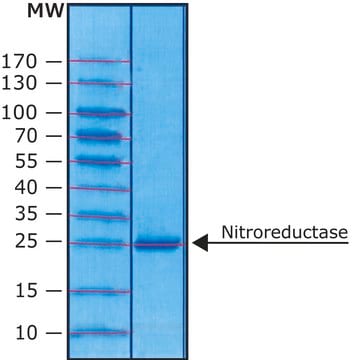
≥90% (SDS-PAGE)
form
lyophilized powder
specific activity
≥100 units/mg protein
mol wt
monomer 31000
UniProt accession no.
storage temp.
2-8°C
Gene Information
human ... NQO1(1728)
Application
Human DT diaphorase has been used in a study to assess the development of novel quinone phosphorodiamidate prodrugs. Human DT diaphorase has also been used to investigate its crystal structure for the development of a model for its interaction with the cytotoxic prodrug 5-(aziridin-1-yl)-2,4-dinitrobenzamide (CB1954).
Biochem/physiol Actions
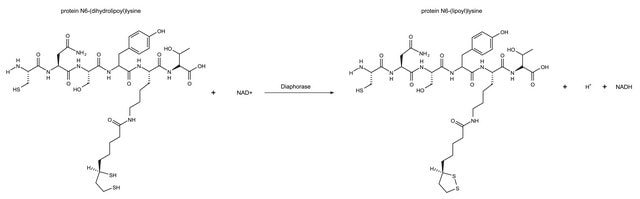
DT-diaphorase, also referred to as NAD(P)H:(quinone-acceptor) oxidoreductase, is involved in the reductive activation process of several cytotoxic antitumor quinones and nitrobenzenes. It catalyzes the two-electron reduction of quinones and quinonoid compounds to hydroquinones, using either NADH or NADPH as the electron donor. The flavoenzyme contains one mole of FAD per mole of enzyme.
NQO1 is a cytosolic homodimeric FAD-dependent enzyme that catalyses the reduction of a broad range of cytotoxic quinones resulting in protection from cellular oxidative stress. Oxidative stress may also enhance NQO1-mediated protection of p53 and p73 against proteasomal degredation. The highly Inducible expression of NQO1 is controlled by the Nrf2-Keap1/ARE pathway and appears to be affected by changes in susceptibility to oxidative stress. During Oxygen/glucose deprivation, NQO1 appears to be involved in AMPK-induced cancer cell death. NQO1 has been observed to be overexpressed in several types of solid tumors, including breast, pancreas, lung and colon cancer.
Shown to activate quinone based anti-tumor agents in vivo. Suitable for conjugation to carrier molecules.
Unit Definition
One unit will reduce 1.0 μmole cytochrome C per min/mg in the presence of menadione substrate at 37 °C.
Inhibitor
Referencia del producto
Descripción
Precios
related product
Storage Class
11 - Combustible Solids
wgk_germany
WGK 3
flash_point_f
Not applicable
flash_point_c
Not applicable
ppe
Eyeshields, Gloves, type N95 (US)
Certificados de análisis (COA)
Busque Certificados de análisis (COA) introduciendo el número de lote del producto. Los números de lote se encuentran en la etiqueta del producto después de las palabras «Lot» o «Batch»
¿Ya tiene este producto?
Encuentre la documentación para los productos que ha comprado recientemente en la Biblioteca de documentos.
Los clientes también vieron

Molecular of Modelling of Human DT-Diaphorase for Enzyme-Directed Bioreductive Drug Design.
Doughtyl, S.W. and Phillips, R.M.
Molecular Simulations, 24, 209-209 (2000)
Yang Yang et al.
Journal of experimental & clinical cancer research : CR, 33, 14-14 (2014-02-07)
NAD (P) H: quinone oxidoreductase 1 (NQO1) is a xenobiotic metabolizing enzyme that detoxifies chemical stressors and antioxidants, providing cytoprotection in normal tissues. However, high-level expression of NQO1 has been correlated with numerous human malignancies, suggesting a role in carcinogenesis
C Flader et al.
Journal of medicinal chemistry, 43(16), 3157-3167 (2000-08-24)
A series of naphthoquinone and benzimidazolequinone phosphorodiamidates has been synthesized and studied as potential cytotoxic prodrugs activated by DT-diaphorase. Reduction of the quinone moiety in the target compounds was expected to provide a pathway for expulsion of the phosphoramide mustard
S Chen et al.
The Journal of biological chemistry, 272(3), 1437-1439 (1997-01-17)
DT-diaphorase (EC 1.6.99.2), also referred to as NAD(P)H:(quinone-acceptor) oxidoreductase, is involved in the reductive activation process of several cytotoxic antitumor quinones and nitrobenzenes. It has been observed in our and other laboratories that the rat enzyme is significantly more effective
David Siegel et al.
Frontiers in pharmacology, 13, 1015642-1015642 (2022-11-22)
The stress induced protein NQO1 can participate in a wide range of biological pathways which are dependent upon the interaction of NQO1 with protein targets. Many of the protein-protein interactions involving NQO1 have been shown to be regulated by the
Nuestro equipo de científicos tiene experiencia en todas las áreas de investigación: Ciencias de la vida, Ciencia de los materiales, Síntesis química, Cromatografía, Analítica y muchas otras.
Póngase en contacto con el Servicio técnico