

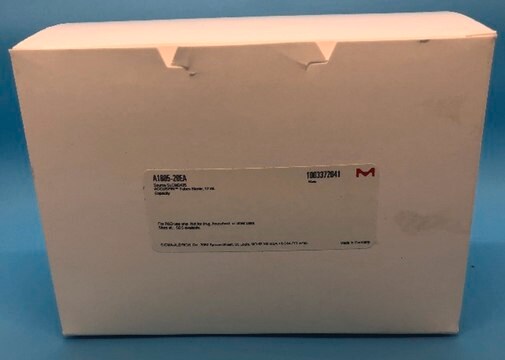
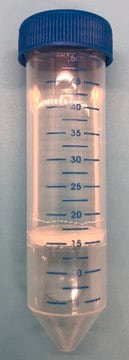


Accuspin tubes are obtained from an outside supplier. Their exact dimensions are not available but should approximate the dimensions of a standard 50 ml centrifuge tube. Standard dimensions are generally 29.1 mm in diameter X 114.4 mm long.
A2055

Tubos estériles ACCUSPIN™, capacidad 50 ml
radiation sterilized tube fitted with a high density polyethylene barrier
Iniciar sesión para ver los precios por organización y contrato.
Seleccione un Tamaño
Cambiar Vistas
| A ustedes/SKU | Disponibilidad | Precio |
|---|
Acerca de este artículo
NACRES:
NA.75
UNSPSC Code:
12352207
En este momento no podemos mostrarle ni los precios ni la disponibilidad
Servicio técnico
¿Necesita ayuda? Nuestro equipo de científicos experimentados está aquí para ayudarle.
Permítanos ayudarleQuality Segment
sterility
sterile; irradiated
form
tubes
application(s)
hematology
histology
storage temp.
15-25°C
General description
Los tubos ACCUSPIN™ son tubos de polipropileno esterilizados con radiación provistos con una barrera de polietileno de alta densidad. Cada tubo aceptará 15 ml del gradiente de densidad.
Application
Los tubos ACCUSPIN™ estériles, con capacidad para 50 ml, están previstos para utilizar con el medio de separación por gradiente de densidad Histopaque™ -1077:
- en el aislamiento de linfocitos y otras células mononucleares.
- en el aislamiento de células progenitoras endoteliales derivadas de la sangre del cordón umbilical.
- para aislar la capa de células mononucleares de muestras de médula ósea.
- adecuados para la purificación de aspirados de médula ósea humana destinados a la investigación del valor terapéutico de los inhibidores BET en la leucemia mieloide aguda.
Biochem/physiol Actions
Tras la adición de Histopaque-1077 al tubo ACCUSPIN, una breve centrifugación coloca elHistopaque-1077 debajo de la frita. La muestra de sangre puedeañadirse a la cámara superior del tubo sin riesgo deque se mezcle con el Histopaque-1077 en la cámara inferiordebajo de la frita. En la centrifugación subsiguiente, la sangre completa desciende a través de la frita para entrar en contacto con elHistopaque-1077. Los elementos de mayor densidaddesplazan un volumen de Histopaque-1077 por encima de la fritaproduciendo una separación clara de los componentes de la sangre. Ellos eritrocitos se agregan y los granulocitos se vuelvenligeramente hipertónicos, aumentando su velocidad de sedimentación,lo que produce su sedimentación en el fondo del tuboACCUSPIN. Los linfocitos y otras células mononucleares, p. ej.,los monocitos, permanecen en la interfaz plasma/Histopaque-1077. Esta densa banda de células mononucleares puederecogerse vaciando el contenido de la cámara superior o con una pipeta. La contaminaciónpor eritrocitos se evita gracias a la barrera entre lascámaras.
Preparation Note
El paquete contiene 10 tubos.
Legal Information
Accuspin is a trademark of Sigma-Aldrich Co. LLC
1 of 1
Este artículo | |||
|---|---|---|---|
| description radiation sterilized tube fitted with a high density polyethylene barrier | description radiation sterilized tube fitted with a high density polyethylene barrier | description sterile-filtered, density: 1.077 g/mL | description sterile-filtered, density: 1.077 g/mL |
| sterility sterile; irradiated | sterility sterile; irradiated | sterility aseptically filled | sterility aseptically filled |
| form tubes | form tubes | form solution | form solution |
| Quality Level 200 | Quality Level 200 | Quality Level 400 | Quality Level 400 |
| storage temp. 15-25°C | storage temp. 15-25°C | storage temp. 2-8°C | storage temp. 2-8°C |
| application(s) hematology | application(s) hematology | application(s) hematology | application(s) hematology |
signalword
Danger
hcodes
Hazard Classifications
Resp. Sens. 1 - Skin Sens. 1
Clase de almacenamiento
10 - Combustible liquids
flash_point_f
Not applicable
flash_point_c
Not applicable
Elija entre una de las versiones más recientes:
¿Ya tiene este producto?
Encuentre la documentación para los productos que ha comprado recientemente en la Biblioteca de documentos.
-
Liebes Team, sind die Abmessungen (AußendurchmesserxHöhe) der Röhrchen bekannt? Liebe Grüße!
1 answer-
Helpful?
-
-
How should a 4-20% sucrose gradient be used to reduce platelet contamination, as recommended in the user manual?
1 answer-
Sucrose exerts an osmotic pressure of 300 mOsm at a concentration of about 0.25M, which is iso-osmotic with the contents of most mammalian cells. This concentration is approximately 81.25 grams/L or 8.125%, as per protocols used to remove platelets. Recommended procedures for removing platelets:
Perform Procedure 1077 or 1077/1119.
Collect the cell band and layer it over a second gradient.
A. Bottom layer = 1077-1
B. Top layer = 8.125% sucrose solution (prepared in deionized water).
C. Layer the cell suspension on top of the gradient formed in steps 1-2.
D. Use a 300 g spin for 10-15 minutes.
E. Depending upon the original volume of the cell suspension, times and speed may have to be adjusted to maximize cell recovery.
F. Use separate tubes for mononuclear and polymorphonuclear cells.Helpful?
-
-
Is Accuspin (A2055) suitable for use with canine blood?
1 answer-
The suggestion is to make a decision based on individual circumstances.If currently using a plain centrifuge tube for collecting PBMCs from canine blood using a single density gradient, the Accuspin Tubes can be used for the same collection, provided that the G force does not exceed 1000G and a single density gradient is used.
Helpful?
-
-
Are Accuspin tubes compatible with blood that has been anticoagulated with ACD-A?
1 answer-
Certainly, Accuspin tubes are suitable for use with any blood containing an anticoagulant, with fresher blood being preferable. Regardless of the anticoagulant used, the anticoagulant is essentially washed away during the steps to remove the density gradient from the collected white blood cells. With ACD-A, the cell band is wider at the interface and the cells are more dispersed over a larger area, possibly due to the dextrose/glucose in the formulation. When using ACD-A, a somewhat unusual cell band is produced after the tubes are removed from the centrifuge. In comparison, cell bands with heparin, EDTA, sodium citrate, and other typical anticoagulants typically provide a rather narrow cell band when viewed from the side of the Accuspin tube.
Helpful?
-
-
Does the Accuspin Tubes Product #A2055, which are prefilled with a frit, also contain EDTA or another anticoagulant?
1 answer-
None of the Accuspin spin tubes (filled or unfilled) contain any anticoagulant. It is expected that when blood is drawn, it is typically drawn into a vacuum tube that already contains an anticoagulant or it is necessary to add anticoagulant immediately after the blood draw is completed. The most common anticoagulants used are EDTA and Heparin.
Helpful?
-
-
Can I remove the Frit after collecting the mononuclear cells to recover the granulocytes?
1 answer-
When using the Accuspin System to collect Peripheral Blood Mononuclear Cells (PBMCs), there is no expectation that the neutrophils can be recovered. Although it is possible to dislodge the frit, some granulocytes will be suspended in the lower layers of the density gradient. The remaining granulocytes will appear as a gray layer on top of the packed red blood cells.
In theory, the end-user may be able to collect this buffy coat that sits atop the packed red blood cell layer. It is recommended to either perform a lysis step to lyse the red blood cells, or run the cells back over another density gradient - such as Histopaque 11191 that has a density of 1.119 g/ml.
Instead of performing this 2-step procedure that has not been validated, the more logical option would be to simply run the whole peripheral blood over a 2-step discontinuous gradient. Currently, Histopaque 10771 and Histopaque 11191, are offered. The Histopaque 11191 instructions for use are available in the DOCUMENTATION section in the 'More Documents' tab of the product detail page:
https://www.sigmaaldrich.com/product/sigma/a2055#product-documentation
https://www.sigmaaldrich.com/deepweb/assets/sigmaaldrich/product/documents/193/872/a2055pis.pdfHelpful?
-