
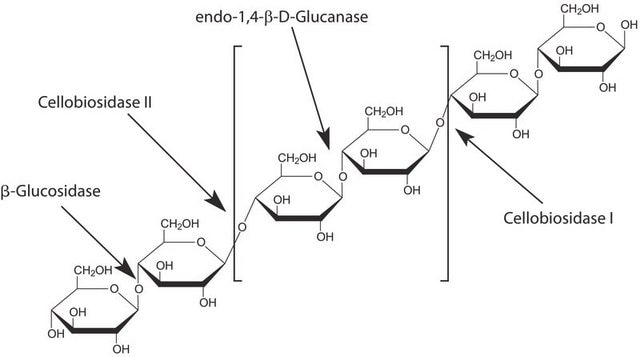


This enzyme hydrolyzes b1,4-glucan linkages in cellulose. Beta-glucan polysaccharides contain b1,4-glucan linkages.
219466

CELLULYSIN™ Cellulase, Trichoderma viride
Synonym(s):
β-D-glucosidase, endo-β-1,4 glucanase, cellobiohydrolase
Sign In to View Organizational & Contract Pricing.
Select a Size
Change View
| Size/SKU | Availability | Price |
|---|
About This Item
CAS Number:
EC Number:
UNSPSC Code:
12352202
NACRES:
NA.54
MDL number:
eCl@ss:
32160410
Specific activity:
≥10,000 units/g dry wt.
Biological source:
fungus (Trichoderma viride)
Pricing and availability is not currently available.
biological source
fungus (Trichoderma viride)
form
solid
specific activity
≥10,000 units/g dry wt.
manufacturer/tradename
Calbiochem®
storage condition
OK to freeze
technique(s)
transformation: suitable
color
yellow-white
input
plant, fungi and insect sample(s)
solubility
water: soluble
suitability
suitable for molecular biology
application(s)
food and beverages
pharmaceutical
shipped in
ambient
storage temp.
2-8°C
General description
Application
CELLULYSIN™ Cellulase, Trichoderma viride has been used:
Biochem/physiol Actions
Preparation Note
Following reconstitution, aliquot and freeze (-20°C) for long term storage or refrigerate (4°C) for short term storage. Stock solutions are stable for up to 3 days at 4°C or for up to 1 month at -20°C.
Other Notes
One unit is a measure of decomposing activity using a filter paper substrate at 40°C, pH 4.0.
Takebe, I., et al. 1968. Plant Cell Physiol.9, 115.
Tomita, Y., et al. 1968. J. Ferment. Technol.46, 701.
Tomita, Y., et al. 1968. J. Ferment. Technol.46, 701.
Legal Information
CALBIOCHEM is a registered trademark of Merck KGaA, Darmstadt, Germany
CELLULYSIN is a trademark of Merck KGaA, Darmstadt, Germany
Disclaimer
Toxicity: Harmful (C)
1 of 1
This Item | |||
|---|---|---|---|
| description - | description powder, off-white, ~0.8 U/mg | description lyophilized powder, ≥600 units/g solid | description powder, ≥0.3 units/mg solid |
| specific activity ≥10,000 units/g dry wt. | specific activity ~0.8 U/mg | specific activity ≥600 units/g solid | specific activity ≥0.3 units/mg solid |
| technique(s) transformation: suitable | technique(s) - | technique(s) - | technique(s) - |
| biological source fungus (Trichoderma viride) | biological source Aspergillus niger | biological source - | biological source - |
| suitability suitable for molecular biology | suitability - | suitability - | suitability - |
| form solid | form powder | form lyophilized powder | form powder |
| application(s) food and beverages | application(s) - | application(s) - | application(s) - |
Signal Word
Danger
Hazard Codes
Precautionary Statements
Hazard Classifications
Resp. Sens. 1
Storage Class
11 - Combustible Solids
WGK
WGK 1
Flash Point (°F)
Not applicable
Flash Point (°C)
Not applicable
Choose from one of the most recent versions:
Already Own This Product?
Find documentation for the products that you have recently purchased in the Document Library.
-
Does this preparation have activity on beta-glucan polysaccharides other than cellulose, (e.g. xylan, yeast glucan, laminarin, lichenin etc.)?
1 answer-
Helpful?
-