Skip to Content
Merck

P7643

PIPES dipotassium salt

≥99% (titration)

Synonym(s):

1,4-Piperazinediethanesulfonic acid dipotassium salt, Piperazine-1,4-bis(2-ethanesulfonic acid) dipotassium salt

Sign In to View Organizational & Contract Pricing.

Select a Size

100 G

CZK 5,710.00

CZK 5,710.00


Please contact Customer Service for Availability

Request a Bulk Order

About This Item

Empirical Formula (Hill Notation):
C8H16K2N2O6S2
CAS Number:
Molecular Weight:
378.55
NACRES:
NA.25
PubChem Substance ID:
UNSPSC Code:
12161700
MDL number:

Skip To

Technical Service
Need help? Our team of experienced scientists is here for you.
Let Us Assist

Quality Level

assay

≥99% (titration)

form

crystalline powder

useful pH range

6.1-7.5

pKa (25 °C)

6.8

solubility

water: 0.25 g/mL, clear, colorless

application(s)

diagnostic assay manufacturing

SMILES string

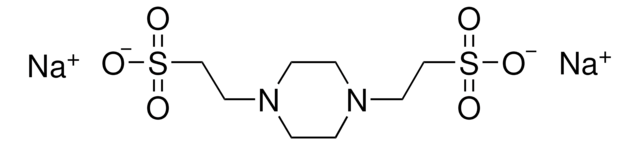
[K+].[K+].[O-]S(=O)(=O)CCN1CCN(CC1)CCS([O-])(=O)=O

InChI

1S/C8H18N2O6S2.2K/c11-17(12,13)7-5-9-1-2-10(4-3-9)6-8-18(14,15)16;;/h1-8H2,(H,11,12,13)(H,14,15,16);;/q;2*+1/p-2

InChI key

BJQYFCAMUXGZFN-UHFFFAOYSA-L

Looking for similar products? Visit Product Comparison Guide

Compare Similar Items

View Full Comparison

Show Differences

1 of 4

This Item
P6757P3768P8203
PIPES ≥99% (titration)

P6757

PIPES

PIPES BioXtra, ≥99% (titration)

P8203

PIPES

assay

≥99% (titration)

assay

≥99% (titration)

assay

≥99% (titration)

assay

≥99% (titration)

Quality Level

200

Quality Level

400

Quality Level

200

Quality Level

400

form

crystalline powder

form

crystalline powder

form

crystalline powder

form

powder

application(s)

diagnostic assay manufacturing

application(s)

diagnostic assay manufacturing

application(s)

diagnostic assay manufacturing

application(s)

diagnostic assay manufacturing

solubility

water: 0.25 g/mL, clear, colorless

solubility

1 M NaOH: 20 + 80 mL g, clear, colorless

solubility

water: 0.5 g/mL, clear, colorless

solubility

1 M NaOH: 0.5 M at 20 °C, clear, colorless

useful pH range

6.1-7.5

useful pH range

6.1-7.5

useful pH range

6.1-7.5

useful pH range

6.1-7.5

General description

PIPES (1,4-Piperazinediethanesulfonic acid) is a zwitterionic buffer. It is a stable buffer and is used majorly in fixation solutions. PIPES is inert towards enzymatic and non-enzymatic reactions. However, it generates artefacts in transmission electron microscope imaging.

Application

PIPES (1,4-Piperazinediethanesulfonic acid) dipotassium salt has been used as buffer for fluorescence polarization microscopy studies of kinesin-microtubule binding. It is suitable for use as a component of PHEM buffer ([K-PIPES], HEPES, EGTA, and MgSO4) used during rinsing and blocking steps in immunofluorescence imaging of HeLa cells. It is also suitable for use as buffer for purification of tubulin.

Storage Class

11 - Combustible Solids

wgk

WGK 3

flash_point_f

Not applicable

flash_point_c

Not applicable

ppe

Eyeshields, Gloves, type N95 (US)


Choose from one of the most recent versions:

Certificates of Analysis (COA)

Lot/Batch Number

Don't see the Right Version?

If you require a particular version, you can look up a specific certificate by the Lot or Batch number.

Already Own This Product?

Find documentation for the products that you have recently purchased in the Document Library.

Visit the Document Library

Imaging the Drosophila retina: zwitterionic buffers PIPES and HEPES induce morphological artifacts in tissue fixation
Nie J, et al.
BMC Developmental Biology, 15(1), 10-10 (2015)
Use of single molecule fluorescence polarization microscopy to study protein conformation and dynamics of kinesin-microtubule complexes
Benoit MPMH and Sosa H
Single Molecule Analysis, 15(1), 199-216 (2018)
Helical alignment inversion of microtubules in accordance with a structural change in their lattice
Shikinaka K, et al.
Soft Matter, 11(19), 3869-3874 (2015)
Dynamic phosphorylation of NudC by Aurora B in cytokinesis
Weiderhold KN
PLoS ONE, 11(4), e0153455-e0153455 (2016)
Nina Marie Pedersen et al.
The Journal of cell biology, 219(8) (2020-06-02)
Cancer cells break tissue barriers by use of small actin-rich membrane protrusions called invadopodia. Complete invadopodia maturation depends on protrusion outgrowth and the targeted delivery of the matrix metalloproteinase MT1-MMP via endosomal transport by mechanisms that are not known. Here

Global Trade Item Number

SKUGTIN
P7643-100G04061832549965
P7643-1KG04061826186640
P7643-25G04061832549972
P7643-500G04061832549989

Questions

Reviews

No rating value

Active Filters

Our team of scientists has experience in all areas of research including Life Science, Material Science, Chemical Synthesis, Chromatography, Analytical and many others.

Contact Technical Service