Skip to Content
Merck

C8286

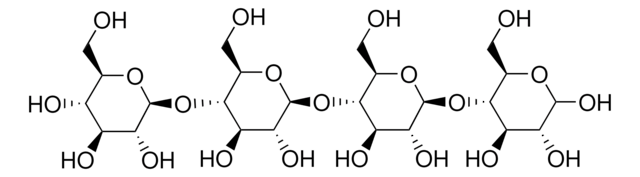
Cellotetraose

≥85% (HPLC)

Synonym(s):

(β-D-Glc-[1→4])3-D-Glc, D-(+)-Cellotetraose

Sign In to View Organizational & Contract Pricing.

Select a Size

2 MG

CZK 3,650.00

10 MG

CZK 12,200.00

CZK 3,650.00


Please contact Customer Service for Availability

Request a Bulk Order

About This Item

Empirical Formula (Hill Notation):
C24H42O21
CAS Number:
Molecular Weight:
666.58
UNSPSC Code:
12352201
NACRES:
NA.25
PubChem Substance ID:
MDL number:
Beilstein/REAXYS Number:
78869

Skip To

Technical Service
Need help? Our team of experienced scientists is here for you.
Let Us Assist

InChI key

LUEWUZLMQUOBSB-YQGOCCRESA-N

SMILES string

OC[C@H]1O[C@@H](O[C@H]2[C@H](O)[C@@H](O)[C@@H](O[C@@H]2CO)O[C@H]3[C@H](O)[C@@H](O)[C@@H](O[C@@H]3CO)O[C@H]4[C@H](O)[C@@H](O)C(O)O[C@@H]4CO)[C@H](O)[C@@H](O)[C@@H]1O

InChI

1S/C24H42O21/c25-1-5-9(29)10(30)15(35)22(40-5)44-19-7(3-27)42-24(17(37)12(19)32)45-20-8(4-28)41-23(16(36)13(20)33)43-18-6(2-26)39-21(38)14(34)11(18)31/h5-38H,1-4H2/t5-,6-,7-,8-,9-,10+,11-,12-,13-,14-,15-,16-,17-,18-,19-,20-,21?,22+,23+,24+/m1/s1

biological source

synthetic (organic)

assay

≥85% (HPLC)

form

powder

color

white

solubility

water: 25 mg/mL, clear, colorless to faintly yellow

storage temp.

−20°C

Quality Level

Compare Similar Items

View Full Comparison

Show Differences

1 of 4

This Item
C725222150M4295
Quality Level

200

Quality Level

200

Quality Level

200

Quality Level

100

Application

Cellotetraose is a 4-glucose polymer cellulodextrin derived from cellulose degradation. Cellotetraose and other cellulodextrins, such as cellulobiose, cellulotriose and cellopentaose are used by cellulosic bacteria as sources of energy. Cellotetraose is used to help identify, differentiate and characterize oligosaccharide metabolizing enzymes.[1][2]

Biochem/physiol Actions

Cellotetraose is a substrate for many cellulases and for 1,4-β-D-glucan glucohydrolases. It is also the end product of some cellulases, such as Cel9R from Clostridium thermocellum.

Other Notes

To gain a comprehensive understanding of our extensive range of Polysaccharides for your research, we encourage you to visit our Carbohydrates Category page.

Storage Class

11 - Combustible Solids

wgk

WGK 3

flash_point_f

Not applicable

flash_point_c

Not applicable

ppe

Eyeshields, Gloves, type N95 (US)


Choose from one of the most recent versions:

Certificates of Analysis (COA)

Lot/Batch Number

Don't see the Right Version?

If you require a particular version, you can look up a specific certificate by the Lot or Batch number.

Already Own This Product?

Find documentation for the products that you have recently purchased in the Document Library.

Visit the Document Library

Yuko Yoneda et al.
Journal of the American Chemical Society, 130(49), 16678-16690 (2009-06-26)
Hydrogen bonding is important in cellulosic and other carbohydrate structures, but the role of interactions between nonpolar groups is less understood. Therefore, we synthesized cyclohexyl 4'-O cyclohexyl beta-D-cellobioside (8), a molecule that has two glucose rings and two nonpolar cyclohexyl
Elizabeth A Znameroski et al.
Proceedings of the National Academy of Sciences of the United States of America, 109(16), 6012-6017 (2012-04-05)
Neurospora crassa colonizes burnt grasslands in the wild and metabolizes both cellulose and hemicellulose from plant cell walls. When switched from a favored carbon source such as sucrose to cellulose, N. crassa dramatically upregulates expression and secretion of a wide
Hitoshi Suzuki et al.
Applied and environmental microbiology, 76(18), 6164-6170 (2010-07-27)
The wood decay basidiomycete Phanerochaete chrysosporium produces a variety of cellobiohydrolases belonging to glycoside hydrolase (GH) families 6 and 7 in the presence of cellulose. However, no inducer of the production of these enzymes has yet been identified. Here, we
Hiroaki Kuki et al.
Plants (Basel, Switzerland), 9(5) (2020-05-20)
The notion that xyloglucans (XG) play a pivotal role in tethering cellulose microfibrils in the primary cell wall of plants can be traced back to the first molecular model of the cell wall proposed in 1973, which was reinforced in
Ya-Shan Cheng et al.
Biochimica et biophysica acta, 1844(2), 366-373 (2013-11-23)
The thermostable 1,3-1,4-β-glucanase PtLic16A from the fungus Paecilomyces thermophila catalyzes stringent hydrolysis of barley β-glucan and lichenan with an outstanding efficiency and has great potential for broad industrial applications. Here, we report the crystal structures of PtLic16A and an inactive

Questions

Reviews

No rating value

Active Filters

Our team of scientists has experience in all areas of research including Life Science, Material Science, Chemical Synthesis, Chromatography, Analytical and many others.

Contact Technical Service