Skip to Content
Merck

Skip To

C1399

Monoclonal Anti-Cytokeratin Peptide 18 antibody produced in mouse

clone KS-B17.2, ascites fluid

Synonym(s):

Anti-CK18

Sign In to View Organizational & Contract Pricing.

Select a Size

Change View
Pack SizeSKUAvailabilityPrice
0.2 mL
Please contact Customer Service for Availability
CZK 13,000.00

About This Item

UNSPSC Code:
12352203
NACRES:
NA.41
MDL number:
Conjugate:
unconjugated
Clone:
KS-B17.2, monoclonal
Application:
ARR, IF, IHC (p)
Citations:
14

CZK 13,000.00


Please contact Customer Service for Availability

Request a Bulk Order
Technical Service
Need help? Our team of experienced scientists is here for you.
Let Us Assist

biological source

mouse

Quality Level

conjugate

unconjugated

antibody form

ascites fluid

antibody product type

primary antibodies

clone

KS-B17.2, monoclonal

contains

15 mM sodium azide

species reactivity

human

technique(s)

immunohistochemistry (formalin-fixed, paraffin-embedded sections): suitable, indirect immunofluorescence: 1:100 using formalin-fixed, paraffin-embedded sections of human tissue, microarray: suitable

isotype

IgG1

Looking for similar products? Visit Product Comparison Guide

Compare Similar Items

View Full Comparison

Show Differences

1 of 1

This Item
C8541C5301C0791
clone

KS-B17.2, monoclonal

clone

CY-90, monoclonal

clone

M20, monoclonal

clone

KS-1A3, monoclonal

species reactivity

human

species reactivity

wide range

species reactivity

feline, human, rabbit, canine, bovine

species reactivity

human

antibody form

ascites fluid

antibody form

ascites fluid

antibody form

ascites fluid

antibody form

ascites fluid

biological source

mouse

biological source

mouse

biological source

mouse

biological source

mouse

conjugate

unconjugated

conjugate

unconjugated

conjugate

unconjugated

conjugate

unconjugated

Gene Information

human ... KRT18(3875)

Gene Information

-

Gene Information

human ... KRT8(3856)

Gene Information

human ... KRT13(3860)

General description

Monoclonal anti-Cytokeratin Peptide 18 (mouse IgG1 isotype) is derived from the hybridoma produced by the fusion of mouse myeloma cells and splenocytes from an immunized mouse.

Immunogen

keratin from the bovine mammary gland epithelial cell line BMGE.

Application

Monoclonal Anti-Cytokeratin Peptide 18 antibody produced in mouse has been used in:
  • immunofluorescence
  • immunoperoxidase staining
  • immunocytochemistry
  • microarray

Biochem/physiol Actions

Cytokeratins are proteins of keratin-containing intermediate filaments that provide mechanical support and other additional functions in epithelial cells. It is found in the intracytoplasmic cytoskeleton of epithelial tissue. Epithelial tissue expresses cytokeratin subunits in a specific and stable pattern. Cytokeratins along with vimentin are involved in cell proliferation, migration and differentiation of preodontoblasts and preameloblasts. The intermediate-sized filaments are abundant in human endothelial cells and are mostly of vimentin type.
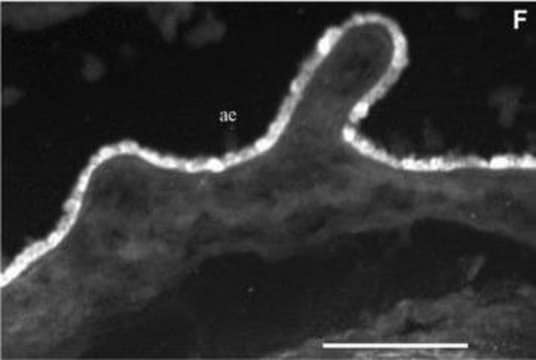
The antibody reacts with a wide variety of simple epithelia (gastrointestinal, respiratory, urinary, liver, and glandular) but does not react with most stratified squamous epithelium (esophagus, epidermis) or non-epithelial cells.

Disclaimer

Unless otherwise stated in our catalog or other company documentation accompanying the product(s), our products are intended for research use only and are not to be used for any other purpose, which includes but is not limited to, unauthorized commercial uses, in vitro diagnostic uses, ex vivo or in vivo therapeutic uses or any type of consumption or application to humans or animals.

Not finding the right product?  

Try our Product Selector Tool.

Storage Class

10 - Combustible liquids

wgk

nwg

flash_point_f

Not applicable

flash_point_c

Not applicable


Choose from one of the most recent versions:

Certificates of Analysis (COA)

Lot/Batch Number

Don't see the Right Version?

If you require a particular version, you can look up a specific certificate by the Lot or Batch number.

Already Own This Product?

Find documentation for the products that you have recently purchased in the Document Library.

Visit the Document Library

R Levy et al.
Differentiation; research in biological diversity, 39(3), 185-196 (1988-12-01)
The aim of the present study was to explore the histogenesis of metaplastic cells in the human uterine cervix. In a previous study we demonstrated that squamous cervical metaplasia expresses a unique set of cytokeratin polypeptides different from that expressed
P H Chen et al.
Journal of virology, 67(6), 3507-3514 (1993-06-01)
Immunofluorescence studies revealed that adenovirus induces a reorganization of the cytokeratin system in lytically infected HeLa cells. At 24 h postinfection, the cytokeratin network began to disassemble into prominent spheroid globules. By 36 h postinfection, host cell lysis occurred, accompanied
The identification and localization of two intermediate filament proteins in the tunic of Styela plicata (Tunicata, Styelidae).
Di Bella MA, et al.
Tissue & cell, 41(6), 381-389 (2009)
M J Wells et al.
The Journal of biological chemistry, 272(45), 28574-28581 (1997-11-14)
During experiments to identify putative hepatic receptors for thrombin-antithrombin (TAT) complexes, a 45-kDa protein was identified by ligand blotting. Following gel purification, amino acid sequencing revealed the 45-kDa TAT-binding polypeptide to be cytokeratin 18 (CK18). The presence of CK18 on
Early events in the pathogenesis of foot-and-mouth disease in pigs; identification of oropharyngeal tonsils as sites of primary and sustained viral replication.
Stenfeldt C, et al.
Testing, 9(9), e106859-e106859 (2014)

Global Trade Item Number

SKUGTIN
C1399-.2ML04061838162601

Questions

Reviews

No rating value

Active Filters

Our team of scientists has experience in all areas of research including Life Science, Material Science, Chemical Synthesis, Chromatography, Analytical and many others.

Contact Technical Service