
C0400

Carmustine
≥98% (TLC), oily liquid to amorphous solid, DNA alkylating agent
Synonym(s):
1,3-Bis(2-chloroethyl)-1-nitrosourea, BCNU
Select a Size
| Size/SKU | Availability | Price |
|---|---|---|
25 mg | Please contact Customer Service for Availability | 2 710,00 CZK |
100 mg | Please contact Customer Service for Availability | 8 140,00 CZK |
About This Item
Product Name
Carmustine, ≥98%
Quality Segment
assay
≥98%
form
(Oily liquid to amorphous solid)
mp
30 °C (lit.)
solubility
ethanol: 19.60-20.40 mg/mL, clear, pale yellow to yellow
originator
Bristol-Myers Squibb
storage temp.
−20°C
SMILES string
ClCCNC(=O)N(CCCl)N=O
InChI
1S/C5H9Cl2N3O2/c6-1-3-8-5(11)10(9-12)4-2-7/h1-4H2,(H,8,11)
InChI key
DLGOEMSEDOSKAD-UHFFFAOYSA-N
Gene Information
human ... GSR(2936)
General description
Application
Biochem/physiol Actions
Features and Benefits
1 of 1
This Item | |||
|---|---|---|---|
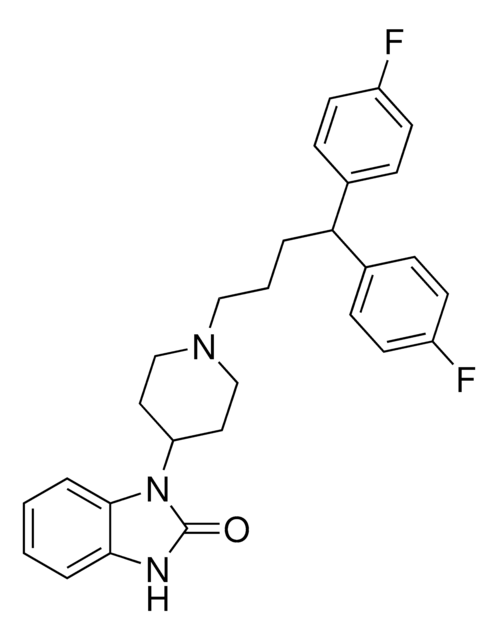
| description ≥98% | description European Pharmacopoeia (EP) Reference Standard | description United States Pharmacopeia (USP) Reference Standard | description The STAT5 Inhibitor III, Pimozide, also referenced under CAS 2062-78-4, controls the biological activity of STAT5. This small molecule/inhibitor is primarily used for Phosphorylation & Dephosphorylation applications. |
| assay ≥98% | assay - | assay - | assay ≥98% (HPLC) |
| form (Oily liquid to amorphous solid) | form (Oily liquid to amorphous solid) | form (Oily liquid to amorphous solid) | form solid |
| Quality Level 200 | Quality Level - | Quality Level - | Quality Level 100 |
| storage temp. −20°C | storage temp. −20°C | storage temp. −20°C | storage temp. −20°C |
| solubility ethanol: 19.60-20.40 mg/mL, clear, pale yellow to yellow | solubility - | solubility - | solubility DMSO: 50 mg/mL |
| originator Bristol-Myers Squibb | originator - | originator - | originator - |

Still not finding the right product?
Explore all of our products under Carmustine


signalword
Danger
hcodes
Hazard Classifications
Acute Tox. 2 Oral - Carc. 1B - Repr. 1B
Storage Class
6.1A - Combustible acute toxic Cat. 1 and 2 / very toxic hazardous materials
wgk
WGK 3
flash_point_f
Not applicable
flash_point_c
Not applicable
ppe
Eyeshields, Faceshields, Gloves, type P3 (EN 143) respirator cartridges
Choose from one of the most recent versions:
Already Own This Product?
Find documentation for the products that you have recently purchased in the Document Library.