
MABS2291

Anti-DPP4/CD26 Antibody, clone KU44.13A
Select a Size
| Size/SKU | Availability | Price |
|---|---|---|
25 μL | Estimated to ship onJune 12, 2026fromAreál Kühne+Nagel spol. s r.o. | CZK 4,060.00 |
100 μL | Estimated to ship onJune 12, 2026fromAreál Kühne+Nagel spol. s r.o. | CZK 10,200.00 |
About This Item
CZK 4,060.00
Estimated to ship onJune 12, 2026Details
biological source
mouse
Quality Segment
conjugate
unconjugated
antibody form
purified antibody
antibody product type
primary antibodies
clone
KU44.13A, monoclonal
mol wt
calculated mol wt 88.28 kDa
purified by
using protein G
species reactivity
human
packaging
antibody small pack of 100 μL
technique(s)
ELISA: suitable, flow cytometry: suitable, immunofluorescence: suitable, immunohistochemistry (formalin-fixed, paraffin-embedded sections): suitable, immunoprecipitation (IP): suitable
isotype
IgG2κ
epitope sequence
Extracellular domain
Protein ID accession no.
UniProt accession no.
shipped in
2-8°C
target post-translational modification
unmodified
General description
Immunogen
Application
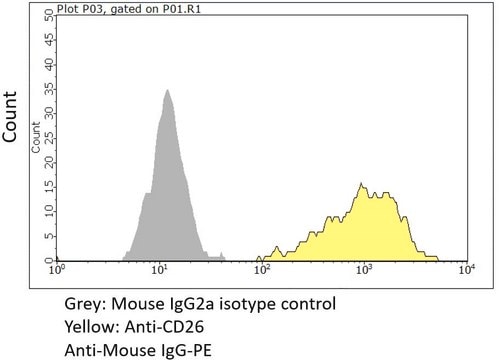
Evaluated by Flow Cytometry in HPAF-II cells.
Flow Cytometry Analysis: 1 μg of this antibody detected DPP4/CD26 in one million HPAF-II cells.
Tested Applications
Immunofluorescence Analysis: A representative lot detected DPP4/CD26 in Immunofluorescence applications (Arias-Pinilla, G.A., et al. (2020). Sci Rep. 10(1):537).
Immunoprecipitation Analysis: A representative lot immunoprecipitated DPP4/CD26 in Immunoprecipitation applications (Arias-Pinilla, G.A., et al. (2020). Sci Rep.10(1):537).
ELISA Analysis: A representative lot detected DPP4/CD26 in ELISA applications (Arias-Pinilla, G.A., et al. (2020). Sci Rep. 10(1):537).
Flow Cytometry Analysis: A representative lot detected DPP4/CD26 in Flow Cytometry applications (Arias-Pinilla, G.A., et al. (2020). Sci Rep. 10(1):537).
Immunohistochemistry Applications: A representative lot detected DPP4/CD26 in Immunohistochemistry applications (Arias-Pinilla, G.A., et al. (2020). Sci Rep. 10(1):537).
Note: Actual optimal working dilutions must be determined by end user as specimens, and experimental conditions may vary with the end user
Biochem/physiol Actions
Physical form
Preparation Note
Other Notes
Disclaimer
1 of 1
This Item | |||
|---|---|---|---|
| species reactivity human | species reactivity rat, mouse, human | species reactivity human | species reactivity human |
| biological source mouse | biological source chicken | biological source mouse | biological source mouse |
| conjugate unconjugated | conjugate unconjugated | conjugate unconjugated | conjugate unconjugated |
| antibody form purified antibody | antibody form affinity isolated antibody | antibody form purified antibody | antibody form purified from hybridoma cell culture |
| clone KU44.13A, monoclonal | clone polyclonal | clone 3C10G8, monoclonal | clone A6H, monoclonal |
| isotype IgG2κ | isotype - | isotype IgG1κ | isotype IgG1 |

Still not finding the right product?
Try our Product Selector Tool to narrow your options
Storage Class
12 - Non Combustible Liquids
wgk
WGK 1
flash_point_f
Not applicable
flash_point_c
Not applicable
Certificates of Analysis (COA)
Search for Certificates of Analysis (COA) by entering the products Lot/Batch Number. Lot and Batch Numbers can be found on a product’s label following the words ‘Lot’ or ‘Batch’.
Already Own This Product?
Find documentation for the products that you have recently purchased in the Document Library.