Passa al contenuto
Merck

Vai a

C199

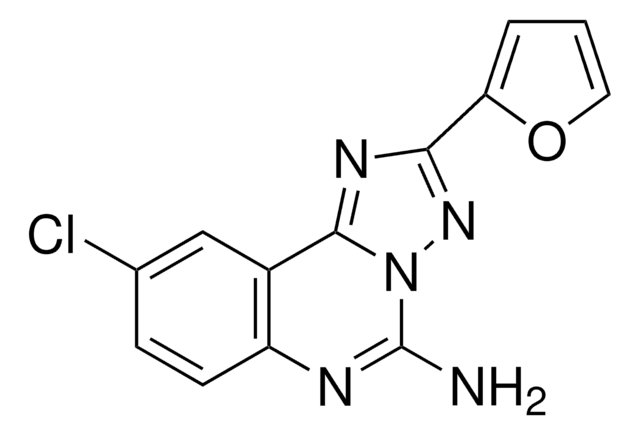
CGS-15943

≥98% (HPLC), Adenosine receptor antagonist, solid

Sinonimo/i:

9-Chloro-2-(2-furanyl)-[1,2,4]triazolo[1,5-c]quinazolin-5-amine

Autenticati per visualizzare i prezzi organizzativi e contrattuali.

Scegli un formato

Cambia visualizzazione
Taglio della confezioneSKUDisponibilitàPrezzo
25 mg
Per conoscere la disponibilità, visualizza il carrello
CHF 150.00

Informazioni su questo articolo

Formula empirica (notazione di Hill):
C13H8ClN5O
Numero CAS:
Peso molecolare:
285.69
UNSPSC Code:
12352202
PubChem Substance ID:
NACRES:
NA.77
MDL number:
Assay:
≥98% (HPLC)
Form:
solid
Quality level:

CHF 150.00


Per conoscere la disponibilità, visualizza il carrello

Richiedi un ordine in blocco
Servizio Tecnico
Hai bisogno di aiuto? Il nostro team di scienziati qualificati è a tua disposizione.
Permettici di aiutarti

Nome del prodotto

CGS-15943, solid

assay

≥98% (HPLC)

Quality Level

form

solid

color

white

solubility

DMSO: >10 mg/mL, H2O: insoluble

storage temp.

room temp

SMILES string

Nc1nc2ccc(Cl)cc2c3nc(nn13)-c4ccco4

InChI

1S/C13H8ClN5O/c14-7-3-4-9-8(6-7)12-17-11(10-2-1-5-20-10)18-19(12)13(15)16-9/h1-6H,(H2,15,16)

InChI key

MSJODEOZODDVGW-UHFFFAOYSA-N

Categorie correlate

Application

CGS-15943 has been used as a non-selective adenosine receptor antagonist to study its effects on the proliferation of pancreatic ductal adenocarcinoma (PDAC) cells and hepatocellular carcinoma (HCC)[1]. It has also been used as a non-selective adenosine receptor antagonist to investigate the mechanism underlying adenosine inhibition on cholangiocarcinoma (CCA) cells.[2]

Biochem/physiol Actions

CGS-15943 is a potent and non-selective adenosine receptor antagonist. It exhibits anti-carcinogenic and anti-apoptotic activity.[1]

ppe

Eyeshields, Gloves, type N95 (US)

Classe di stoccaggio

11 - Combustible Solids

wgk

WGK 3

flash_point_f

Not applicable

flash_point_c

Not applicable


Scegli una delle versioni più recenti:

Certificati d'analisi (COA)

Lot/Batch Number

Non trovi la versione di tuo interesse?

Se hai bisogno di una versione specifica, puoi cercare il certificato tramite il numero di lotto.

Possiedi già questo prodotto?

I documenti relativi ai prodotti acquistati recentemente sono disponibili nell’Archivio dei documenti.

Visita l’Archivio dei documenti

Lazaros C Foukas et al.
The Journal of biological chemistry, 277(40), 37124-37130 (2002-07-30)
We investigated the effects of methylxanthines on enzymatic activity of phosphoinositide 3-kinases (PI3Ks). We found that caffeine inhibits the in vitro lipid kinase of class I PI3Ks (IC(50) = 75 microm for p110 delta, 400 microm for p110 alpha and
A C Ngai et al.
American journal of physiology. Heart and circulatory physiology, 280(5), H2329-H2335 (2001-04-12)
The purpose of this study was to investigate the receptor subtypes that mediate the dilation of rat intracerebral arterioles elicited by adenosine. Penetrating arterioles were isolated from the rat brain, cannulated with the use of a micropipette system, and luminally
E Ongini et al.
Naunyn-Schmiedeberg's archives of pharmacology, 359(1), 7-10 (1999-02-05)
Three structurally related non-xanthine compounds, CGS 15943, ZM 241385 and SCH 58261, are potent A2A adenosine receptor antagonists and have been used as tools in many pharmacological studies. We have now characterized their affinity and selectivity profile on human adenosine
Elise M Weerts et al.
Psychopharmacology, 168(1-2), 155-163 (2003-04-02)
Caffeine and the adenosine A(1) and A(2A) receptor antagonist CGS15943 produce many behavioral effects that are similar to those produced by classic stimulant drugs (e.g. cocaine and amphetamines). The current study evaluated whether CGS15943 would maintain self-administration and reinstate extinguished
J m Li et al.
The Journal of surgical research, 80(2), 357-364 (1999-01-08)
Adenosine is a potent vasodilator of vascular smooth muscle. Endothelium-derived nitric oxide (NO) elicits vasodilation. We have previously reported that adenosine stimulates the production of NO from porcine carotid arterial endothelial cells (PCAEC) via a receptor-mediated mechanism. This study was

Numero articolo commerciale globale

SKUGTIN
C199-25MG04061833474914

Questions

Reviews

No rating value

Active Filters

Il team dei nostri ricercatori vanta grande esperienza in tutte le aree della ricerca quali Life Science, scienza dei materiali, sintesi chimica, cromatografia, discipline analitiche, ecc..

Contatta l'Assistenza Tecnica