Passa al contenuto
Merck

ABE74

Anti-FoxP4 Antibody

serum, from rabbit

Sinonimo/i:

forkhead box P4, fork head-related protein like A, Fork head-related protein-like A, winged-helix repressor FOXP4

Autenticati per visualizzare i prezzi organizzativi e contrattuali.

Scegli un formato

100 μL

CHF 404.00

CHF 404.00


Per conoscere la disponibilità, visualizza il carrello

Richiedi un ordine in blocco

Informazioni su questo articolo

UNSPSC Code:
12352203
NACRES:
NA.41
eCl@ss:
32160702
Conjugate:
unconjugated
Clone:
polyclonal
Application:
ICC, IHC, WB
Citations:
3

Vai a

Servizio Tecnico
Hai bisogno di aiuto? Il nostro team di scienziati qualificati è a tua disposizione.
Permettici di aiutarti

biological source

rabbit

conjugate

unconjugated

antibody form

serum

antibody product type

primary antibodies

clone

polyclonal

species reactivity

human

species reactivity (predicted by homology)

mouse (based on 100% sequence homology)

technique(s)

immunocytochemistry: suitable, immunohistochemistry: suitable, western blot: suitable

NCBI accession no.

UniProt accession no.

shipped in

wet ice

target post-translational modification

unmodified

Quality Level

Gene Information

mouse ... Foxp4(74123)

Confronta articoli simili

Visualizza il confronto per intero

Mostra le differenze

1 of 4

Questo articolo
ABE68ABE73AV39817
biological source

rabbit

biological source

rabbit

biological source

rabbit

biological source

rabbit

antibody form

serum

antibody form

serum

antibody form

serum

antibody form

IgG fraction of antiserum

Quality Level

100

Quality Level

100

Quality Level

100

Quality Level

100

species reactivity

human

species reactivity

human, mouse

species reactivity

rabbit, human, mouse

species reactivity

human, rabbit

clone

polyclonal

clone

polyclonal

clone

polyclonal

clone

polyclonal

Gene Information

mouse ... Foxp4(74123)

Gene Information

human ... FOXP1(27086)

Gene Information

human ... FOXP2(93986)
mouse ... Foxp2(114142)

Gene Information

human ... FOXP4(116113)

General description

86 and 79 kDa Observed. Three known isoforms due to alternative splicing.
Forkhead box protein P4 (FoxP4) is a multidomain transcriptional repressor. This protein is a member of the Fox family of proteins characterized by it unique winged-helix DNA binding motif. Members of this family are known for their ability to regulate both the cell fate and differentiation of several tissues. FoxP4 acts to repress expression by inteacting with DNA. For DNA binding to occur, FoxP4 must form homodimers and heterodimers with FoxP1 and FoxP2. During embryogenesis, expression of this protein is observed in lung and brain. In adults expression is observed in adult heart, lung, brain, liver, spleen, testis and kidney. Alternative splicing result in the expression of three known isoforms.

Immunogen

Epitope: Unknown
GST-tagged recombinant protein corresponding to mouse FoxP4.

Application

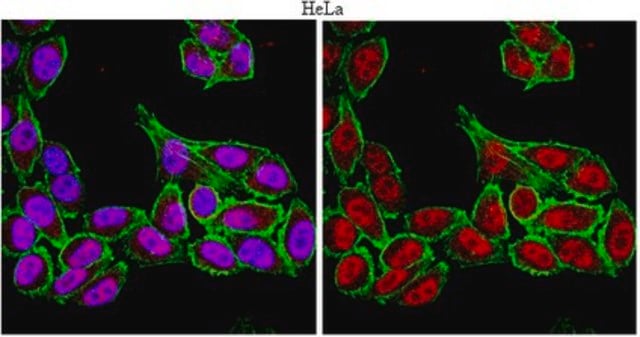
Immunocytochemistry Analysis: 1:500 dilution from a representative lot detected FoxP4 in HeLa cells.

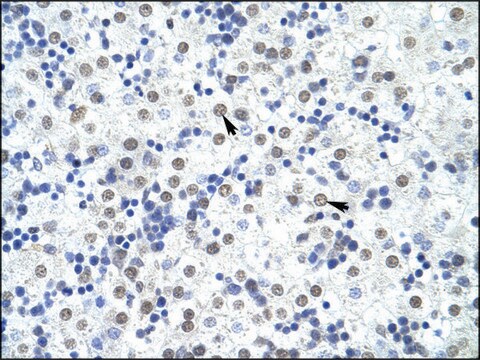
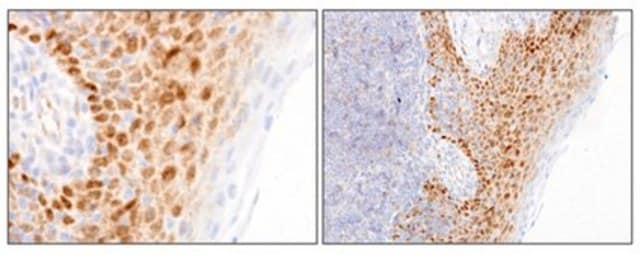
Immunohistochemistry Analysis: A representative lot was used by an independent laboratory in IH. (Lu, M.M., et al. (2002). Mechanisms of Development 119S:S197–S202.)
Research Category
Epigenetics & Nuclear Function
Research Sub Category
Transcription Factors
Use Anti-FoxP4 Antibody (Rabbit Polyclonal Antibody) validated in ICC, WB, IHC to detect FoxP4 also known as forkhead box P4, winged-helix repressor FOXP4.

Biochem/physiol Actions

This antibody recognizes FoxP4.

Physical form

Unpurified
Unpurified rabbit polyclonal serum with 0.05% sodium azide.

Preparation Note

Stable for 1 year at -20°C from date of receipt.
Handling Recommendations: Upon receipt and prior to removing the cap, centrifuge the vial and gently mix the solution. Aliquot into microcentrifuge tubes and store at -20°C. Avoid repeated freeze/thaw cycles, which may damage IgG and affect product performance.

Analysis Note

Control
Human brain cell lysate
Evaluated by Western Blot in human brain cell lysate.

Western Blot Analysis: 1:1,000 dilution of this antibody detected FoxP4 on 10 µg of human brain cell lysate.

Other Notes

Concentration: Please refer to the Certificate of Analysis for the lot-specific concentration.

Disclaimer

Unless otherwise stated in our catalog or other company documentation accompanying the product(s), our products are intended for research use only and are not to be used for any other purpose, which includes but is not limited to, unauthorized commercial uses, in vitro diagnostic uses, ex vivo or in vivo therapeutic uses or any type of consumption or application to humans or animals.

Non trovi il prodotto giusto?  

Prova il nostro Motore di ricerca dei prodotti.

Classe di stoccaggio

10 - Combustible liquids

wgk

WGK 1


Certificati d'analisi (COA)

Cerca il Certificati d'analisi (COA) digitando il numero di lotto/batch corrispondente. I numeri di lotto o di batch sono stampati sull'etichetta dei prodotti dopo la parola ‘Lotto’ o ‘Batch’.

Possiedi già questo prodotto?

I documenti relativi ai prodotti acquistati recentemente sono disponibili nell’Archivio dei documenti.

Visita l’Archivio dei documenti

Fuhua Wang et al.
Development (Cambridge, England), 149(7) (2022-03-18)
Beige adipocytes have a discrete developmental origin and possess notable plasticity in their thermogenic capacity in response to various environmental cues, but the transcriptional machinery controlling beige adipocyte development and thermogenesis remains largely unknown. By analyzing beige adipocyte-specific knockout mice
Haixia Zhao et al.
Developmental biology, 398(2), 242-254 (2014-12-21)
Osteoblast induction and differentiation in developing long bones is dynamically controlled by the opposing action of transcriptional activators and repressors. In contrast to the long list of activators that have been discovered over past decades, the network of repressors is
Caroline Alayne Pearson et al.
Cell reports, 30(6), 1964-1981 (2020-02-13)
The laminar architecture of the mammalian neocortex depends on the orderly generation of distinct neuronal subtypes by apical radial glia (aRG) during embryogenesis. Here, we identify critical roles for the autism risk gene Foxp1 in maintaining aRG identity and gating

Questions

Reviews

No rating value

Active Filters

Il team dei nostri ricercatori vanta grande esperienza in tutte le aree della ricerca quali Life Science, scienza dei materiali, sintesi chimica, cromatografia, discipline analitiche, ecc..

Contatta l'Assistenza Tecnica