
AB5692

Anti-ATH 1 Antibody
Chemicon®, from rabbit
Sinonimo/i:
MATH1
Scegli un formato
| A voi/SKU | Disponibilità | Prezzo |
|---|---|---|
100 μg | Per conoscere la disponibilità, visualizza il carrello | CHF 491.00 |
Informazioni su questo articolo
biological source
rabbit
Quality Segment
conjugate
unconjugated
antibody form
affinity purified immunoglobulin
antibody product type
primary antibodies
clone
polyclonal
purified by
affinity chromatography
species reactivity
human, mouse
manufacturer/tradename
Chemicon®
technique(s)
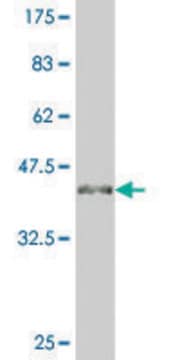
immunohistochemistry: suitable, western blot: suitable
NCBI accession no.
UniProt accession no.
shipped in
dry ice
target post-translational modification
unmodified
Gene Information
human ... ATOH1(474)
General description
Immunogen
Application
Neuroscience
Developmental Neuroscience
Neuronal & Glial Markers
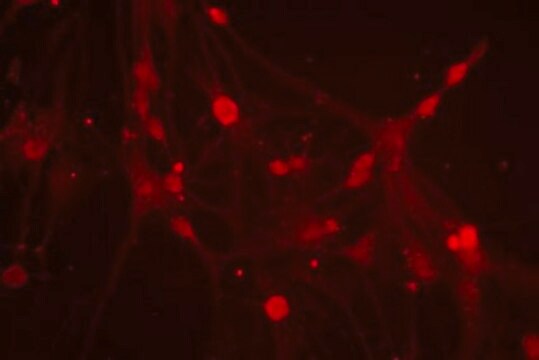
Immunohistochemistry: 1:200-1:1,000.
Optimal working dilutions must be determined by the end user.
Biochem/physiol Actions
Physical form
Preparation Note
PREPARATION AND USE:
To reconstitute the antibody, centrifuge the antibody vial at moderate speed (5,000 rpm) for 5 minutes to pellet the precipitated antibody product. Carefully remove the ammonium sulfate/PBS buffer solution and discard. It is not necessary to remove all of the ammonium sulfate/PBS solution: 10 μL of residual ammonium sulfate solution will not affect the resuspension of the antibody. Do not let the protein pellet dry, as severe loss of antibody reactivity can occur.
Resuspend the antibody pellet in a suitable biological buffer such as PBS or TBS (pH 7.3-7.5) to a final concentration of 1.0 mg/mL. For example, to achieve a 1.0 mg/mL concentration with 50 μg of precipitated antibody, the amount of buffer needed would be 50 μL.
Carefully add the liquid buffer to the pellet. DO NOT VORTEX. Mix by gentle stirring with a wide pipet tip or gentle finger-tapping. Let the precipitated antibody rehydrate for 1 hour at 4-25°C prior to use. Small particles of precipitated antibody that fail to resuspend are normal. Vials are overfilled to compensate for any losses.
The rehydrated antibody solutions can be stored undiluted at 2-8°C for 2 months without any significant loss of activity. Note, the solution is not sterile, thus care should be taken if product is stored at 2-8°C.
For storage at -20°C, the addition of an equal volume of glycerol can be used, however, it is recommended that ACS grade or higher glycerol be used, as significant loss of activity can occur if the glycerol used is not of high quality.
For long-term storage at -70°C, it is recommended that the rehydrated antibody solution be further diluted 1:1 with a 2% BSA (fraction V, highest-grade available) solution made with the rehydration buffer. The resulting 1% BSA/antibody solution can be aliquoted and stored frozen at -70°C for up to 6 months. Avoid repeated freeze/thaw cycles.
Analysis Note
Brain tissue
Legal Information
Disclaimer
1 of 1
Questo articolo | |||
|---|---|---|---|
| biological source rabbit | biological source mouse | biological source mouse | biological source mouse |
| Quality Level 100 | Quality Level - | Quality Level 100 | Quality Level - |
| antibody form affinity purified immunoglobulin | antibody form purified immunoglobulin | antibody form purified immunoglobulin | antibody form purified immunoglobulin |
| conjugate unconjugated | conjugate unconjugated | conjugate unconjugated | conjugate unconjugated |
| UniProt accession no. | UniProt accession no. | UniProt accession no. | UniProt accession no. |
| shipped in dry ice | shipped in dry ice | shipped in dry ice | shipped in dry ice |
Still not finding the right product?
Provate il nostro Motore di ricerca dei prodotti per restringere le opzioni.
Classe di stoccaggio
12 - Non Combustible Liquids
wgk
WGK 2
flash_point_f
Not applicable
flash_point_c
Not applicable
Certificati d'analisi (COA)
Cerca il Certificati d'analisi (COA) digitando il numero di lotto/batch corrispondente. I numeri di lotto o di batch sono stampati sull'etichetta dei prodotti dopo la parola ‘Lotto’ o ‘Batch’.
Possiedi già questo prodotto?
I documenti relativi ai prodotti acquistati recentemente sono disponibili nell’Archivio dei documenti.