
07-697

Anti-E-Cadherin Antibody
serum, Upstate®
Autenticati per visualizzare i prezzi organizzativi e contrattuali.
Scegli un formato
Cambia visualizzazione
| A voi/SKU | Disponibilità | Prezzo |
|---|
Informazioni su questo articolo
UNSPSC Code:
12352203
NACRES:
NA.41
eCl@ss:
32160702
Clone:
polyclonal
Species reactivity:
human
Application:
IHC, WB
Citations:
20
Prezzi e disponibilità al momento non sono disponibili
Servizio Tecnico
Hai bisogno di aiuto? Il nostro team di scienziati qualificati è a tua disposizione.
Permettici di aiutartiQuality Segment
biological source
rabbit
conjugate
unconjugated
antibody form
serum
antibody product type
primary antibodies
clone
polyclonal
species reactivity
human
packaging
antibody small pack of 25 μL
manufacturer/tradename
Upstate®
technique(s)
immunohistochemistry: suitable, western blot: suitable
isotype
IgG
NCBI accession no.
UniProt accession no.
shipped in
ambient
target post-translational modification
unmodified
Gene Information
human ... CDH1(999)
General description
106kDa
Cadherin-1 (UniProt: P12830; also known as CAM 120/80, Epithelial cadherin, E-cadherin, Uvomorulin, CD324) is encoded by the CDH1 (also known as CDHE, UVO) gene (Gene ID: 999) in human. Cadherins are calcium-dependent cell adhesion molecules that participate in cell-cell adhesion during embryogenesis, development, organogenesis, and differentiation. E-cadherin is a single-pass type I membrane glycoprotein that is mainly expressed in non-neural epithelial tissues. It is synthesized with a signal peptide (aa 1-22) and a propeptide (aa 23-154) that are subsequently cleaved off to produce the mature form that contains an extracellular domain (aa 155-709), a transmembrane domain (aa 710-730), and a cytoplasmic domain (aa 731-882). N-glycosylation at Asn-637 is shown to be essential for its expression, folding, and trafficking. E-cadherin is known to contain five cadherin domains. Three calcium ions are usually bound at the interface of each cadherin domain and rigidify the connections, imparting a strong curvature to the full-length ectodomain. Post-translationally it can be cleaved into three chains: E-Cad/CTF1 (aa 701-882); E-Cad/CTF2 (aa 732-882); and E-Cad/CTF3 (aa 751-882). During apoptosis or with calcium influx, it is cleaved by a membrane-bound metalloproteinase (ADAM10; at residues 700-701), which causes disruption of cell-cell adhesion and the subsequent release of b-catenin into the cytoplasm. The residual membrane-tethered cleavage product is then rapidly degraded via an intracellular proteolytic pathway. It can also be cleaved by PS1/g-secretase (at residues 731-732) and this cleavage promotes disassembly of adherens junctions. Caspase 3 can cleave it at residues 750-751, which releases the cytoplasmic tail resulting in disintegration of the actin microfilament system. (Ref.: Marambaud, M., et al. (2002). EMBO J. 21(8); 1948-1956; Steinhausen, U., et al. (2001). J. Biol. Chem. 276(7); 4972-4980; Ito, K., et al. (1999). Oncogene. 18(50); 7080-7090).
Immunogen
synthetic peptide corresponding to amino acids 859-874 of human E-Cadherin
Application
Detect E-Cadherin using this Anti-E-Cadherin Antibody validated for use in Immunohistochemistry and WB.
Immunohistochemistry (Paraffin) Analysis: A 1:250 dilution of this antibody detected E-Cadherin in Human small intestine tissue sections.
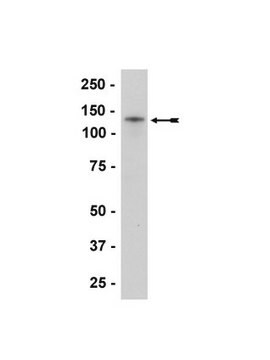
Western Blotting Analysis: A 1:1,000 dilution of this antibody detected E-Cadherin in HepG2 cell lysate.
Immunohistochemistry (Paraffin) Analysis: A 1:250 dilution of this antibody detected E-Cadherin in Human small intestine tissue sections.
Western Blotting Analysis: A 1:1,000 dilution of this antibody detected E-Cadherin in HepG2 cell lysate.
Research Category
Cell Structure
Cell Structure
Research Sub Category
Adhesion (CAMs)
Adhesion (CAMs)
Biochem/physiol Actions
E-Cadherin
Predicted to cross-react with mouse, rat, orangutan, bovine, chicken and canine based on sequence homology
Physical form
Serum
Preparation Note
2 years at -20°C from date of shipment
Analysis Note
Routinely evaluated by immunoblot with RIPA lysates from HepG2 cells.
Other Notes
Legal Information
UPSTATE is a registered trademark of Merck KGaA, Darmstadt, Germany
Disclaimer
Unless otherwise stated in our catalog or other company documentation accompanying the product(s), our products are intended for research use only and are not to be used for any other purpose, which includes but is not limited to, unauthorized commercial uses, in vitro diagnostic uses, ex vivo or in vivo therapeutic uses or any type of consumption or application to humans or animals.
1 of 1
Questo articolo | |||
|---|---|---|---|
| description serum, Upstate® | description clone 67A4, 0.5 mg/mL, from mouse | description culture supernatant, clone 13A9, Upstate® | description - |
| clone polyclonal | clone 67A4, monoclonal | clone 13A9, monoclonal | clone CSTEM29, monoclonal |
| conjugate unconjugated | conjugate unconjugated | conjugate unconjugated | conjugate unconjugated |
| antibody form serum | antibody form purified antibody | antibody form culture supernatant | antibody form purified antibody |
| species reactivity human | species reactivity human | species reactivity human | species reactivity human |
| biological source rabbit | biological source mouse | biological source mouse | biological source mouse |
| UniProt accession no. | UniProt accession no. | UniProt accession no. | UniProt accession no. |


Still not finding the right product?
Provate il nostro Motore di ricerca dei prodotti per restringere le opzioni.
Classe di stoccaggio
10 - Combustible liquids
wgk
WGK 1
Scegli una delle versioni più recenti:
Possiedi già questo prodotto?
I documenti relativi ai prodotti acquistati recentemente sono disponibili nell’Archivio dei documenti.