


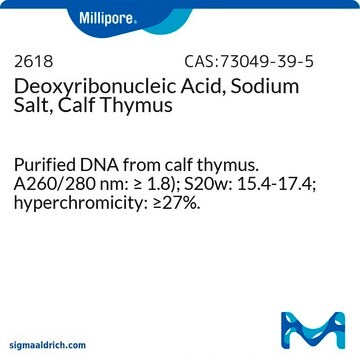
This calf thymus DNA is a highly polymerized DNA containing both double-stranded and single-stranded forms, with double-stranded DNA being the predominant form. The length of the DNA is not determined. The base pair length of the starting material is at least 20 kilobases but the product is "activated" which means nicked for nick translation reaction and more fragile resulting in shorter lengths than the starting material.
Fortfahren mit
D1501

Desoxyribonukleinsäure Natriumsalz aus Kalbsthymus
Type I, fibers
Synonym(e):
ctDNA, DNA Natriumsalz aus Kalbsthymus, Thymonukleinsäure Natriumsalz
Anmelden zur Ansicht der Organisations- und Vertragspreise.
Größe auswählen
Ansicht ändern
| Ihnen/SKU | Verfügbarkeit | Preis |
|---|---|---|
50 mg | Warenkorb auf Verfügbarkeit prüfen | CHF 72.80 |
100 mg | Warenkorb auf Verfügbarkeit prüfen | CHF 112.00 |
500 mg | Warenkorb auf Verfügbarkeit prüfen | CHF 473.00 |
1 g | Warenkorb auf Verfügbarkeit prüfen | CHF 531.00 |
5 g | Warenkorb auf Verfügbarkeit prüfen | CHF 2’580.00 |
Über diesen Artikel
Form:
fibers
Storage temp.:
2-8°C
Technischer Dienst
Benötigen Sie Hilfe? Unser Team von erfahrenen Wissenschaftlern ist für Sie da.
Unterstützung erhaltenGeneral description
λmax 259 nm (100 mM Phosphatpuffer, pH 7,0).
DNA aus Kalbsthymus besteht zu 41,9 Mol-% aus G-C und zu 58,1 Mol-% aus A-T.1 Eine OD von 1,0 bei 260 nm entspricht ~ 50 μg doppelsträngiger DNA.
DNA aus Kalbsthymus besteht zu 41,9 Mol-% aus G-C und zu 58,1 Mol-% aus A-T.1 Eine OD von 1,0 bei 260 nm entspricht ~ 50 μg doppelsträngiger DNA.
Application
Kalbsthymus-DNA (CT-DNA) ist eine natürliche DNA, die häufig in Studien über DNA-bindende Antikrebsmittel und DNA-bindende Wirkstoffe, die die DNA-Struktur und -Funktion modulieren, verwendet wird. Kalbsthymus-DNA wird auch in physikalisch-chemischen Studien über das Verhalten von DNA in Lösung verwendet.
Physical form
Faseriges Präparat
Preparation Note
DNA-Lösungen wurden mehrere Monate lang bei 4 °C, pH 7,5–8, in 10 mM Tris mit 1 mM EDTA und ohne bakteriostatisches Mittel erfolgreich gelagert. Bei niedrigen Konzentrationen (μg/mL) neigt die DNA dazu, an der Oberfläche von Kunststoffröhrchen zu haften. Es wird nicht empfohlen, DNA in stark alkalischen Lösungen aufzubewahren, da DNA dazu neigt, sich bei einem alkalischen pH-Wert von über 8,0 abzubauen.
Dieses Produkt kann mit 2 mg/mL in Wasser aufgelöst werden. Um ein weiteres Scheren der DNA zu vermeiden, sollte keine Beschallung und kein Rühren erfolgen. Es wird empfohlen, das Probengefäß zur vollständigen Auflösung der DNA vorsichtig zu invertieren und über Nacht bei 0–4 °C zu lagern. Die Zugabe von 1 mM EDTA wird empfohlen, um zu verhindern, dass Nukleasen die DNA abbauen.
Dieses Produkt wird aus dem Thymusgewebe von geschlechtsunspezifischen Kälbern erzeugt.
Dieses Produkt wird mit einer Methode extrahiert, die eine Scherung bewirkt, die eine hochpolymerisierte Mischung aus doppel- und einzelsträngiger DNA hervorbringt, wobei jedoch die doppelsträngige DNA überwiegt.
Analysis Note
„Hochgradig polymerisiert“
1 of 1
Dieser Artikel | |||
|---|---|---|---|
| Quality Level 300 | Quality Level 200 | Quality Level 100 | Quality Level 200 |
| form fibers | form powder or crystals | form solid | form lyophilized powder |
| storage temp. 2-8°C | storage temp. 2-8°C | storage temp. −20°C | storage temp. 2-8°C |
| color white | color - | color off-white | color - |
| type Type I | type - | type - | type - |
Still not finding the right product?
Explore all of our products under Desoxyribonukleinsäure Natriumsalz aus Kalbsthymus
Lagerklasse
11 - Combustible Solids
wgk
WGK 3
flash_point_f
Not applicable
flash_point_c
Not applicable
ppe
Eyeshields, Gloves, type N95 (US)
Hier finden Sie alle aktuellen Versionen:
Besitzen Sie dieses Produkt bereits?
In der Dokumentenbibliothek finden Sie die Dokumentation zu den Produkten, die Sie kürzlich erworben haben.
-
What is the bp(length) of this ctDNA? and is it a mixture of ds and ss DNA ?
1 answer-
Helpful?
-
-
What is the purity of the chemical available?
1 answer-
The purity of this material is determined by UV absorption at 260 nm. One milligram of DNA is equivalent to approximately 20 A260 units. This product is assigned a minimum A260 specification of 16. This information is lot specific and reported in the product Certificate of Analysis. Please see the link below to review a sample or lot specific certificate:
https://www.sigmaaldrich.com/US/en/product/sigma/d1501#product-documentationHelpful?
-
-
This product is tested in 15 mM NaCl with 1.5 mM Sodium citrate, pH 7.0 using a 1 cm light path. One mg of DNA is equivalent to 20 A260 units. Is the sodium citrate monobasic, dibasic or tribasic? thank you
1 answer-
Sodium citrate tribasic dihydrate was used to test this product.
Helpful?
-
-
How would you recommend soluting ctDNA for DNA determination? In Tris-EDTA (93302) or 15 mM NaCl and 1.5 mM Sodium Citrate? If we prepare the solution of 50 mg ctDNA + 50 ml Tris-EDTA and dilute it 1/20, would OD260 of 1.0 correspond to 50 ug/l? Thank you
1 answer-
This product is tested in 15 mM NaCl with 1.5 mM Sodium citrate, pH 7.0 using a 1 cm light path. One mg of DNA is equivalent to 20 A260 units. Using other buffers would not be recommended as the data could not be comparable to that reported in the product Certificate of Analysis. See the link below for a sample CofA:
https://www.sigmaaldrich.com/certificates/sapfs/PROD/sap/certificate_pdfs/COFA/Q14/D1501-BULKSLBW1517.pdfHelpful?
-