


If this product has an expiration or retest date, it will be shown on the Certificate of Analysis (COA, CofA). If there is no retest or expiration date listed on the product's COA, we do not have suitable stability data to determine a shelf life. For these products, the only date on the COA will be the release date; a retest, expiration, or use-by-date will not be displayed.
For all products, we recommend handling per defined conditions as printed in our product literature and website product descriptions. We recommend that products should be routinely inspected by customers to ensure they perform as expected.
For products without retest or expiration dates, our standard warranty of 1 year from the date of shipment is applicable.
For more information, please refer to the Product Dating Information document: https://www.sigmaaldrich.com/deepweb/assets/sigmaaldrich/marketing/global/documents/418/501/product-dating-information-06-25-mk.pdf
369462

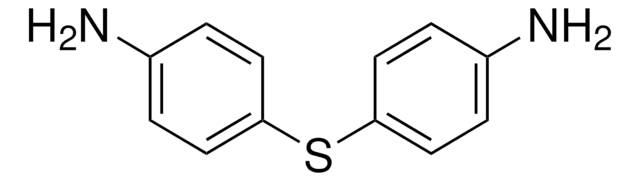
4-Aminophenyl disulfide
98%
Synonyme(s) :
4,4′-Dithiodianiline
Sélectionner une taille de conditionnement
| À vous/Référence | Disponibilité | Prix |
|---|
A propos de cet article
Quality Segment
assay
98%
form
powder
mp
77-78 °C (lit.)
SMILES string
Nc1ccc(SSc2ccc(N)cc2)cc1
InChI
1S/C12H12N2S2/c13-9-1-5-11(6-2-9)15-16-12-7-3-10(14)4-8-12/h1-8H,13-14H2
InChI key
MERLDGDYUMSLAY-UHFFFAOYSA-N
General description
Application
- A crosslinker in the synthesis of self-healing poly(urea-urethane) elastomers because of its quantitative healing efficiency. These self-healing materials find applications in various fields such as drug delivery, wound healing, and tissue engineering, electronics, aerospace, and coatings.
- A hardener in the formulation of re-processable, repairable, and recyclable epoxy networks due to the presence of dynamic disulfide bonds, which enable the epoxy networks to undergo chemical recycling. These epoxy networks are widely used in various applications which include, composite materials, coatings, adhesives, and fiber-reinforced thermoset composites.
- A crosslinking agent for the development of epoxy vitrimers and carbon fiber composites with enhanced mechanical properties, multi-shape memory capabilities for the potential applications in high-performance materials.
Bioconjugation: The amine group can react with carboxylic acids or their derivatives, making it useful for conjugating biomolecules like proteins and peptides. This is particularly valuable in developing targeted drug delivery systems where the drug is directly linked to a molecule that can home in on cancer cells or other disease sites.
Diagnostic Agents: It can be used to modify surfaces of diagnostic devices, such as biosensors. They can help in the immobilization of biomolecules on sensor surfaces, improving the sensitivity and specificity of detection.
1 of 1
Cet article | |||
|---|---|---|---|
| description 98% | description 98% | description 98% | description analytical standard |
| assay 98% | assay 98% | assay 98% | assay ≥99.0% (GC) |
| form powder | form solid | form solid | form - |
| mp 77-78 °C (lit.) | mp 91-92 °C (lit.) | mp 105-107 °C (lit.) | mp 105-107 °C (lit.) |
| Quality Level 100 | Quality Level 100 | Quality Level 100 | Quality Level 100 |
Classe de stockage
11 - Combustible Solids
wgk
WGK 2
flash_point_f
Not applicable
flash_point_c
Not applicable
ppe
dust mask type N95 (US), Eyeshields, Gloves
Faites votre choix parmi les versions les plus récentes :
Déjà en possession de ce produit ?
Retrouvez la documentation relative aux produits que vous avez récemment achetés dans la Bibliothèque de documents.
-
How can I determine the shelf life / expiration / retest date of this product?
1 answer-
Helpful?
-
-
How is shipping temperature determined? And how is it related to the product storage temperature?
1 answer-
Products may be shipped at a different temperature than the recommended long-term storage temperature. If the product quality is sensitive to short-term exposure to conditions other than the recommended long-term storage, it will be shipped on wet or dry-ice. If the product quality is NOT affected by short-term exposure to conditions other than the recommended long-term storage, it will be shipped at ambient temperature. As shipping routes are configured for minimum transit times, shipping at ambient temperature helps control shipping costs for our customers. For more information, please refer to the Storage and Transport Conditions document: https://www.sigmaaldrich.com/deepweb/assets/sigmaaldrich/marketing/global/documents/316/622/storage-transport-conditions-mk.pdf
Helpful?
-