Skip to Content
Merck

Skip To

D6571

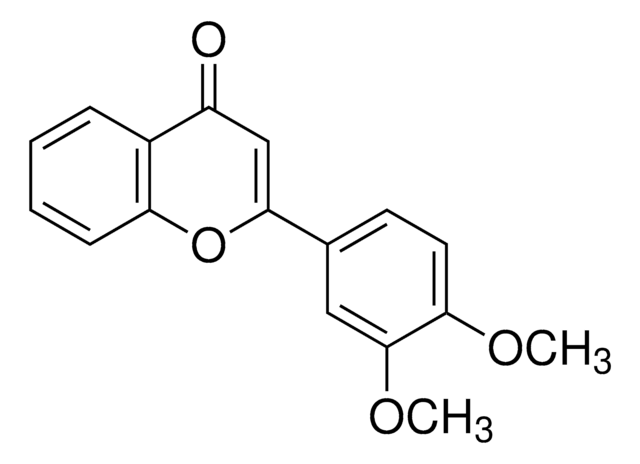
3′,4′-Dimethoxyflavone

Synonym(s):

2-(3,4-Dimethoxyphenyl)chromen-4-one, 3′,4′-DMF

Sign In to View Organizational & Contract Pricing.

Select a Size

Change View
Pack SizeSKUAvailabilityPrice

About This Item

Empirical Formula (Hill Notation):
C17H14O4
CAS Number:
Molecular Weight:
282.29
NACRES:
NA.77
PubChem Substance ID:
UNSPSC Code:
12352200
MDL number:
Assay:
≥98% (HPLC)
Form:
powder
Quality level:
Pricing and availability is not currently available.
Technical Service
Need help? Our team of experienced scientists is here for you.
Let Us Assist

assay

≥98% (HPLC)

Quality Level

form

powder

color

white to off-white

solubility

DMSO: ≥20 mg/mL

storage temp.

room temp

SMILES string

COc1ccc(cc1OC)C2=CC(=O)c3ccccc3O2

InChI

1S/C17H14O4/c1-19-15-8-7-11(9-17(15)20-2)16-10-13(18)12-5-3-4-6-14(12)21-16/h3-10H,1-2H3

InChI key

ZGHORMOOTZTQFL-UHFFFAOYSA-N

Compare Similar Items

View Full Comparison

Show Differences

1 of 1

This Item
SML0699T4080SML1052
assay

≥98% (HPLC)

assay

≥97% (HPLC)

assay

≥98% (HPLC)

assay

≥98% (HPLC)

form

powder

form

lyophilized powder

form

powder

form

powder

Quality Level

100

Quality Level

100

Quality Level

100

Quality Level

100

storage temp.

room temp

storage temp.

2-8°C

storage temp.

room temp

storage temp.

2-8°C

solubility

DMSO: ≥20 mg/mL

solubility

DMSO: 5 mg/mL, clear (warmed)

solubility

DMSO: >5 mg/mL

solubility

DMSO: 20 mg/mL, clear

color

white to off-white

color

white

color

yellow

color

white to beige

Application

3′,4′-Dimethoxyflavone has been used in urease inhibition assay.

Biochem/physiol Actions

3′,4′-dimethoxyflavone is a competitive antagonist of the AhR that inhibits AhR-mediated induction of CYP1A1, and also displays antiestrogen activity in breast tumor cell lines. The compound blocks transformation of the cytosolic AhR complex, and formation of nuclear AhR complexes.
3′,4′-dimethoxyflavone is a competitive antagonist of the aryl hydrocarbon receptor (AhR) that inhibits AhR-mediated induction of CYP1A1, and also displays antiestrogen activity in breast tumor cell lines.
3′,4′-Dimethoxyflavone is a flavone compound, which has the ability to prevent the production and accumulation of poly (ADP-ribose) (PAR) polymer. It guards against N-methyl-D-aspartate (NMDA) toxicity in cortical neurons. 3′,4′-Dimethoxyflavone is a member of the class of plant-derived polyphenolic flavonoids. It is known to have antioxidant, anti-cancer, anti-inflammatory, anti-atherogenic, hypolipidemic and neuroprotective or neurotrophic effects.

pictograms

Skull and crossbones

signalword

Danger

hcodes

Hazard Classifications

Acute Tox. 3 Oral

Storage Class

6.1C - Combustible acute toxic Cat.3 / toxic compounds or compounds which causing chronic effects

wgk

WGK 3

flash_point_f

Not applicable

flash_point_c

Not applicable


Choose from one of the most recent versions:

Certificates of Analysis (COA)

Lot/Batch Number

Don't see the Right Version?

If you require a particular version, you can look up a specific certificate by the Lot or Batch number.

Already Own This Product?

Find documentation for the products that you have recently purchased in the Document Library.

Visit the Document Library

Identification through high-throughput screening of 4'-methoxyflavone and 3', 4'-dimethoxyflavone as novel neuroprotective inhibitors of parthanatos
Fatokun AA, et al.
British Journal of Pharmacology, 169(6), 1263-1278 (2013)
Flavonoids as natural inhibitors of jack bean urease Enzyme
AJ Awllia, et al.
Letters in Drug Design & Discovery, 13(3), 243-249 (2016)
Dan J M Nguyen et al.
Molecular cancer research : MCR, 18(1), 105-117 (2019-10-20)
Cisplatin resistance is a major barrier in the effective treatment of lung cancer. Cisplatin-resistant (CR) lung cancer cells do not primarily use glucose but rather consume amino acids such as glutamine and tryptophan (Trp) for survival. CR cells activate the
Nada H Eisa et al.
International journal of molecular sciences, 21(21) (2020-10-30)
There is increasing evidence of the involvement of the tryptophan metabolite kynurenine (KYN) in disrupting osteogenesis and contributing to aging-related bone loss. Here, we show that KYN has an effect on bone resorption by increasing osteoclastogenesis. We have previously reported
Ke Wang et al.
International journal of molecular sciences, 16(7), 16454-16468 (2015-07-25)
Exposure to aristolochic acid I (AAI) can lead to aristolochic acid nephropathy (AAN), Balkan endemic nephropathy (BEN) and urothelial cancer. The induction of hepatic CYP1A, especially CYP1A2, was considered to detoxify AAI so as to reduce its nephrotoxicity. We previously

Global Trade Item Number

SKUGTIN
D6571-5MG04061832824185
D6571-25MG04061832824178

Our team of scientists has experience in all areas of research including Life Science, Material Science, Chemical Synthesis, Chromatography, Analytical and many others.

Contact Technical Service