
A5251

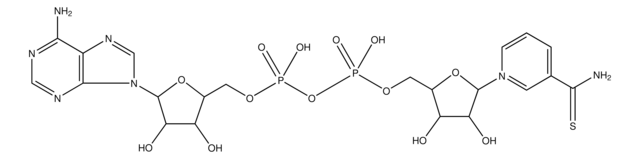
3-Acetylpyridine adenine dinucleotide
≥85%
Synonym(s):
3 -Acetyl NAD, APADH, APAD
Select a Size
| Size/SKU | Availability | Price |
|---|---|---|
25 mg | Check Cart for Availability | € 156,00 |
100 mg | Check Cart for Availability | € 496,00 |
500 mg | Check Cart for Availability | € 1.920,00 |
1 g | Check Cart for Availability | € 2.850,00 |
About This Item
biological source
Porcine brain
Quality Segment
assay
≥85%
form
powder
mol wt
662.44 g/mol
concentration
≤100% (3-acetylpyridine-adenine dinucleotide)
color
white to off-white
solubility
water: 50 mg/mL, clear, colorless to faintly yellow
λmax
259-260 nm
fluorescence
λem 15.2- 17.2 (dry basis at pH 7.0)
storage temp.
−20°C
SMILES string
CC(=O)c1ccc[n+](c1)[C@@H]2O[C@H](COP([O-])(=O)OP(O)(=O)OC[C@H]3O[C@H]([C@H](O)[C@@H]3O)n4cnc5c(N)ncnc45)[C@@H](O)[C@H]2O
InChI
1S/C22H28N6O14P2/c1-10(29)11-3-2-4-27(5-11)21-17(32)15(30)12(40-21)6-38-43(34,35)42-44(36,37)39-7-13-16(31)18(33)22(41-13)28-9-26-14-19(23)24-8-25-20(14)28/h2-5,8-9,12-13,15-18,21-22,30-33H,6-7H2,1H3,(H3-,23,24,25,34,35,36,37)/t12-,13-,15-,16-,17-,18-,21-,22-/m1/s1
InChI key
KPVQNXLUPNWQHM-RBEMOOQDSA-N
General description
Application
Biochem/physiol Actions
Other Notes
1 of 1
This Item | |||
|---|---|---|---|
| description ≥85% | description ≥90% | description ≥98% | description - |
| biological source Porcine brain | biological source - | biological source synthetic (inorganic) | biological source animal |
| Quality Level 200 | Quality Level 200 | Quality Level 200 | Quality Level 200 |
| assay ≥85% | assay ≥90% | assay ≥98% | assay ≥98.0% (HPLC) |
| form powder | form - | form powder | form powder |
| concentration ≤100% (3-acetylpyridine-adenine dinucleotide) | concentration - | concentration - | concentration - |
| solubility water: 50 mg/mL, clear, colorless to faintly yellow | solubility - | solubility H2O: soluble-50 mg/mL, clear, colorless | solubility - |



Signal Word
Warning
Hazard Codes
Precautionary Statements
Hazard Classifications
Eye Irrit. 2 - Skin Irrit. 2 - STOT SE 3
Target Organs
Respiratory system
Storage Class
11 - Combustible Solids
WGK
WGK 3
Flash Point (°F)
Not applicable
Flash Point (°C)
Not applicable
Choose from one of the most recent versions:
Already Own This Product?
Find documentation for the products that you have recently purchased in the Document Library.