Direkt zum Inhalt
Merck

Fortfahren mit

ZRB1677

Anti-Wilms Tumor Protein Antibody, clone 2O18 ZooMAb® Rabbit Monoclonal

recombinant, expressed in HEK 293 cells

greener alternative

Umweltfreundlichere Alternative

enhanced validation

Verbesserte Validierung

Synonym(e):

WT33

Anmelden zur Ansicht der Organisations- und Vertragspreise.

Größe auswählen

Ansicht ändern
Größe/SKUVerfügbarkeitPreis
25 μL
Warenkorb auf Verfügbarkeit prüfen
€ 198,00
4 x 25 μL
Warenkorb auf Verfügbarkeit prüfen
€ 409,00

Über diesen Artikel

NACRES:
NA.43
UNSPSC Code:
12352203
Conjugate:
unconjugated
Clone:
2O18, recombinant monoclonal
Application:
ICC, IHC (p), WB
Citations:
-

€ 198,00


Warenkorb auf Verfügbarkeit prüfen

​
Sonderanfertigung anfragen
Technischer Dienst
Benötigen Sie Hilfe? Unser Team von erfahrenen Wissenschaftlern ist für Sie da.
Unterstützung erhalten


biological source

rabbit

Quality Segment

recombinant

expressed in HEK 293 cells

conjugate

unconjugated

antibody form

purified antibody

antibody product type

primary antibodies

clone

2O18, recombinant monoclonal

description

recombinant, expressed in HEK 293 cells

product line

ZooMAb® learn more

form

lyophilized

mol wt

calculated mol wt 49.19 kDa, observed mol wt ~54 kDa

purified by

using Protein A

species reactivity

human

species reactivity (predicted by homology)

monkey, mouse, rat

packaging

antibody small pack of 25 μL

greener alternative product characteristics

Waste Prevention
Designing Safer Chemicals
Design for Energy Efficiency
Learn more about the Principles of Green Chemistry.

enhanced validation

recombinant expression
Learn more about Antibody Enhanced Validation

sustainability

Greener Alternative Product

technique(s)

immunocytochemistry: suitable, immunohistochemistry (formalin-fixed, paraffin-embedded sections): suitable, western blot: suitable

isotype

IgG

epitope sequence

N-terminal half

Protein ID accession no.

UniProt accession no.

greener alternative category

shipped in

ambient

storage temp.

2-8°C

target post-translational modification

unmodified

Gene Information

human ... WT1(7490)

General description

We are committed to bringing you greener alternative products, which adhere to one or more of The 12 Principles of Green Chemistry.This antibody is Preservative-free, produced without the harm or sacrifice of animals and exceptionally stable to allow for ambient shipping and storage if needed and thus aligns with "Waste Prevention", "Designing Safer Chemicals" and "Design for Energy Efficiency". Click here for more information.
Wilms tumor protein (UniProt: P19544; also known as WT33) is encoded by the WT1 gene (Gene ID: 7490) in human. It serves as a transcription factor that plays an important role in cellular development and cell survival. It is expressed in the kidney and a subset of hematopoietic cells. It regulates the expression of numerous target genes, including EPO. Wilms tumor protein plays an essential role for development of the urogenital system and has a tumor suppressor as well as an oncogenic role in tumor formation. Eight different isoforms of Wilms tumor protein have been described that are produced by alternative splicing. Isoforms lacking the KTS motif act as transcription factors while isoforms containing the KTS motif may bind mRNA and play a role in mRNA metabolism or splicing. Isoform 1 has lower affinity for DNA and can bind RNA. The N-terminal region of Wilms tumor protein contains a proline-rich region (aa 27-83) involved in transcriptional regulation, self-association, and RNA recognition, while its C-terminal region contains four C2H2-type zinc fingers (aa 323-347, 353-377, 383-405, 414-438) that mediate DNA and RNA binding. Its zinc finger domain can bind to GC-rich sequences, such as the EGR-1 consensus sequence (5 -GCG(T/G)GGGCG-3 ), the WTE motif (5′-GCGTGGGAGT-3′), or (TCC)n motif. Mutations in WT1 gene are reported to cause Wilms tumors characterized by embryonal malignancy of the kidney. Some mutations are reported to cause nephrotic syndrome 4, which causes severe proteinuria, resulting in complications such as hypoalbuminemia, hyperlipidemia and edema. This ZooMAb® recombinant monoclonal antibody, generated by our propriety technology, offers significantly enhanced specificity, affinity, reproducibility, and stability over conventional monoclonals.
ZooMAb® antibodies represent an entirely new generation of recombinant monoclonal antibodies.

Each ZooMAb® antibody is manufactured using our proprietary recombinant expression system, purified to homogeneity, and precisely dispensed to produce robust and highly reproducible lot-to-lot consistency. Only top-performing clones are released for use by researchers. Each antibody is validated for high specificity and affinity across multiple applications, including its most commonly used application. ZooMAb® antibodies are reliably available and ready to ship when you need them.

Immunogen

KLH-conjugated linear peptide corresponding to 23 amino acids from the N-terminal half of human Wilms Tumor Protein.

Application

Quality Control Testing

Evaluated by Western Blotting in HEK293 cell lysate.

Western Blotting Analysis: A 1:10,000 dilution of this antibody detected Wilms Tumor Protein in HEK293 cell lysate.

Tested applications

Western Blotting Analysis: A 1:10,000 dilution from a representative lot detected Wilms Tumor Protein in OVCAR-3 cell lysate.

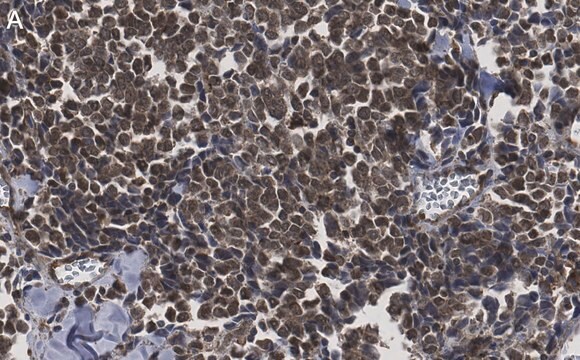
Immunocytochemistry Analysis: A 1:100 dilution from a representative lot detected Wilms Tumor Protein (WT33) in OVCAR-3 cells.

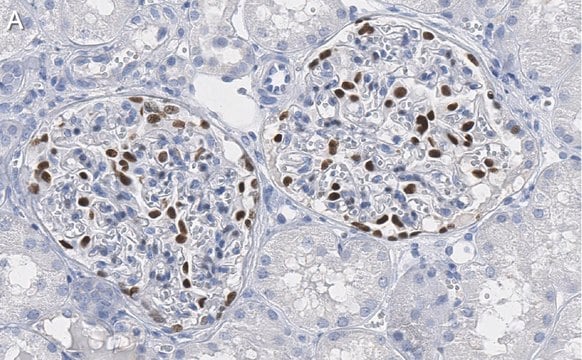
Immunohistochemistry (Paraffin) Analysis: A 1:100 dilution from a representative lot detected Wilms Tumor Protein (WT33) in human kidney tissue sections.

Note: Actual optimal working dilutions must be determined by end user as specimens, and experimental conditions may vary with the end user

Biochem/physiol Actions

Clone 2O18 is a ZooMAb® Rabbit recombinant monoclonal antibody that specifically detects Wilms Tumor Protein (WT33). It targets an epitope within 23 amino acids from the N-terminal half.

Physical form

Purified recombinant rabbit monoclonal antibody IgG, lyophilized in PBS, 5% Trehalose, normal appearance a coarse or translucent resin. The PBS/trehalose components in the ZooMAb formulation can have the appearance of a semi-solid (bead like gel) after lyophilization. This is a normal phenomenon. Please follow the recommended reconstitution procedure in the data sheet to dissolve the semi-solid, bead-like, gel-appearing material. The resulting antibody solution is completely stable and functional as proven by full functional testing. Contains no biocide or preservatives, such as azide, or any animal by-products. Larger pack sizes provided as multiples of 25 μL.

Preparation Note

Recommend storage of lyophilized product at 2-8°C; Before reconstitution, micro-centrifuge vials briefly to spin down material to bottom of the vial; Reconstitute each vial by adding 25 μL of filtered lab grade water or PBS; Reconstituted antibodies can be stored at 2-8°C, or -20°C for long term storage. Avoid repeated freeze-thaws.
Reconstitute lyophilized antibody pellet with 25μL of ultrapure water or Phosphate Buffered Saline (PBS). Please refer to our reconstitution protocol and the specific application guidance on the suggested starting dilutions and sample type.

Legal Information

ZooMAb is a registered trademark of Merck KGaA, Darmstadt, Germany

Disclaimer

Unless otherwise stated in our catalog or other company documentation accompanying the product(s), our products are intended for research use only and are not to be used for any other purpose, which includes but is not limited to, unauthorized commercial uses, in vitro diagnostic uses, ex vivo or in vivo therapeutic uses or any type of consumption or application to humans or animals.

Ähnliche Artikel vergleichen

Vollständigen Vergleich anzeigen

Unterschiede anzeigen

1 of 1

Dieser Artikel
ZRB1685ZRB1633ZRB1614
description

recombinant, expressed in HEK 293 cells

description

recombinant, expressed in HEK 293 cells

description

recombinant, expressed in HEK 293 cells

description

recombinant, expressed in HEK 293 cells

Gene Information

human ... WT1(7490)

Gene Information

-

Gene Information

-

Gene Information

-

biological source

rabbit

biological source

rabbit

biological source

rabbit

biological source

rabbit

species reactivity

human

species reactivity

human

species reactivity

mouse, human

species reactivity

human, rat, mouse

clone

2O18, recombinant monoclonal

clone

1M17, recombinant monoclonal

clone

1B20, recombinant monoclonal

clone

2O13, recombinant monoclonal

conjugate

unconjugated

conjugate

unconjugated

conjugate

unconjugated

conjugate

unconjugated

antibody form

purified antibody

antibody form

purified antibody

antibody form

purified antibody

antibody form

purified antibody


Still not finding the right product?

Probieren Sie unser Produkt-Auswahlhilfe, um Ihre Auswahl einzugrenzen


Lagerklasse

11 - Combustible Solids

Was ist los?

WGK 1

Flammpunkt (°F)

Not applicable

Flammpunkt (°C)

Not applicable


Hier finden Sie alle aktuellen Versionen:

Analysenzertifikate (COA)

Lot/Batch Number

It looks like we've run into a problem, but you can still download Certificates of Analysis from our Dokumente section.

Wenn Sie Hilfe benötigen, wenden Sie sich bitte an Kundensupport

Besitzen Sie dieses Produkt bereits?

In der Dokumentenbibliothek finden Sie die Dokumentation zu den Produkten, die Sie kürzlich erworben haben.

Die Dokumentenbibliothek aufrufen


Questions

Reviews

No rating value

Active Filters