Direkt zum Inhalt
Merck

Fortfahren mit

T2928

Anti-Tyrosine Hydroxylase Antibody

mouse monoclonal, TH-16

Synonym(e):

Anti-DYT14, Anti-DYT5b, Anti-TYH

Anmelden zur Ansicht der Organisations- und Vertragspreise.

Größe auswählen

Ansicht ändern
Ihnen/SKUVerfügbarkeitPreis
100 μL
Warenkorb auf Verfügbarkeit prüfen
€ 482,00
0.2 mL
Warenkorb auf Verfügbarkeit prüfen
€ 635,00

Über diesen Artikel

UNSPSC Code:
12352203
NACRES:
NA.41
MDL number:
Conjugate:
unconjugated
Clone:
TH-16, monoclonal
Application:
ARR, IHC, IP, WB
Citations:
209

€ 482,00


Warenkorb auf Verfügbarkeit prüfen
Für Ihr Target ist ein rekombinanter, konservierungsmittelfreier Antikörper verfügbar. Probieren Sie ZMS1033

Sonderanfertigung anfragen
Technischer Dienst
Benötigen Sie Hilfe? Unser Team von erfahrenen Wissenschaftlern ist für Sie da.
Unterstützung erhalten


Produktname

Monoclonal Anti-Tyrosine Hydroxylase antibody produced in mouse, clone TH-16, ascites fluid

biological source

mouse

Quality Segment

conjugate

unconjugated

antibody form

ascites fluid

antibody product type

primary antibodies

clone

TH-16, monoclonal

contains

15 mM sodium azide

species reactivity

rat, sheep, human, monkey, bovine, rabbit, guinea pig

technique(s)

immunohistochemistry: suitable, immunoprecipitation (IP): suitable using native or SDS-denatured TH., microarray: suitable, western blot: 1:8,000 using extracts of cultured rat adrenal pheochromocytoma (PC12) cells.

isotype

IgG1

UniProt accession no.

shipped in

dry ice

storage temp.

−20°C

target post-translational modification

unmodified

Gene Information

human ... TH(7054)
rat ... Th(25085)

General description

Monoclonal Anti-Tyrosine Hydroxylase (mouse IgG1 isotype) is derived from the TH-16 hybridoma produced by the fusion of mouse myeloma cells and splenocytes from immunized BALB/c mice. Tyrosine hydroxylase (TH) exists in four isoforms in humans. They are are TH-1 (M.W. 55,600), TH-2 (4 additional amino acids; M.W. 56,000), TH-3, (27 additional amino acids; M.W. 58,100), and TH-4 (4 plus 27 additional amino acids; 58,500). Only humans express all four isoforms; all other anthropoids express only the TH-1 and TH-2 isoforms.
Tyrosine hydroxylase (TH) is encoded by the gene mapped to human chromosome 11p15. TH is a tetramer of four identical subunits, which is characterized with a regulatory, catalytic and tetramerization domains. The enzyme utilizes tyrosine, tetrahydrobiopterin (BH4) and O2 as cosubstrates, and Fe2+ as a cofactor.

Immunogen

rat tyrosine hydroxylase (TH).

Application

Monoclonal Anti-Tyrosine Hydroxylase antibody produced in mouse has also been used in
  • western blotting[1]
  • immunofluorescence labelling
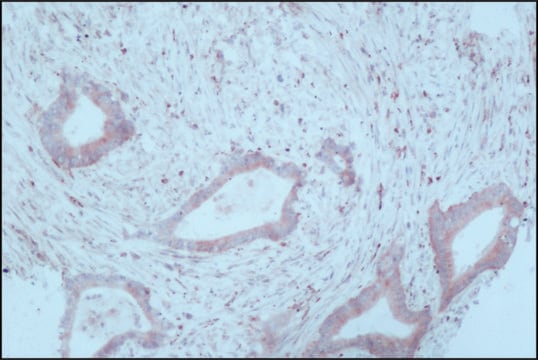
  • immunohistochemical staining[2]
  • enzyme linked immunosorbent assay (ELISA)
  • dot blot
  • immunoprecipitation
  • immunocytochemistry

Monoclonal Anti-tyrosine hydroxylase antibody produced in mouse has been used in immunohistochemistry and double immunofluorescence labeling.[3][4]

Biochem/physiol Actions

The antibody recognizes an epitope present in the N-terminal region (between aa 40-152) of both rodent and human tryosine hydroxylase. TH-16 detects both the intact subunits and the 59/57 kDa doublet and an array of decreasing molecular weight TH forms resulting from severe proteolysis.
Tyrosine hydroxylase (TH) catalyzes the first rate limiting step in the biosynthesis of catecholamine neurotransmitter i.e. the conversion of L-tyrosine to L-dopa. Inhibition of TH by L-phenylalanine, might play a crucial role in phenylketonuria and block the synthesis of norepinephrine. Activity of TH can be regulated by phosphorylation. Decreased expression of TH is associated with various neuropsychiatric diseases such as schizophrenia and Parkinson′s disease (PD).

Disclaimer

Unless otherwise stated in our catalog or other company documentation accompanying the product(s), our products are intended for research use only and are not to be used for any other purpose, which includes but is not limited to, unauthorized commercial uses, in vitro diagnostic uses, ex vivo or in vivo therapeutic uses or any type of consumption or application to humans or animals.

Ähnliche Artikel vergleichen

Vollständigen Vergleich anzeigen

Unterschiede anzeigen

1 of 1

Dieser Artikel
T1299T0678SAB4200697
description

clone TH-16, ascites fluid

description

clone TH-2, ascites fluid

description

clone WH-3, ascites fluid

description

clone TH-16, purified from hybridoma cell culture

clone

TH-16, monoclonal

clone

TH-2, monoclonal

clone

WH-3, monoclonal

clone

TH-16, monoclonal

Gene Information

human ... TH(7054)
rat ... Th(25085)

Gene Information

human ... TH(7054)
rat ... Th(25085)

Gene Information

human ... TPH1(7166), TPH2(121278)
rat ... Tph1(24848), Tph2(317675)

Gene Information

human ... TH(7054)

antibody form

ascites fluid

antibody form

ascites fluid

antibody form

ascites fluid

antibody form

purified immunoglobulin

species reactivity

rat, sheep, human, monkey, bovine, rabbit, guinea pig

species reactivity

human, monkey, guinea pig, rat, sheep, bovine, rabbit

species reactivity

human, monkey, rabbit, rat

species reactivity

rat, dog, rabbit, human, sheep, guinea pig, mouse, monkey, bovine

biological source

mouse

biological source

mouse

biological source

mouse

biological source

mouse

conjugate

unconjugated

conjugate

unconjugated

conjugate

unconjugated

conjugate

-


Still not finding the right product?

— oder —

Probieren Sie unser Produkt-Auswahlhilfe, um Ihre Auswahl einzugrenzen


Lagerklasse

10 - Combustible liquids

flash_point_f

Not applicable

flash_point_c

Not applicable


Hier finden Sie alle aktuellen Versionen:

Analysenzertifikate (COA)

Lot/Batch Number

It looks like we've run into a problem, but you can still download Certificates of Analysis from our Dokumente section.

Wenn Sie Hilfe benötigen, wenden Sie sich bitte an Kundensupport

Besitzen Sie dieses Produkt bereits?

In der Dokumentenbibliothek finden Sie die Dokumentation zu den Produkten, die Sie kürzlich erworben haben.

Die Dokumentenbibliothek aufrufen


Questions

  1. Can the specified antibody effectively distinguish TH+ cells derived from human IPSCs versus endogenous TH+ cells in brain slices when staining human TH+ neurons grafted into mouse brains?

    1 answer
    1. Upon verification, we have not tested the reactivity of this antibody on mouse samples. Based on citations regarding mouse reactivity, it appears that the antibody may not achieve the targeted specificity as described. The relevant studies include:

      1. "Neuropharmacology" (2015 Dec; 99:67-78) titled "NRSF is an essential mediator for the neuroprotection of trichostatin A in the MPTP mouse model of Parkinson's disease," which discusses implications for the mouse model.
      2. "Neurobiology of Aging" (2013 Mar; 34(3):873-86) titled "Trophic factors differentiate dopamine neurons vulnerable to Parkinson's disease," which provides insights into neuronal vulnerability in Parkinson's disease models.

      Helpful?

Reviews

No rating value

Active Filters